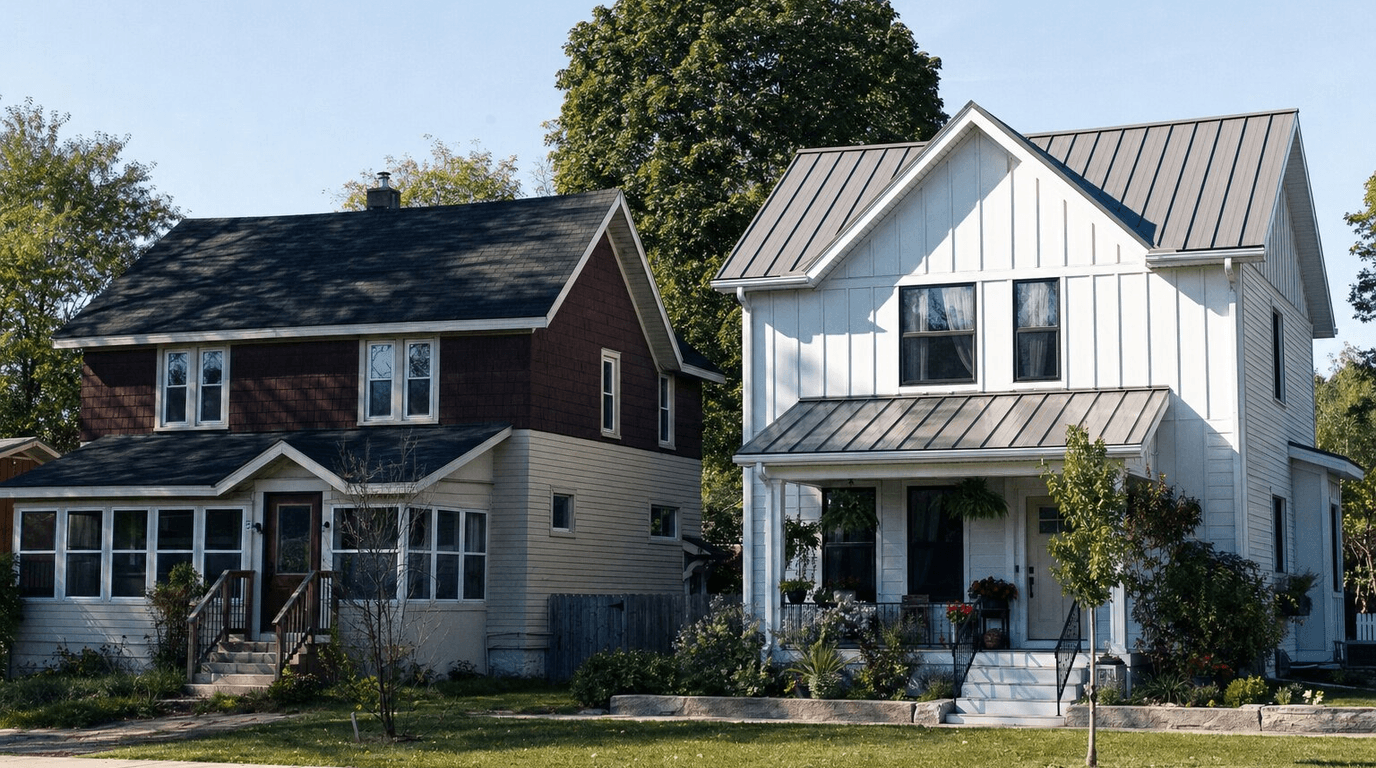
Asphalt vs. Metal Roofing in Wisconsin: A Straight-Talk Comparison
This is one of the most common questions we get from homeowners in the Green Bay area, and it deserves a real answer — not a sales pitch dressed up as a guide.
Both asphalt and metal roofing are legitimate choices for Wisconsin homes. Both have real advantages. Both have real drawbacks. The right answer depends on your budget, how long you plan to stay in the house, what you care about in a roof, and honestly, what your house actually needs given its slope, sun exposure, and surrounding trees.
Let's go through what actually matters when you're comparing these two materials in our climate.
The Cost Difference Is Real — and Large
If budget is your primary constraint, the numbers tell most of the story.
A standard architectural asphalt shingle installation typically runs $8,000 to $15,000 for an average-sized home in Northeast Wisconsin, depending on roof complexity, decking condition, and material grade. Premium asphalt options — designer shingles, impact-resistant lines — push that higher, but you're still generally under $20,000.
Metal roofing is a different conversation. Standing seam metal (the good stuff, with concealed fasteners and proper panel interlocking) typically starts around $18,000 and can go significantly higher depending on panel profile, metal gauge, and roof complexity. Exposed-fastener metal panels are cheaper, but they come with maintenance considerations that offset some of that savings over time.
That upfront cost gap matters. For a lot of homeowners, especially those who bought their house 10 years ago and didn't plan to be facing a full replacement right now, asphalt is the practical answer — and there's nothing wrong with that.
But the cost comparison changes when you factor in lifespan.
Lifespan: Where Metal Wins Clearly
Architectural asphalt shingles are typically rated for 25 to 30 years. In Wisconsin's climate — with its combination of summer UV, hail seasons, and brutal freeze-thaw cycling from November through March — real-world performance often lands in the 20 to 25 year range. If you go with a premium impact-resistant shingle, you can push that closer to the rated lifespan.
Quality standing seam metal roofing, properly installed, routinely lasts 40 to 70 years. Some metal roofs in the Midwest are still performing well at 50 years. The panel systems are sealed, the metal expands and contracts in ways that don't compromise the weatherproofing, and there's no granule coating to lose, no asphalt to dry out, no tabs to crack.
If you're planning to stay in your home for the next 30-plus years, metal's lifespan advantage starts to reshape the cost conversation. You may be buying one roof for the rest of your time in that house instead of two. That changes what the "expensive" choice actually is.
If you're planning to sell in the next 10 years, it's harder to justify the premium. A quality asphalt roof installed now will be in great shape for the next owner. The ROI on metal at resale exists, but it doesn't fully bridge the upfront cost gap.
Wisconsin Weather Performance: What Each Material Actually Does
This is where the comparison gets most interesting for our specific climate.
Ice and Snow Load
Both materials handle snow load similarly in terms of structural performance — that's a function of your roof deck and framing, not the surface material. Where they differ is in what happens with ice dams.
Metal roofing is significantly better at shedding snow and ice. The slick surface sheds accumulated snow faster than asphalt, which reduces the standing snow load and the conditions that create ice dams in the first place. For homeowners who've dealt with chronic ice dam problems on an asphalt roof, switching to metal sometimes resolves the issue — though it's worth noting that ice dams are fundamentally a ventilation and insulation problem, not a shingle problem. Metal helps, but it's not a substitute for addressing the real cause.
Asphalt shingles are more vulnerable to freeze-thaw cycling. Every winter in Brown County involves multiple cycles of subfreezing temperatures followed by warming — and that thermal stress, repeated over decades, gradually breaks down the asphalt binder and accelerates granule loss.
Hail Damage
This matters in Wisconsin. We get meaningful hail events most springs and summers across Outagamie, Winnebago, and Brown counties. Impact resistance is worth thinking about.
Class 4 impact-resistant asphalt shingles are specifically designed to handle hail better than standard shingles, and many insurance carriers in Wisconsin offer premium discounts for them. They're a meaningful upgrade worth considering if you're going with asphalt.
Metal roofing varies in hail resistance depending on metal gauge and profile. Thicker gauge panels (26-gauge and heavier) handle hail well. Thinner panels can dent. Cosmetic denting from hail on a metal roof doesn't affect performance the way granule loss affects asphalt, but it's worth knowing the difference before you buy.
Wind Performance
Standing seam metal, properly installed with concealed fasteners, is extremely wind-resistant. There are no exposed fasteners to back out, no tab edges to lift, no joints that degrade over time.
Quality architectural asphalt shingles installed to manufacturer specs (which means proper nailing pattern and appropriate starter strips at the eaves) perform well in wind too. The failure modes on asphalt in high winds typically involve improper installation more than material quality. Work with a certified contractor and you're generally in good shape.
Maintenance Requirements Over Time
Asphalt shingles need periodic attention. Keeping gutters clean matters because water backup damages the shingle edges and accelerates deterioration near the eaves. You'll want professional inspections every few years, and you'll likely deal with minor repairs — a cracked shingle here, some failed flashing there — somewhere in the middle of the roof's lifespan. None of this is onerous, but it's real.
Metal roofing requires less ongoing maintenance. The panels themselves are low-maintenance; the attention points are the trim pieces, sealants at penetrations, and exposed fasteners if you have an exposed-fastener system. Properly installed standing seam metal with quality sealants at chimneys and vents can genuinely go many years without any maintenance intervention.
One caveat: metal roofing is less forgiving of poor installation. A badly installed asphalt roof still functions for years even if it underperforms. A badly installed metal roof can develop chronic leak points at panel seams or penetrations that are genuinely difficult to track down and fix. This is why installer experience matters even more with metal than with asphalt.
The Aesthetics Question
Asphalt shingles come in a wide range of styles and colors. Architectural shingles in particular have gotten very good at mimicking the look of wood shake and slate without the maintenance burden. For most residential neighborhoods in Northeast Wisconsin, asphalt looks completely at home.
Metal roofing has a distinct look. Standing seam panels have clean, modern lines that suit certain architectural styles very well — contemporary homes, farmhouses, cabins — and look out of place on others. Metal shingles and stone-coated steel products offer more traditional appearances if you want metal's performance without the industrial aesthetic, though they come at a cost premium.
Neither material is objectively more attractive. It depends on the house and what you're going for.
Resale Value and Insurance Considerations
A well-installed metal roof can add meaningful resale value, particularly if the market in your area rewards it. In some Green Bay neighborhoods it matters; in others, buyers don't pay much premium for it. Talk to a local realtor before using projected resale value as a major factor in your decision — the market varies.
On the insurance side, some carriers offer discounts for Class 4 impact-resistant materials, which includes both qualifying asphalt shingles and certain metal options. Call your insurance agent before you finalize your material decision. In some cases the discount changes the math on premium materials.
Which One Should You Actually Choose?
Here's the honest answer: there's no universal right choice. But there are some clear patterns.
Choose asphalt shingle roofing if you need to manage upfront cost, plan to sell within 15 years, or just want a proven, well-understood material that every roofer in Northeast Wisconsin knows how to install correctly.
Choose metal roofing if you're planning a long-term stay in the house, you've had chronic ice dam problems and want a material that sheds snow faster, you want to minimize long-term maintenance, or you've budgeted for the higher upfront cost and the lifespan math works in your favor.
If you're not sure which applies to your situation, that's exactly what a professional assessment is for. The slope of your roof, the current state of your decking, your home's insulation and ventilation setup, your local HOA rules (if applicable), and your specific budget all factor into a real recommendation.
When you're ready to explore a roof replacement, a good contractor will walk through all of this with you, not steer you toward the option with the higher margin.
A Note on Installation Quality
With both materials, the installer matters as much as the material itself. Maybe more.
A properly installed asphalt roof from a certified contractor outperforms a poorly installed metal roof in real-world durability, every time. If you're comparing bids, the lowest number is not automatically the best value. Ask about manufacturer certifications, check references, verify insurance, and make sure whoever is on your roof knows what they're doing with the specific material you've chosen.
Pierce Roofing is Atlas PRO+ Platinum certified — one of the highest certification levels available from Atlas Roofing, covering both asphalt and metal products. That certification reflects real training and installation standards, not just a marketing relationship. Michael Pierce has been in Northeast Wisconsin roofing for over 30 years, and the team knows both materials well. We'll tell you which one fits your house and your situation, not which one we happen to have more of in the yard.
Ready to Compare Quotes for Your Specific Home?
If you're trying to decide between asphalt and metal for your home in Brown, Kewaunee, Oconto, Outagamie, Winnebago, or Manitowoc County, we're happy to do a thorough assessment and walk you through both options with real numbers.
Explore our full breakdown of roofing types and materials to dig deeper on what's available, or give us a call directly at (920) 609-8304 to talk through your situation. You can also request a free estimate online — we'll get back to you promptly to schedule a time that works.