How to Choose the Right Shingle Color for Your Home
Most homeowners spend more time picking a paint color for a bedroom wall than they do choosing a shingle color — even though the shingle will be on their house for the next 25 years and the bedroom paint can be changed on a Sunday afternoon.
Shingle color is one of those decisions that feels simple until you're actually in it. There are dozens of options. Manufacturers have names like "Weathered Wood" and "Antique Silver" and "Patriot Red" that don't tell you much about how they'll actually look on your specific house, in your specific neighborhood, in Wisconsin winter light at 4pm in December. And unlike a lot of decisions, this one is hard to undo. Replacing shingles just because you don't like the color isn't something anyone wants to do twice.
So here's a practical guide to getting it right the first time — based on what actually works in Northeast Wisconsin, not generic advice written for a national audience.
Start With What You Can't Change
Before you look at a single shingle sample, take stock of the fixed elements on your house: siding color, brick or stone, trim, windows, door color, and any masonry or concrete elements. These things aren't changing. Your shingle color has to work with them, not just on its own.
This sounds obvious, but it's where a lot of people go wrong. They fall in love with a shingle in a showroom or on a manufacturer's website without holding it up against the actual colors already on their house.
A few general principles that hold up well:
Match the undertone, not just the hue. If your siding has warm undertones (cream, tan, beige, warm gray), a shingle with cool undertones (blue-gray, slate, silver) is going to fight it. The colors don't have to match — they just need to play in the same tonal family.
Contrast without clashing. A house that's all one value (everything light or everything dark) looks flat. Some contrast between the roof and the walls creates definition. But if your house is light gray, a jet-black roof might be too stark. A dark charcoal reads as sophisticated. There's a difference.
Brick and stone are harder than you think. If you have brick or stone on your exterior, you're working with a lot of color already — multiple tones baked into one material. Look for shingles that pull out one of the secondary tones in the masonry rather than trying to match the dominant one.
The Most Popular Shingle Colors in Wisconsin (And Why)
If you ask a Northeast Wisconsin roofer what colors they install most, the answer is going to be some variation of charcoal gray. And there's a reason for that — it's genuinely versatile. Charcoal reads as neutral, works with nearly any siding color, photographs well, and ages gracefully. It doesn't get trendy and then look dated five years later.
Beyond charcoal, here's what we see most often in Brown, Kewaunee, Oconto, Outagamie, Winnebago, and Manitowoc counties:
Weathered wood tones. These are the multi-dimensional browns and tans that try to mimic the look of cedar shake. They work especially well on traditional-style homes, Cape Cods, and colonials — the architectural styles that dominate a lot of the older housing stock in the Green Bay area.
Pewter and slate grays. Cooler than charcoal, lighter in value. A good match for homes with light siding in white, gray, or blue-gray tones. Popular on newer construction.
Aged bronze and brown blends. Warmer than gray, earthier than weathered wood. These work on craftsman-style homes and brick-heavy exteriors where you want warmth without going red or tan.
Truly bold colors — deep green, terracotta, burgundy — show up occasionally, and they can look great. But they require more commitment. A dark green roof on a white farmhouse is striking. That same green on a beige split-level in a conventional neighborhood might feel out of place. Know your context before you commit.
Color and Energy Performance: What's True and What's Overstated
You'll see a lot of claims online about how much shingle color affects your energy bills. Some of them are true. Most are exaggerated.
Here's what's actually supported: dark shingles absorb more solar heat, which means your attic gets warmer on sunny days. Light shingles reflect more heat. In a hot climate, that difference can meaningfully affect cooling costs. In Wisconsin, the math is more complicated.
We have four months of genuine summer and five or six months where we're far more concerned with heat retention than heat rejection. A dark roof in Green Bay might add a few degrees to your attic in July and August. But that same dark roof might — in theory — help offset a small amount of winter heat loss through passive solar gain. In practice, the impact in either direction is pretty modest, especially on a well-insulated house with proper attic ventilation.
The bigger factor for thermal performance isn't shingle color — it's attic insulation and ventilation. A house with excellent attic insulation and a properly ventilated roof system will outperform a poorly insulated house with a reflective shingle regardless of color. If energy efficiency is a real priority, that's where to put the attention.
That said: if you're genuinely torn between two colors and one happens to be lighter, and you're in a house without great attic ventilation, the lighter one is a reasonable tiebreaker for summer comfort. It's just not the primary driver it's sometimes marketed as.
HOA Rules and Neighborhood Covenants
Before you get attached to a color, check your homeowners association rules or neighborhood covenants if you have them. This is non-negotiable.
Some HOAs in the Green Bay area specify approved shingle colors or require that new roofs be approved before installation. Finding this out after you've already purchased materials is an expensive and frustrating mistake. A reputable contractor will ask about this upfront, but it's worth checking yourself.
If you're not in an HOA, still spend five minutes looking at what your neighbors have. Not because you have to match them — you don't — but because roofs don't exist in isolation. A color that looks great on its own can stand out awkwardly in a neighborhood where everything else runs in a similar tonal family. Sometimes standing out is the right call. But it should be a deliberate choice, not a surprise.
How to Actually Test a Shingle Color Before You Commit
Here's the mistake most people make: they pick a color from a small sample card or a photo on a website, and the installed result looks nothing like what they expected.
Shingle color looks different at scale. A sample that's three inches square doesn't tell you what 30 squares of that color will look like covering your entire roof. Scale changes everything. Colors that look bold on a small sample often read as much softer on a whole roof. Colors that look subdued can become dominant.
A few ways to get a better read before you commit:
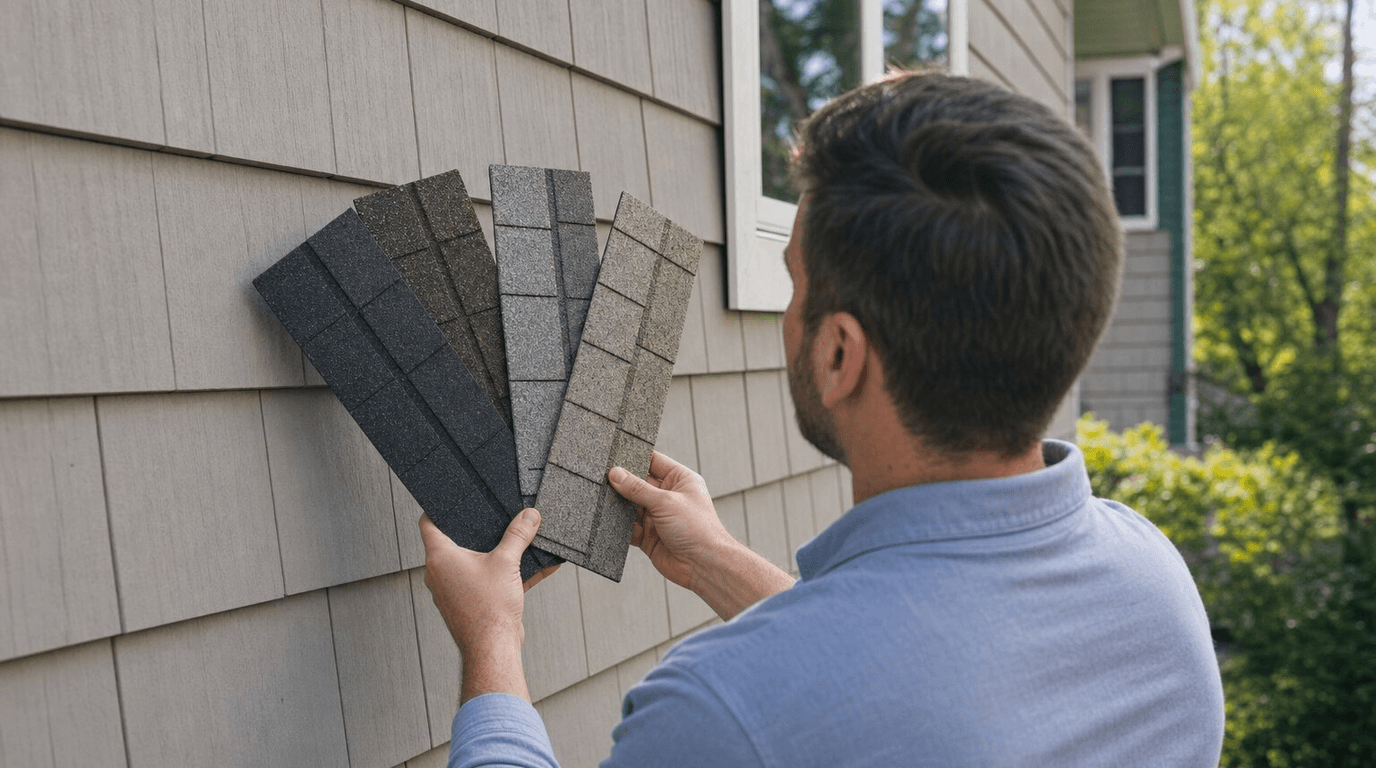
Look at physical samples in outdoor light on your house. Hold them up against your siding and trim on a sunny day and again on an overcast day. Wisconsin's sky is overcast more than most people realize, especially from October through March. How the color looks under flat gray light matters just as much as how it looks in full sun.
Use manufacturer visualizer tools — with appropriate skepticism. Atlas and other major manufacturers offer online tools where you can see how a shingle color looks on a photo of a house. They're not perfect, but they're useful for eliminating obvious mismatches before you narrow down to physical samples.
Ask your contractor what's popular in your specific neighborhood type. Any roofer who's been working in an area for decades has strong opinions about what works and what doesn't. That experience is worth asking about. It doesn't mean you have to follow the most common choice, but knowing what looks good on houses like yours is useful information.
Atlas Shingles: The Color Range Worth Knowing
If you're doing an asphalt shingle roofing project with Pierce Roofing, you'll be choosing from the Atlas lineup. As an Atlas PRO+ Platinum certified contractor, we have access to the full product range — including the Pinnacle Pristine series, which includes Scotchgard protectant for long-term algae resistance. That's worth knowing in Wisconsin, where damp springs and humid summers create conditions that favor roof algae growth.
Atlas's dimensional shingles come in around 20 colors depending on the product line. The color names aren't always descriptive, but the physical samples are easy to look at. Ask us to bring samples to your estimate appointment — we bring them on every roof replacement consultation so you're not choosing blind.
A few Atlas colors that consistently work well in this region:
- Weathered Wood — a multi-dimensional brown that reads as natural and warm; works on almost anything
- Charcoal — the reliable workhorse; cool-toned, flexible, ages well
- Antique Silver — lighter and cooler, good on white or light-colored homes
- Biscayne Blue — for the homeowner who wants something distinctive; a muted blue-gray that looks better on an actual house than it sounds
The Atlas roofing program also backs certain products with extended warranty coverage, which is available exclusively through certified contractors. That's another reason the color choice happens alongside the product selection — both affect your warranty options.
Resale Value: Does Shingle Color Actually Matter?
Honest answer: probably a little, but not as much as condition.
A buyer looking at your house isn't going to pass on it because the shingles are charcoal instead of brown. But they will notice if the shingles are 22 years old, curling, and staining — regardless of color. The condition of the roof factors into purchase negotiations far more than the specific color.
That said, unusual or polarizing color choices can become a small negative for some buyers. A hunter green roof on a beige ranch isn't going to tank your sale, but it might stick in someone's mind as "the thing that needs to be replaced." Sticking to neutral, broadly appealing colors is a reasonable strategy if resale is on your mind.
The more important resale-related consideration: a newer roof in a neutral, quality shingle is a meaningful selling point. It's one of the things buyers and their inspectors look for. A roof that's clearly at end of life, regardless of color, is a negotiating chip that goes the wrong way.
When to Have the Color Conversation
Shingle color is something to think about before your replacement is scheduled, not the day the crew shows up.
At Pierce Roofing, we bring samples to every estimate so you have something to look at in context — not just a paper catalog. We can also point you toward online visualizers and walk you through what we've seen work well on houses similar to yours in the area. It's part of the conversation, not an afterthought.
If you're not sure whether your roof needs replacement yet, a free roof inspection is the right starting point. We'll tell you honestly what condition your roof is in, how much useful life it has left, and when you realistically need to be thinking about replacement. That gives you time to make the color decision thoughtfully instead of under pressure.
Ready to Talk Shingles?
Pierce Roofing has been helping Green Bay area homeowners make these decisions for over 30 years. We're Atlas PRO+ Platinum certified, insured to $2 million, and we back every job with a 10-year workmanship warranty. We serve Brown, Kewaunee, Oconto, Outagamie, Winnebago, and Manitowoc counties.
Call us at (920) 609-8304 with questions, or request a free estimate and we'll schedule a time to come out, look at your roof, and bring samples so you can see your options in context. No pressure, no guesswork.