The Math That Most Business Owners Never Run
A commercial roof replacement in Northeast Wisconsin runs anywhere from $8 to $20 per square foot depending on the system — TPO, EPDM, modified bitumen, metal. For a 10,000-square-foot building, you're looking at $80,000 to $200,000 when it's time to replace.
A commercial roof maintenance program typically costs $1,500 to $4,000 per year, depending on the roof size and what's included.
If that maintenance program extends your roof's life by just five years, you've deferred $80,000 to $200,000 in capital expense. The ROI isn't close. It isn't even a debate.
And yet, most commercial building owners in Green Bay don't have a formal maintenance program. They have a mental note that says "call someone when it leaks." That reactive approach is expensive, and this post explains exactly why.
What a Commercial Roof Maintenance Program Actually Is
The term gets thrown around loosely, so let's be specific. A real commercial roof maintenance program includes three things:
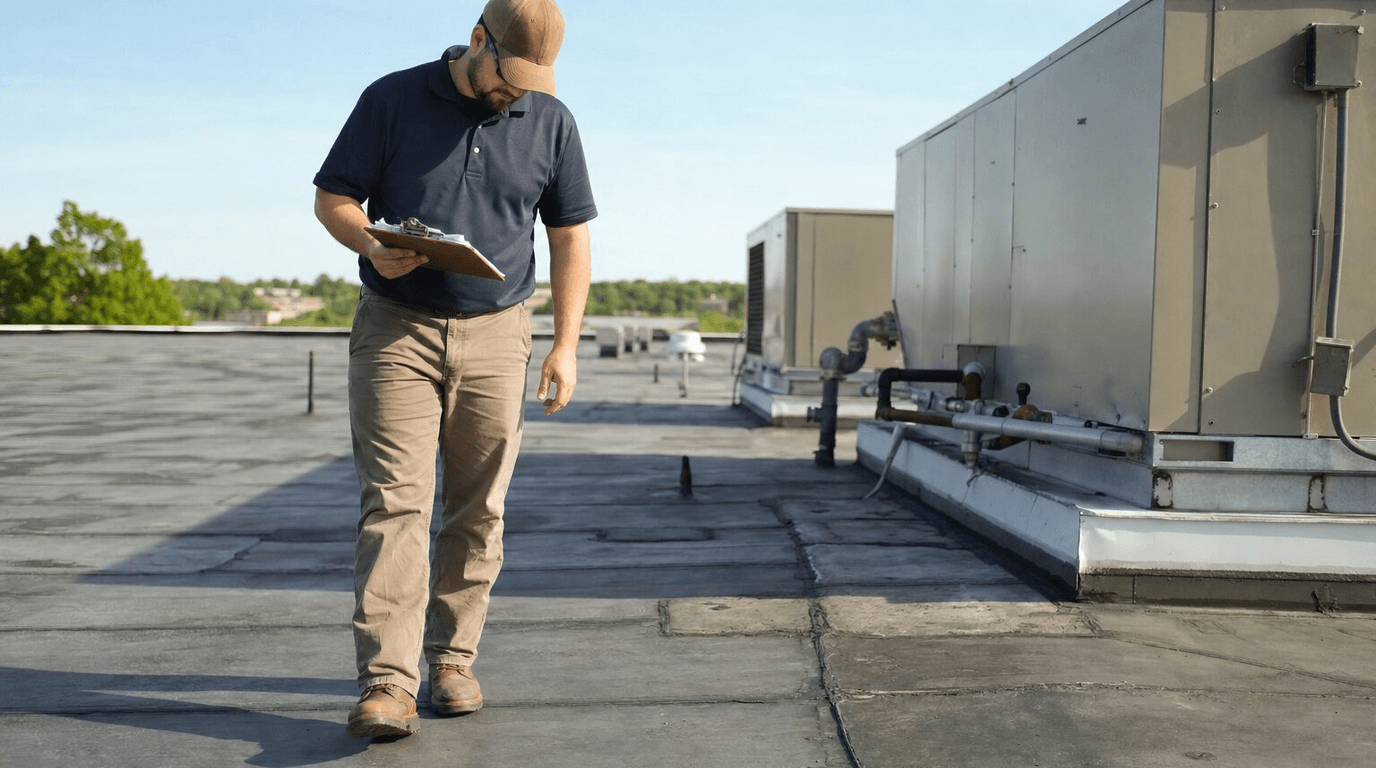
Scheduled inspections — typically twice per year in Wisconsin, ideally in spring after the freeze-thaw season and in fall before winter loads arrive. A trained inspector goes on the roof, not just around the perimeter.
Documented condition reports — every inspection produces a written record of what was found, photographed evidence, and a prioritized list of any repairs needed. This documentation matters for warranty purposes, insurance claims, and capital planning.
Proactive minor repairs — things like resealing around penetrations, re-adhering lifted membrane edges, clearing clogged drains, and addressing flashing separations before water finds them. Small things, done on a schedule, before they become big things.
That's it. It's not complicated. But the discipline of doing it consistently — with a contractor who knows your specific roof, knows its history, and shows up on time — is where the value actually lives.
What Wisconsin Does to Commercial Roofs
Green Bay businesses face a climate that's genuinely hard on roofing systems. The freeze-thaw cycle is the main culprit. When water gets into small gaps in a membrane, seam, or flashing detail during winter, it expands when it freezes. That expansion widens the gap. More water gets in next time. The cycle repeats.
By April, what was a hairline crack in October is now a half-inch gap with compromised substrate underneath.
Flat and low-slope commercial roofs are particularly vulnerable because water doesn't drain as quickly. Standing water — even a quarter inch — accelerates membrane degradation, adds structural weight, and creates an ongoing entry point for moisture when seams aren't perfect. On Northeast Wisconsin roofs, ponding water that freezes is one of the most common causes of premature roof failure we see.
Snow load is another factor commercial owners underestimate. Wisconsin building codes account for snow loads, but roofs that aren't regularly maintained can develop drainage problems that concentrate loads in unexpected areas. A well-maintained roof has clear drains, intact crickets, and no debris accumulation that traps snow in drifts.
Then there's UV degradation. TPO and EPDM membranes lose their reflectivity and flexibility over time, even in cold climates. Summer sun in Wisconsin is more intense than most people expect, and without maintenance to catch surface wear early, membrane lifespans shrink fast.
The Real Cost of the Reactive Approach
Here's what "call someone when it leaks" actually looks like in practice.
First, you don't usually know you have a leak until it shows up inside the building. That means the water has already been traveling for a while — through the membrane, through the insulation, through the roof deck. By the time there's a ceiling stain, the damage is significantly more widespread than the visible entry point.
Emergency roofing calls cost more than scheduled work. Always. Contractors charge premium rates for urgent response, and mobilizing a crew on short notice to a commercial roof is rarely cheap.
Then there's the secondary damage. Water in a commercial building doesn't stay in the ceiling. It reaches inventory, equipment, electrical systems, and flooring. A single undetected leak running for a month before it's discovered can produce five to ten times the repair cost of the roof damage itself in collateral damage.
And if the leak happens during business hours? Add the disruption, the customer impression, and in some industries, the regulatory exposure.
A free roof inspection that catches a failing drain seal in October costs nothing. The emergency call after that drain backs up under a February freeze, with water pooling under the membrane for three months, does not.
What a Maintenance Visit Covers
To make this concrete, here's what Pierce Roofing's commercial maintenance inspections cover on a typical flat or low-slope system:
Membrane condition — scanning the field of the roof for blisters, splits, punctures, and areas of delamination. On TPO and EPDM, seam integrity gets particular attention since that's where most failures start.
Drainage system — every interior drain and scupper is checked for debris, confirmed to be functioning, and inspected for signs of leakback or improper slope. Clogged drains are one of the most preventable causes of commercial roof damage, and they're genuinely common on roofs near trees or with heavy foot traffic from HVAC maintenance.
Penetration seals — every pipe boot, conduit penetration, HVAC curb, exhaust vent, and skylight gets a hands-on inspection of the surrounding seal. Sealants crack and shrink. Flashing details loosen. These are small fixes when caught early.
Flashing at transitions — parapet walls, expansion joints, and any point where the roof membrane meets a vertical surface are common failure points. Separation there gets resealed.
Edge metal and coping — the metal that caps parapet walls takes wind and temperature stress. Loose or lifted edge metal creates an immediate water entry point and can become a projectile in high wind events.
Roof surface debris — leaves, branches, and anything else that traps moisture or blocks drainage gets cleared.
Minor repairs found during an inspection are typically handled on the same visit when possible. That's the whole point — early intervention while the crew is already on site.
How Maintenance Affects Your Roof's Warranty
This is where commercial building owners leave money on the table.
Most commercial roofing manufacturer warranties — including those offered through Atlas — have maintenance requirements built into their terms. Skipping annual inspections or failing to document maintenance can void a warranty, even if the roof failure itself is clearly a product defect.
At Pierce Roofing, we're Atlas PRO+ Platinum certified, which gives our commercial clients access to extended manufacturer warranties that aren't available through non-certified contractors. But those warranties require documented maintenance. The inspection reports we provide aren't just paperwork — they're your proof of compliance.
If you ever need to make a warranty claim, having two years of inspection records showing proactive maintenance puts you in a completely different position than showing up with a leak and no documentation.
When Maintenance Is Not Enough
A maintenance program isn't a substitute for replacement when a roof has genuinely failed. There's a point in every commercial roof's life where the cost of ongoing repairs exceeds the cost of starting fresh, and a good contractor will tell you honestly when you've reached it.
The indicators that maintenance has run its course: membrane that's brittle across most of its surface rather than isolated areas, widespread seam failures that have been re-welded multiple times, insulation that's wet underneath even in sections that haven't visibly leaked, or structural deck deterioration.
When that's the situation, continuing to patch is throwing money into a system that can't hold it. At that point, commercial roof replacement is the financially sound decision, and a maintenance program on the new system from day one is how you protect that investment going forward.
If you're not sure where your roof falls on that spectrum, an honest inspection will tell you. Not every contractor will give you a straight answer — some would rather keep collecting repair invoices. We'd rather tell you the truth and earn your business for the long term.
Building a Maintenance Program for Your Property
The right program depends on a few variables: roof type and age, building use, local tree coverage, HVAC equipment on the roof, and whether the roof gets foot traffic from maintenance personnel. A 20-year-old modified bitumen roof with four rooftop HVAC units near a tree line needs more frequent attention than a 5-year-old TPO system on a clean warehouse.
For most commercial properties in Green Bay and surrounding counties, twice-yearly inspections with minor repairs included is the right starting point. Buildings that see heavy rooftop traffic or have aging systems may benefit from quarterly walk-throughs between formal inspections.
We work with property owners across Brown, Kewaunee, Oconto, Outagamie, Winnebago, and Manitowoc counties to build programs that fit the actual roof — not a one-size template. Some clients need us twice a year. Some need us four times. The goal is to match the level of attention to the level of risk.
What It Takes to Get Started
The first step is knowing what you're working with. If you don't have recent inspection records on your commercial roof, start there. A baseline inspection gives you a condition report to work from — what's good, what needs attention now, and what to watch over the next year.
From there, a maintenance schedule gets built around your specific system. Pierce Roofing handles everything from the inspection to the documentation to the minor repairs, so the program actually happens instead of sitting on a to-do list.
Michael Pierce has been doing this work in Northeast Wisconsin for over 30 years. Atlas PRO+ Platinum certified, $2 million insured, 10-year workmanship warranty. If you want to know where your commercial roof stands and what a realistic maintenance plan would look like for your property, the conversation starts with an inspection.
Call us at (920) 609-8304 or request a free estimate online. We cover the full six-county area and we'll give you a straight answer on what your roof needs.