What Wisconsin's Climate Does to Flat Roofs
Flat roofs have a reputation problem in cold climates. Talk to enough building owners in Green Bay and you'll hear some version of the same story: the flat roof was fine until it wasn't, and then it was a headache for years. Leaks nobody could trace. Patches on top of patches. A membrane that lifted at the seams after the third polar vortex.
Most of those problems weren't caused by flat roofing itself. They were caused by the wrong flat roofing system installed by someone who didn't understand what Wisconsin winters actually do to a membrane.
There are three flat roofing systems that dominate the market in Northeast Wisconsin: TPO, EPDM, and modified bitumen. Each has a different chemistry, a different installation method, a different price point, and a different set of trade-offs. Knowing how they differ — and where each one earns its keep — is the starting point for any smart flat roof decision.
If you're still in the early stages and want a broader look at what roofing options exist for your building type, our roofing types overview covers low-slope and steep-slope systems side by side.
What Makes Flat Roofing Different From Steep-Slope Roofing
Before getting into materials, it helps to understand what flat roofing is actually solving for.
On a steep-slope roof, gravity does most of the waterproofing work. Water hits the shingles and runs off quickly. The materials don't need to hold water — they just need to shed it.
On a flat or low-slope roof, water moves slowly. It pools. In Wisconsin, that standing water freezes, expands, and puts pressure on every seam, joint, and penetration in the membrane. The membrane itself needs to be waterproof — not just water-resistant — and it needs to stay bonded and flexible through dozens of freeze-thaw cycles every season.
That's a different ask. And it's why the material choice on a flat roof matters more than most building owners realize.
Flat isn't actually flat, either. Proper installations include a slight slope (usually 1/4 inch per foot minimum) to direct water toward drains. Without that, you end up with chronic ponding, and even the best membrane degrades faster when water sits on it for days at a time.
TPO: The Dominant Material for Commercial Roofing in Green Bay
Thermoplastic polyolefin — TPO — has become the most commonly specified flat roofing membrane in commercial construction over the last two decades. Walk the commercial districts of Green Bay, Appleton, or Oshkosh and most of the flat roofs you're looking at are TPO.
Why? A few reasons.
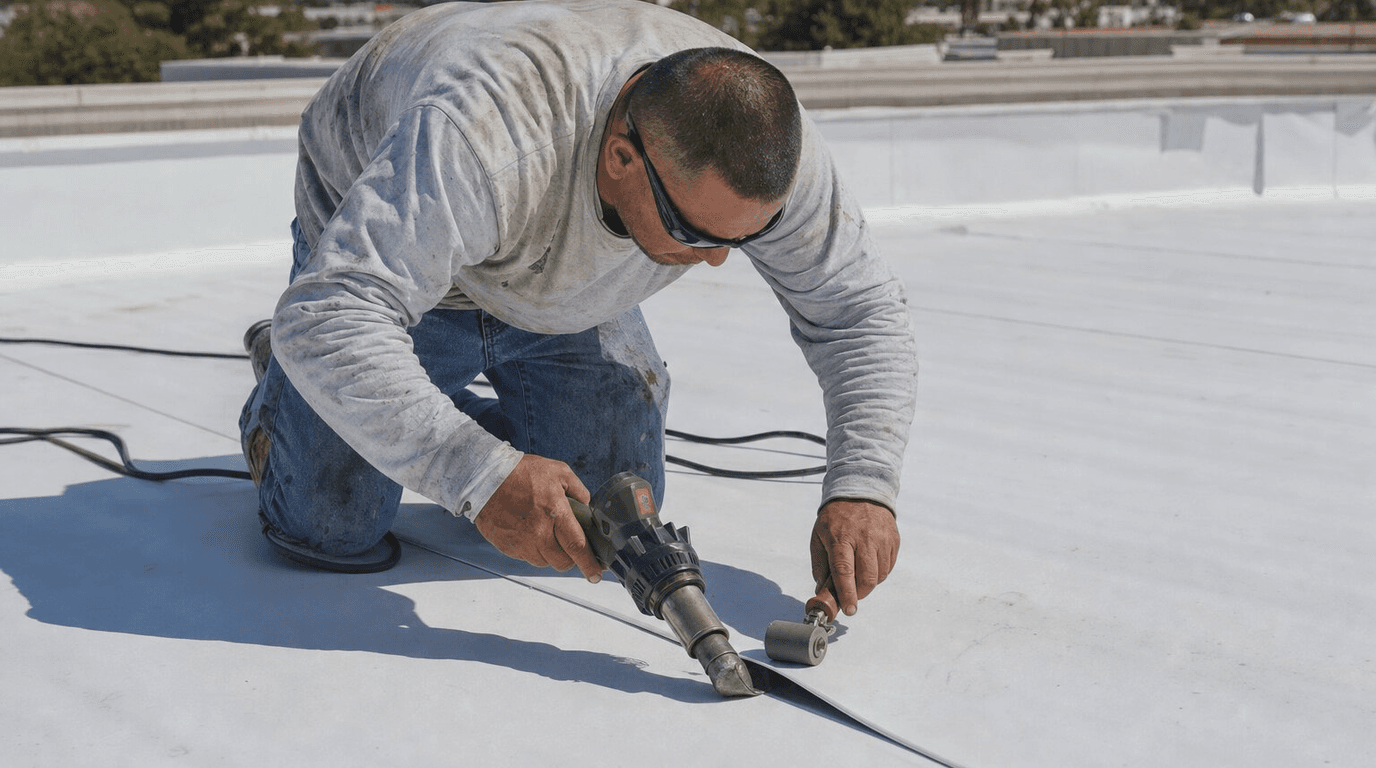
TPO seams are heat-welded, not glued or taped. A hot-air welder fuses the overlapping membrane sections together, creating a bond that's often stronger than the membrane itself. When those seams are done right, they're essentially waterproof for the life of the roof. There's no adhesive to dry out, no tape to peel, no caulk to crack.
TPO is also white or light-colored by default, which gives it strong reflectivity. In summer, that reflectivity keeps the building cooler and reduces cooling loads. Energy Star certification is common with TPO systems. In Wisconsin, where summer energy costs aren't trivial, that matters.
And TPO handles cold reasonably well. It stays flexible at lower temperatures than some other membranes, which reduces the risk of cracking during rapid temperature swings.
The trade-offs? TPO formulations have improved significantly since the early 2000s, but older or budget-grade TPO can become brittle over time. Membrane thickness matters here: 45-mil TPO is the minimum you'd want to see on any commercial installation, and 60-mil or 80-mil gives better durability and puncture resistance. On a commercial building with foot traffic from HVAC technicians or other maintenance personnel, going thicker is worth the upfront cost.
Installation quality is also critical. Heat-welded seams are only as good as the technician doing them. An improperly welded seam can fail within a few years. On any commercial roofing project, ask specifically about the installer's experience with TPO and whether seam testing is part of the quality control process.
EPDM: The Long-Track Record Option
Ethylene propylene diene terpolymer. Nobody uses the full name — it's always EPDM, or just rubber roofing. It's been a major player in the flat roofing market since the 1960s, and that track record tells you something.
EPDM is a synthetic rubber membrane, typically black, available in large sheets that minimize the number of seams in a given installation. Fewer seams means fewer potential failure points. On a simple rectangular roof with minimal penetrations, a skilled installer can sometimes cover the whole field with a single sheet. That's genuinely attractive from a waterproofing standpoint.
In cold climates, EPDM has an edge: it stays flexible in extreme cold. When temperatures drop below zero in January and the building goes through its nightly contraction, EPDM moves with it rather than resisting. That flexibility reduces stress on seams and penetrations.
EPDM also has a strong history in Wisconsin specifically. Installers who have been working in this region for decades know how to spec and install EPDM for the freeze-thaw cycle. That institutional knowledge matters.
The downsides are real, though. Traditional EPDM is joined with adhesives and seam tape rather than heat-welded, and those seam systems are generally considered more vulnerable than TPO's welded seams over the long haul. The black surface absorbs heat rather than reflecting it, which means EPDM roofs run hotter in summer and can increase cooling loads. Darker membranes also expand and contract more with temperature swings, which puts additional stress on the system over time.
There are now EPDM systems with improved tape seam technology, and white EPDM exists (though it's less common). Overall, EPDM tends to work best on lower-complexity roofs where you can maximize sheet size and minimize seams, and where solar reflectivity isn't the primary concern.
For residential properties with a flat or nearly flat roof section — a garage, a home addition, a sunroom — EPDM is often a practical and cost-effective choice. We evaluate it alongside TPO on every flat roof we quote.
Modified Bitumen: When Layered Systems Make Sense
Modified bitumen is the modern evolution of built-up roofing (BUR) — the old-school multiple-layer tar and gravel systems that covered commercial roofs for most of the twentieth century. Modified bitumen takes that layered approach and updates it with polymer-modified asphalt applied in a more controlled way.
There are two main installation methods: torch-applied and self-adhering (cold-applied). In torch-applied systems, a propane torch melts the underside of the membrane, which bonds it to the surface below. Self-adhering systems use a peel-and-stick approach with a pressure-sensitive adhesive backing.
Modified bitumen systems are typically installed in two or more layers — a base sheet and a cap sheet — which gives them good built-in redundancy. If the cap sheet develops a small breach, the base sheet often catches it before water reaches the deck. That layered defense is one of the reasons modified bitumen holds up well in punishing climates.
The material itself is familiar to roofing contractors everywhere, easier to repair in the field, and often more cost-effective on smaller or irregular-shaped roofs where the geometry makes single-membrane systems harder to install cleanly. Repairs are also more straightforward: a damaged section of modified bitumen can often be patched by a competent roofer without specialized equipment.
The torch-applied method raises some eyebrows because of fire risk during installation, and rightfully so. It requires care and experience. Self-adhering alternatives exist and have gotten better, though adhesion in cold temperatures can be tricky — another reason installer experience matters.
For roofing projects that involve complex geometry, multiple levels, or are part of a larger roof replacement that also includes steep-slope sections, modified bitumen is sometimes the best fit for the flat portions. It's a flexible system in more ways than one.
TPO vs. EPDM vs. Modified Bitumen: The Honest Comparison
There's no universally right answer here. The right flat roofing system depends on building size and geometry, roof access and foot traffic, existing deck condition, local budget constraints, and the specific installer doing the work.
That said, here's a straight summary of how these systems compare on the factors that matter most in Northeast Wisconsin:
Seam strength: TPO wins. Heat-welded seams outperform adhesive and tape systems in most long-term studies. On a large commercial roof with many linear feet of seam, that advantage compounds.
Cold flexibility: EPDM has the edge, followed closely by modified bitumen. TPO has improved but historically shows more brittleness at extreme low temperatures.
Energy efficiency: TPO (white) reflects more solar energy. This matters more for commercial buildings with significant cooling loads than for smaller residential structures.
Repairability: Modified bitumen and EPDM are generally more forgiving to repair in the field. TPO repairs can be done but require the right equipment and technique.
Installation complexity: TPO and EPDM single-ply systems are faster to install on simple roofs. Modified bitumen is more labor-intensive but offers flexibility on complex geometry.
Cost: Generally, modified bitumen comes in lower on larger commercial applications. TPO and EPDM are competitive with each other, with regional pricing variation.
For most commercial buildings in the Green Bay area — offices, retail, light industrial — TPO at 60-mil or greater is what we recommend most often. For residential flat sections and smaller accessory structures, EPDM or modified bitumen often makes more practical sense.
What to Ask Before Signing a Flat Roofing Contract
If you're getting estimates for a flat roof project, a few questions will tell you quickly whether you're dealing with someone who knows what they're doing.
What membrane thickness are they specifying? Anything under 45-mil on TPO is a red flag. What's the manufacturer warranty on the system, and is it a material-only warranty or does it cover labor? How do they handle penetrations — drains, HVAC curbs, pipe boots? Those details are where most flat roofs fail, and a vague answer suggests vague workmanship.
Also ask about slope. If your current roof has ponding water problems, the drainage situation needs to be addressed in the new installation, not just covered over.
If you've never gone through a commercial roofing project before, our guide on how to read a roofing estimate walks through what should and shouldn't appear in a solid estimate — the same principles apply whether it's a steep-slope or flat system.
Flat Roofing in Wisconsin: A Long-Term Investment
A properly installed flat roofing system in Wisconsin should last 20 to 30 years. TPO from a reputable manufacturer with a quality installation regularly hits 25 years. EPDM systems from the 1980s are still performing on buildings in this region. Modified bitumen, properly installed and maintained, follows a similar trajectory.
The enemy isn't the material. It's shortcuts: undersized membrane, undertrained installers, penetrations that aren't properly flashed, drainage that isn't addressed, or maintenance that gets skipped year after year. Flat roofs require periodic inspection — twice a year is reasonable — to catch small problems before they become water intrusion.
Pierce Roofing has been working on flat roofing systems across Brown, Kewaunee, Oconto, Outagamie, Winnebago, and Manitowoc counties for over 30 years. Michael Pierce is Atlas PRO+ Platinum certified, and every project is backed by $2 million in liability coverage and a 10-year workmanship warranty. We're not going to recommend a system because it's easier for us to install — we're going to recommend what's right for your building and your climate.
If you've got a flat roof project coming up, give us a call at (920) 609-8304 or request a free estimate online. We'll come out, walk the roof, and give you a straight answer on what system makes sense and why.