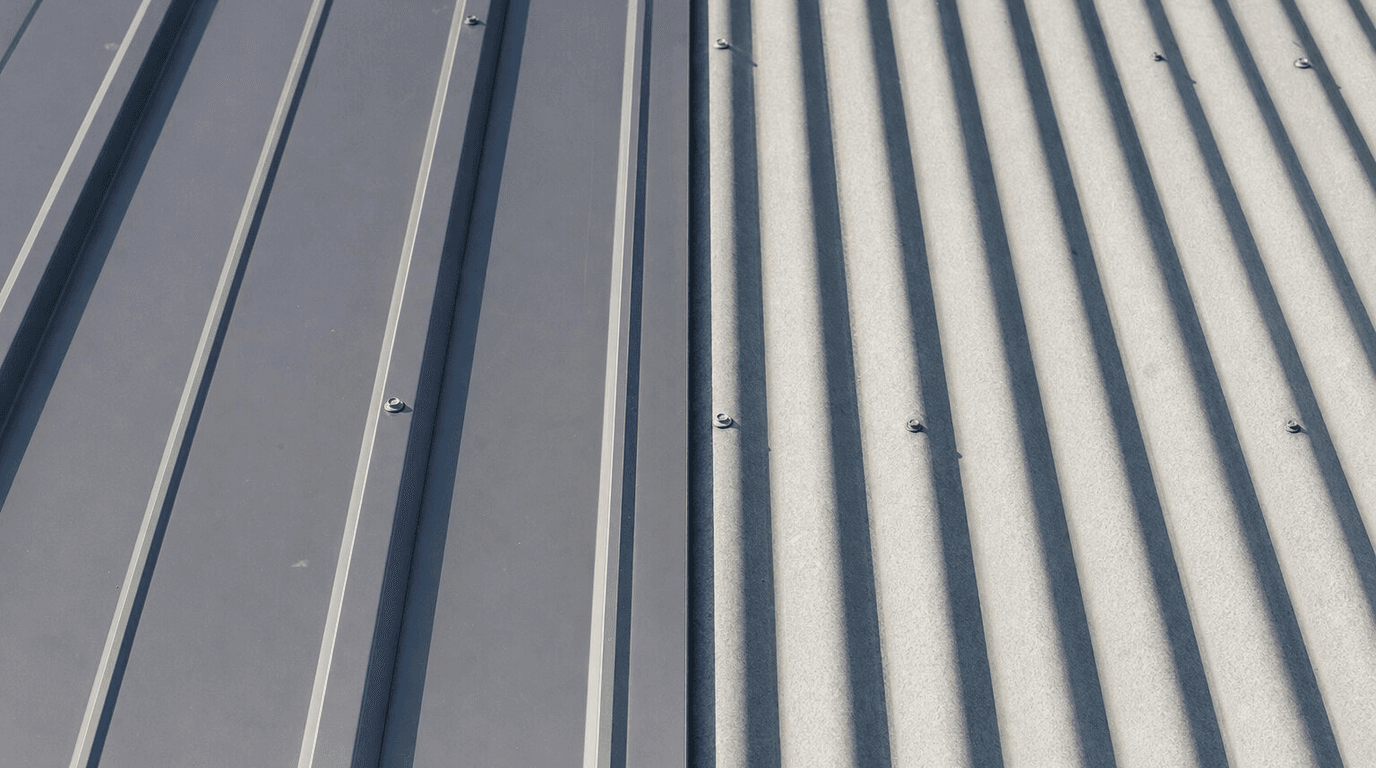
Metal Roofing Panel Types: Why the Difference Matters More Than You Think
When most people say "metal roof," they're picturing something specific — maybe the clean vertical lines of a standing seam roof on a farmhouse, or the wavy corrugated panels on an old barn. But those aren't the same product. They perform differently, cost differently, and belong in different situations. Choosing the wrong panel type isn't just an aesthetic mistake — it can mean exposed fasteners failing in year five, or a roof profile that doesn't match your building's drainage demands.
This guide covers the three metal roofing panel types you'll most commonly encounter in Northeast Wisconsin: R-panel, corrugated, and standing seam. By the end, you'll have a clear sense of what each one is built for, what it costs to install, and how to think about the tradeoffs for your specific project — whether that's a residential replacement, a commercial metal roofing application, or something in between.
R-Panel Metal Roofing: The Workhorse of Commercial Metal
R-panel — sometimes called PBR panel — is the most common exposed-fastener metal roofing system on the market. You've seen it on warehouses, agricultural buildings, metal-clad commercial construction, and the occasional pole barn. The profile is characterized by a flat field with a single raised rib running the length of each panel, typically about 1.25 inches high, repeating every 12 inches across the width.
The defining feature of R-panel is the exposed fastener. Screws go directly through the panel face and into the structure beneath, with a rubber washer under the screw head creating the weather seal. It's fast to install, straightforward to repair, and considerably less expensive than concealed-fastener systems.
Where R-Panel Works Well
R-panel is a practical choice in a few specific situations:
- Agricultural buildings and outbuildings where appearance is secondary to cost and speed of installation
- Low-slope commercial roofs with adequate pitch for drainage (R-panel needs at least a 1:12 slope, and performs better at 2:12 or steeper)
- Budget-driven commercial projects where longevity expectations are moderate and the client understands the maintenance tradeoffs
- Re-roofing over existing metal where a concealed-fastener system isn't structurally feasible
The Honest Tradeoffs
Exposed fasteners are the weak point. The rubber washers under the screws compress and harden over time, especially with Wisconsin's freeze-thaw cycling. A well-installed R-panel roof might go 10 to 15 years before fasteners start becoming a maintenance item. After that, you're periodically checking for backed-out screws, cracked washers, and early leak points around penetrations. It's manageable, but it's not maintenance-free.
Thermal movement is another factor. Metal expands and contracts with temperature changes, and exposed-fastener systems have to accommodate that movement through the screw holes themselves. Over time, that cycling can elongate the holes and create moisture pathways. This is especially relevant in a climate like Green Bay's, where winter temperatures can swing 60 to 70 degrees Fahrenheit over the course of a week.
For a deeper look at where R-panel fits into the broader landscape of roofing types, including how it compares to membrane systems on low-slope commercial buildings, that overview is worth reading before committing to any metal system.
Corrugated Metal Roofing: Classic Profile, Real Performance
Corrugated metal is what most people picture when they think "old barn roof" — the alternating wave pattern that's been used on agricultural and industrial buildings for well over a century. The sinusoidal profile (that's a fancy word for S-wave) gives the panels structural stiffness that the flat field of R-panel doesn't have, which is part of why it's held up on farm buildings for generations.
Modern corrugated panels are a different product from the galvanized sheets of 50 years ago. Today's corrugated roofing comes in Galvalume-coated steel, aluminum, and painted Kynar finishes, with better corrosion resistance and tighter manufacturing tolerances than older versions.
Corrugated in Residential and Commercial Contexts
Corrugated metal has made a comeback in residential design over the past decade, particularly on homes with a modern farmhouse or contemporary architectural style. The profile reads as intentional and textured rather than industrial, which is why architects specify it on projects where standing seam's clean lines feel too corporate.
On the commercial side, corrugated panels are common on agricultural structures, covered walkways, canopies, and outbuildings. They're less common on primary commercial roofing applications than R-panel, partly because R-panel's rib geometry is more optimized for structural spanning.
Exposed Fasteners Here Too
Like R-panel, most corrugated installations use exposed fasteners. The same maintenance considerations apply: washer degradation, thermal movement through the hole, and periodic inspection requirements. Some manufacturers offer through-fastener systems with oversized washers and silicone-based seals that outperform basic rubber, which is worth specifying if you're doing a corrugated installation and want to extend the maintenance cycle.
Corrugated also sheds snow and ice more readily than a flat-profile system, partly because the wave pattern creates less surface tension for water to wick under. In Green Bay's winters, that's a minor but real advantage.
Standing Seam Metal Roofing: The Premium Option Worth Understanding
Standing seam is the category that gets the most attention, and for good reason. It's a fundamentally different design from exposed-fastener systems, and the difference in performance over time is significant.
Instead of screws through the panel face, standing seam panels connect at raised seams — vertical ribs that run the full length of the roof — using concealed clips that attach to the structure. The panels themselves float over these clips, which allows the metal to expand and contract freely with temperature changes without stressing any fastener points. No exposed hardware on the roof surface at all.
Why Concealed Fasteners Change the Equation
The absence of through-fasteners eliminates the primary failure point of exposed-fastener systems. There are no rubber washers to degrade, no holes for water to wick into, and no screw heads to back out. A properly installed standing seam roof in Northeast Wisconsin can genuinely go 30 to 50 years with minimal maintenance beyond keeping debris off the surface and inspecting flashing points periodically.
For homeowners who have had bad experiences with metal roofing and assume all metal needs ongoing attention, standing seam is a different category. The maintenance profile is much closer to "install and forget" than exposed-fastener systems would suggest.
The snow performance on standing seam is also notable. The smooth, uninterrupted panel surface lets snow and ice slide off readily, which reduces roof load and minimizes the ice dam formation that costs Wisconsin homeowners real money every winter. It won't replace proper attic insulation and ventilation, but the surface behavior is genuinely better than most alternatives.
Standing Seam Panel Profiles
Not all standing seam is the same. The main variables are:
- Seam height: typically 1 inch to 2 inches. Taller seams handle more severe weather exposure and work better on lower-slope applications.
- Snap-lock vs. mechanical seam: snap-lock panels click together during installation and are common on residential projects. Mechanical seam systems are folded and locked on-site using a seaming machine, creating a tighter weather seal — specified for steeper commercial applications or extreme weather exposure.
- Panel width: narrower panels (12 to 16 inches) have a more refined, architectural look. Wider panels (18 to 24 inches) are more common on agricultural and commercial applications and install faster.
- Gauge: 24-gauge steel is the standard for quality residential standing seam. 22-gauge is heavier and specified for commercial or high-load applications. Thinner 26-gauge is available but isn't a good choice for Wisconsin's hail season.
What Standing Seam Costs
Honestly, standing seam costs more — sometimes significantly more — than exposed-fastener alternatives. On a residential project in Green Bay, you might be looking at $14 to $20 per square foot installed for steel standing seam, compared to $7 to $11 for R-panel or corrugated on a comparable structure. The gap is real.
But the cost comparison is more useful when you look at total cost over time. A standing seam roof with 40+ years of service life and minimal maintenance demands is a different economic proposition than a less expensive system that needs fastener maintenance in year 12 and a full replacement in year 25. For homeowners planning a roof replacement they expect to be their last, the math often tilts toward standing seam.
Standing Seam vs. Corrugated: Which One for a Wisconsin Home?
This is the comparison most residential homeowners are actually making, so it's worth being direct about it.
Standing seam wins on longevity, maintenance, and performance in every category that matters in Northeast Wisconsin — snow shedding, freeze-thaw durability, wind resistance, and absence of fastener failure points. If budget allows, it's the better residential choice in most situations.
Corrugated is a legitimate option when budget is constrained, when the architectural style calls for it specifically, or when the application is an outbuilding, covered walkway, or structure where 25 years of service is perfectly acceptable. It's not a compromise material — it's just built for different expectations.
For commercial buildings where R-panel or corrugated are under consideration, the question is usually framed differently. Read through our commercial metal roofing overview to see how material choices intersect with occupancy type, insurance requirements, and maintenance budget planning for business properties.
How Wisconsin's Climate Affects the Decision
Northeast Wisconsin's climate creates specific demands that shift the calculus on every panel type comparison. Here's what actually matters locally:
Snow load: Brown, Kewaunee, Oconto, Outagamie, Winnebago, and Manitowoc counties all deal with significant winter snow accumulation, and the Lake Michigan effect pushes that higher east of Green Bay. Standing seam's smooth surface sheds snow more effectively than any exposed-fastener system. For a home with a lower roof pitch (under 4:12), that matters more than it would on a steeply pitched structure.
Freeze-thaw cycling: The temperature swings from January through March put exposed fasteners under repeated mechanical stress. This is the primary reason we see premature fastener failure on exposed-fastener systems in our region compared to milder climates. It's not that R-panel or corrugated is a bad product — it's that the local climate is harder on the weak points.
Hail: Wisconsin gets meaningful hail events in summer, and heavier-gauge steel handles that better than lighter-gauge aluminum. Specifying 24-gauge or heavier steel, and looking for products with UL 2218 Class 4 impact ratings, is worth doing regardless of which panel type you choose.
Wind: Areas with open exposure — rural properties, homes on elevated ground, anything near the shoreline — benefit more from standing seam's concealed fastener design, since exposed fasteners create more uplift resistance variability under sustained high winds.
Questions to Ask Before Choosing a Metal Panel System
Before you commit to a panel type, these are the questions worth getting clear answers on:
- What's the roof pitch, and does the panel system meet the manufacturer's minimum slope requirement?
- Is the installer experienced specifically with this panel type, or are they adapting a skill set from a different system?
- What gauge steel is being specified, and why?
- How is thermal movement accommodated — floating clips, slotted holes, or through-fasteners?
- What does the warranty cover, and who backs it — the manufacturer, the installer, or both?
A contractor who hesitates on any of these questions is telling you something important.
Michael Pierce has been installing and replacing metal roofing systems across Northeast Wisconsin for over 30 years. Pierce Roofing holds Atlas PRO+ Platinum certification, carries $2 million in liability coverage, and backs every installation with a 10-year workmanship warranty. We work with all three panel types covered here and will tell you honestly which one fits your project — not which one has the best margin for us.
Call us at (920) 609-8304 or request a free estimate to talk through your metal roofing options. We serve all six counties in Northeast Wisconsin and will come take a look at your current roof before recommending anything.