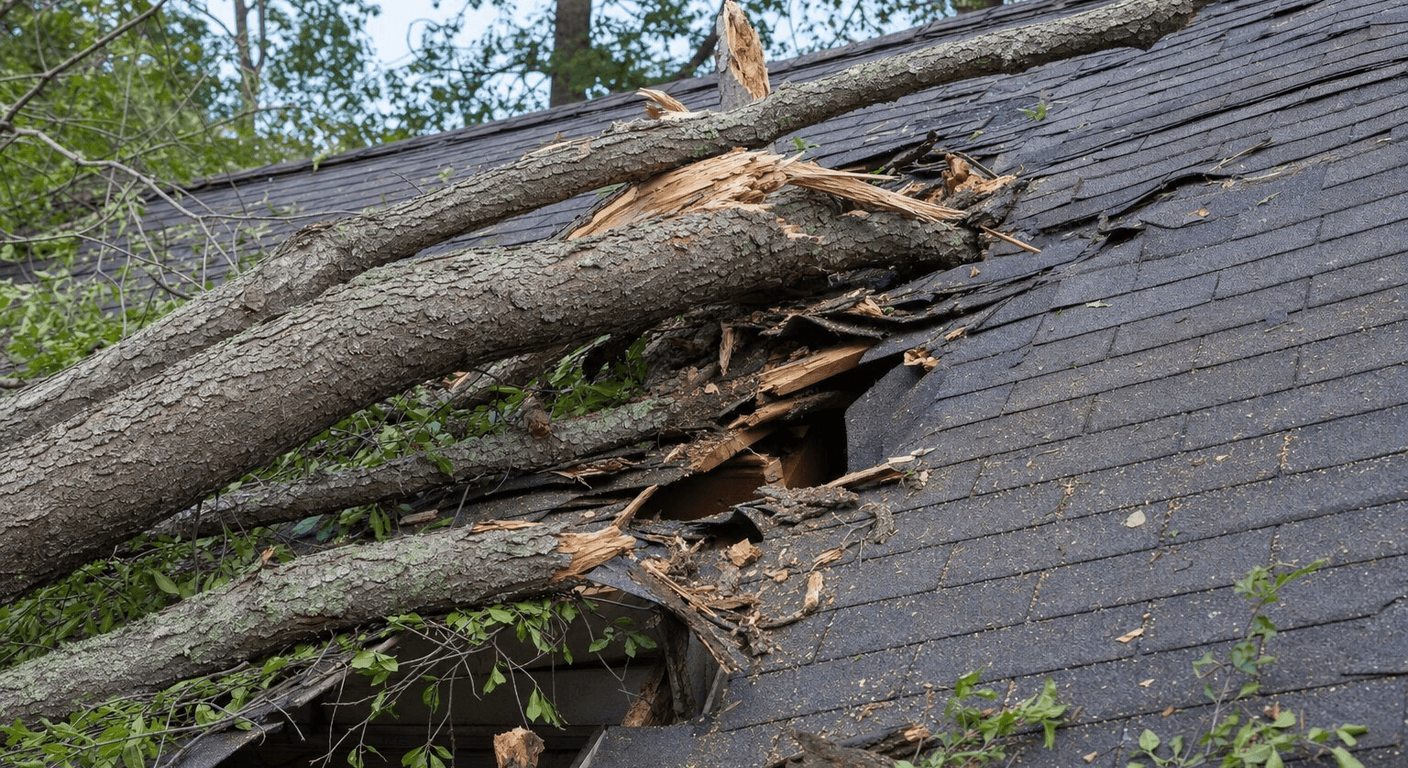
When a Tree Hits Your Roof, the Next Hour Matters More Than You Think
A falling tree doesn't give you any warning. One minute everything is fine, the next you're hearing a sound you'll never forget — a crash that shakes the walls and leaves you standing in your living room trying to figure out what just happened. If a tree or large limb has landed on your roof, you're probably scared, overwhelmed, and not sure what to do first.
This guide walks you through it. Step by step, in order, without making it more complicated than it needs to be. The decisions you make in the next few hours will have a real impact on how much damage you end up dealing with — and what your insurance claim looks like.
Step 1: Get Everyone Out of the Affected Part of the House
First and only priority right now: people. Not the roof. Not your stuff.
If a tree has penetrated your roof, the structural integrity of that area is unknown. Ceilings can collapse. If the tree is still partially suspended in the roof, it can shift. Get everyone — people and pets — out of the rooms below the impact zone and away from the exterior where the tree came down.
If there's any question about whether the house is safe to stay in, leave. You can sort out where to sleep later. You can't unsee a ceiling coming down on someone.
Once people are safe, do a quick check for anything urgent: gas smell, sparks, exposed electrical wiring, or a fire starting where the tree impacted. If you smell gas, don't touch a light switch — get out and call 911 and your gas utility from outside. If there's no immediate danger, you can start working through the rest of these steps.
Step 2: Call Your Insurance Company Before You Do Anything Else
Seriously — before you start moving debris, before you call a roofer, call your homeowners insurance company and open a claim. This is not something to put off until morning.
Most policies cover sudden storm-related damage, and a falling tree absolutely qualifies. But insurance companies are not just going to hand you a check based on your word. They want documentation of the original damage — before anything gets moved or covered. If you clean up first and call later, you've made your own claim harder to prove.
When you call, give them the basic facts: date and time, what happened, the address, and your policy number. Ask whether an adjuster will come out and when. Ask whether you have permission to make temporary protective repairs before the adjuster arrives — most companies say yes to this, but you want it confirmed.
Write down the name of every person you speak with and what they tell you. It matters.
Step 3: Document Everything — Every Single Thing
Your phone is your most important tool right now. Before anything is moved, photograph and video the damage from every angle you can safely access. That means:
- The tree where it landed on the roof, from multiple angles outside
- Any visible holes, crushed sections, or displaced shingles
- Interior damage below the impact — ceiling stains, cracks, anything that fell
- The full tree from where it snapped or uprooted to where it landed
- Any gutters, siding, fascia, or other parts of the house that got caught in the fall
Get timestamps on every photo. If your phone doesn't automatically embed them, text a photo to yourself or a family member so the timestamp is recorded. This documentation is what turns an insurance claim from a fight into a straightforward process.
Don't skip this even if the damage looks minor. Tree impacts often do more to the underlying structure than is visible from the outside, and you'll want a clear record of what the scene looked like immediately after it happened.
Step 4: Stop Water from Getting In — Carefully
Once you've documented the damage, the next concern is water intrusion. An open hole in your roof is an open invitation for rain to get into your insulation, drywall, framing, and ceilings. In Wisconsin, where summer storms tend to come in waves, you may not have much time before the next one rolls through.
If it's safe to access your attic, go up and assess what you can see from the inside. Look for light coming through, active dripping, wet insulation, or any structural members that look cracked or displaced. Place buckets where water is actively entering. Do not climb onto the roof while the tree is still on it — the surface and structure underneath are both compromised.
For the exterior, a heavy-duty tarp secured over the damaged area can reduce water intrusion significantly until a roofer arrives. This is also something most insurance companies expect you to do as part of your obligation to prevent further damage. Use weights or long boards along the tarp edges rather than driving nails into the damaged area.
If the damage is extensive or the tree is still lodged in the roof, this is not a DIY situation. Call a professional who handles emergency roof repair from tree damage and let them assess whether it's safe to work before anyone gets on that roof.
Step 5: Don't Remove the Tree Yourself
This is where a lot of homeowners get into trouble. The instinct is to start cleaning up — get the tree off, clear the debris, make it look manageable. That instinct is wrong here.
A tree that's partially embedded in your roof may be acting as a plug — keeping the hole sealed enough to slow water intrusion. Move it without understanding what's underneath and you may open up a much larger breach. Beyond that, chainsaws on a damaged roof with compromised footing is genuinely dangerous.
Tree removal after a storm event is typically covered under your homeowners insurance as part of the claim — so there's also no financial reason to rush it yourself. Let a qualified tree service and your roofer coordinate the removal together, so the tree comes off at the same time the hole is properly staged for repair or temporary protection.
What Happens When a Roofer Arrives
When a qualified roofer gets on site after a tree impact, they're looking at several things at once — not just the surface damage you can see from the ground.
The first question is structural. Did the tree impact the roof deck, the rafters, or the trusses? Surface damage to shingles and decking is a known quantity. Structural damage to the framing underneath changes the repair scope significantly and affects whether the home is safe to occupy. A roofer who doesn't get into the attic and assess the framing after a tree impact isn't giving you the full picture.
From there, they'll look at the full extent of surface damage. Tree impacts rarely affect just one small area — falling branches drag across shingles, debris gets driven under edges, gutters get bent or torn away. A proper assessment covers everything the tree touched on the way down.
Finally, they'll put together a written scope of work with costs. That document becomes part of your insurance claim, and it needs to be specific. Vague estimates with round numbers are a red flag — you want line-item detail that matches what the adjuster is going to look for.
Our storm damage repair process at Pierce Roofing covers all of this. We've handled more tree-impact repairs than we can count across Green Bay and the surrounding area, and we know exactly what insurance adjusters want to see in a damage report.
Will Your Homeowners Insurance Cover It?
In most cases, yes — but there are some things to understand upfront.
Standard homeowners insurance policies in Wisconsin cover sudden, accidental damage from falling objects, which includes trees and large limbs. That covers the roof repair, interior damage caused by the impact, and usually the cost of removing the tree from the structure and immediate area. What policies typically don't cover is removing the tree if it fell but didn't actually damage your structure — a tree down in your yard, for example.
One thing that comes up regularly: whose tree was it? If the tree was your neighbor's, you may assume they're liable. Generally, that's not how it works. In Wisconsin, if a tree falls due to a storm or act of nature, your insurance covers your property damage regardless of where the tree came from — unless the neighbor had prior written notice that the tree was dead or hazardous and failed to act on it. That's a narrow exception and hard to prove without documentation.
If your roof was already in poor condition before the tree fell, some adjusters will try to reduce what they pay out based on the pre-existing depreciation of the roof. This is where having a roofer who knows how to write a claim-supporting scope of work makes a real difference. Don't go through this alone.
How Bad Is the Damage, Really?
This is almost impossible to answer without a professional on site, but here's a general framework.
A small limb that scraped across the roof on the way down and knocked off a few shingles is a repair job. Significant, but manageable. An active storm damage claim handled quickly, properly repaired, and you're done.
A large branch or trunk section that penetrated the roof deck and may have hit the framing beneath is a different situation. That's where you need a thorough structural assessment before anyone makes promises about repair timelines or costs. In some cases, a tree impact on an older roof can push a repair into replacement territory — either because the structural damage is too widespread, or because repairing the impact zone reveals that the surrounding roof is too deteriorated to be worth patching around.
An honest roofer will tell you which category you're in without trying to upsell you. If someone immediately pushes replacement without getting in the attic and looking at your framing, ask why.
Green Bay Homeowners: What to Do About the Tree in Your Yard
Northeast Wisconsin has no shortage of large mature trees — one of the things that makes neighborhoods like those in Green Bay and surrounding communities so beautiful to live in. But those same trees are a real storm risk. White pines, silver maples, box elders — fast-growing species with weak wood that don't hold up well in high winds.
If you've had a tree come down on your roof, once the immediate situation is handled, it's worth taking stock of any other trees near your home. A certified arborist can assess whether other trees on your property show signs of disease, root damage, or structural weakness that make them likely to fall in another storm. That kind of preemptive look costs a fraction of what a second tree impact would cost you.
For more information on how tree damage affects your roof over time, including scraping branches and surface wear that happens long before a full impact, see our page on roof damage from trees.
If You're Dealing with This Right Now, Here's the Short Version
Get people safe first. Document before you touch anything. Call your insurance company immediately. Cover the hole to stop water. Don't remove the tree yourself. Get a qualified roofer on site as soon as possible.
That's it. Everything else flows from those steps.
And if you need someone on the phone right now to talk through what you're looking at — call us. Pierce Roofing has served Green Bay and all six counties of Northeast Wisconsin for over 30 years. Michael Pierce is Atlas PRO+ Platinum certified, carries $2 million in liability coverage, and backs every repair with a 10-year workmanship warranty. We know this situation is stressful. We're going to give you straight answers.
Call (920) 609-8304 for immediate assistance, or if you'd rather start online, request a free estimate and we'll get back to you fast. If you need emergency roof leak repair right now, don't wait — call directly.