How Do You Know When a Commercial Roof Actually Needs Replacing?
Most commercial property owners don't think much about their roof until something goes wrong. That's understandable — there are a hundred other things demanding attention. But a commercial roof that's quietly failing costs money in ways that don't always show up as an obvious drip through the ceiling.
Energy bills climb. Insulation gets wet and loses R-value. Tenants complain about humidity. A membrane that looks intact from the ground develops micro-tears that won't seal with another coat of coating. At some point, patching stops making financial sense — and a full commercial roof replacement becomes the right call.
The question is how to know when you've crossed that line. This guide covers the concrete signs, the honest cost picture for Wisconsin, and the factors that push a replacement price up or down.
Why Commercial Roofs Are Different From Residential
Before getting into signs and costs, it's worth being clear about what we're actually talking about. Commercial roofing is not just a bigger version of residential roofing. The systems are different, the failure modes are different, and the decisions involve different stakes.
Most commercial buildings in Northeast Wisconsin use flat roofing systems — TPO, EPDM rubber membranes, modified bitumen, or built-up roofing (BUR). These systems drain by slope rather than pitch, which means standing water is a chronic challenge. They also expand and contract significantly across Wisconsin's temperature swings, from negative-20 wind chills in January to 90-degree July days. That thermal stress takes a real toll over time.
The stakes are different too. A failing residential roof might damage drywall and insulation. A failing commercial roof can shut down operations, ruin inventory, damage equipment, and trigger tenant lease disputes. The tolerance for a "we'll keep an eye on it" approach is much lower.
Signs It's Time to Replace Your Commercial Roof
Persistent Leaks That Return After Repairs
One leak, repaired properly, is just maintenance. The same area leaking again six months later, or leaks appearing in multiple spots within a short window, tells a different story. It usually means the membrane or substrate has deteriorated broadly — not just at one point — and localized repairs are just plugging holes in a failing system.
If your maintenance log shows three or more leak repairs in the past two years, that's a pattern worth evaluating seriously. At some point the repair cost per year exceeds what systematic replacement would have cost, spread over a 20-year life.
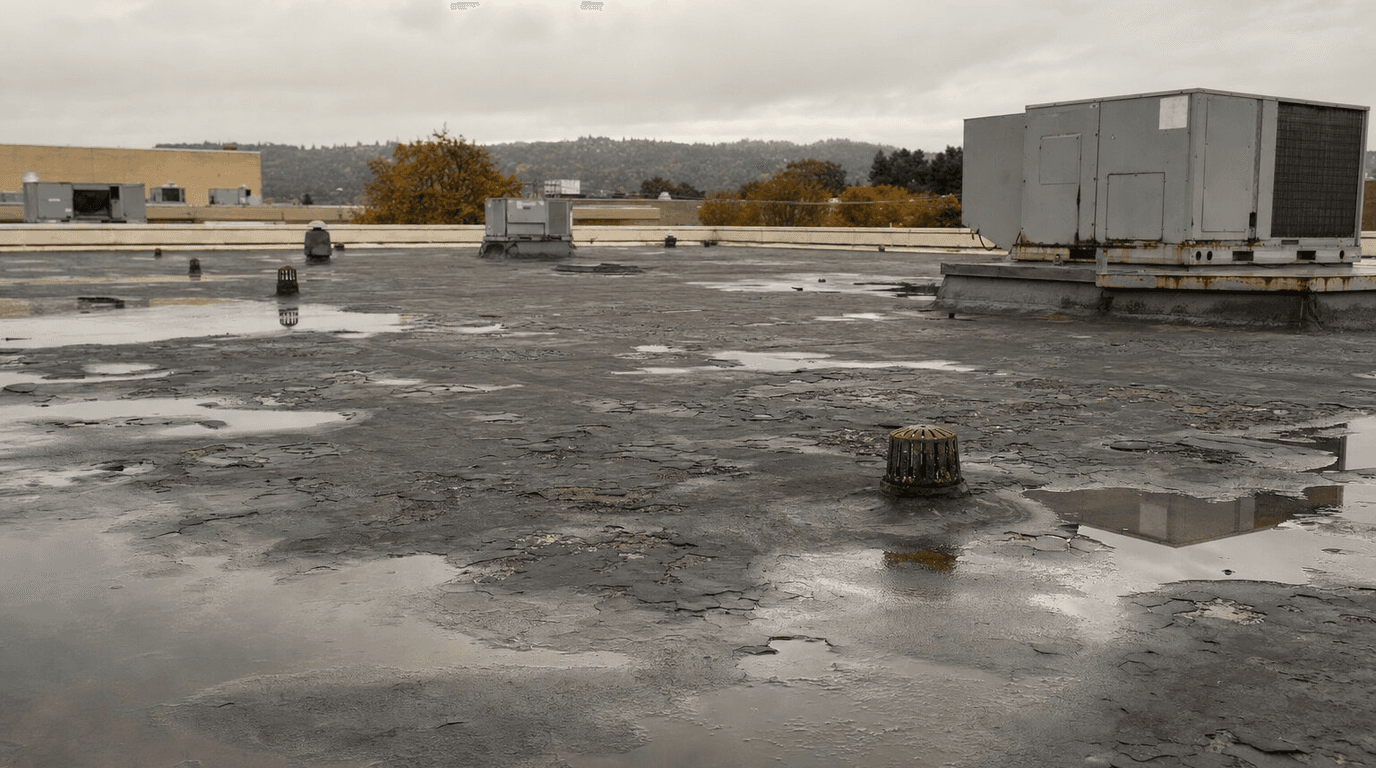
Significant Ponding Water
Flat roofs are designed to drain, not to hold water permanently. Some standing water right after a rain is normal. Water that's still sitting 48 hours after a storm is not. Ponding accelerates membrane degradation, adds structural load (water weighs about 5 pounds per square foot), and creates a breeding environment for algae and biological growth that breaks down roofing materials.
If you have chronic ponding areas, the question isn't whether they'll cause problems — it's whether re-sloping and re-draining a section is more cost-effective than a full replacement. Usually that calculation tips toward replacement once the membrane is already aging.
Membrane Blistering, Cracking, or Shrinkage
Walk the roof — or have a professional do it — and look at the surface. Blistering (raised bubbles under the membrane) means moisture or air has gotten between layers. Once blisters form, they tend to grow and eventually rupture. Cracking along seams or at membrane edges signals that the material has lost flexibility and is starting to fail under thermal movement. Shrinkage, where the membrane pulls away from parapet walls or curbs, creates open gaps that no amount of caulk reliably seals long-term.
Any of these, across a significant portion of the roof rather than isolated spots, indicates the membrane is at or past the end of its useful life.
Deteriorated Flashing
Flashing at parapet walls, HVAC curbs, drains, skylights, and penetrations is where water almost always finds its way in first. On an aging commercial roof, flashing metal corrodes, lap sealants dry out and crack, and counterflashing separates from the wall. You can reapply sealant, but if the flashing metal itself has corroded or the substrate it's attached to has deteriorated, you're working around a problem rather than fixing it.
Flashing issues on a roof that's otherwise holding up can often be addressed through a targeted repair. On a roof that's 15 to 20 years old with multiple problems, it's usually a sign that the entire system is aging out together.
Sagging or Soft Sections
When you walk a commercial roof and feel soft or spongy areas underfoot, that's wet insulation or compromised decking. Either one is serious. Wet insulation has lost its thermal value and will continue to absorb moisture, adding weight and accelerating structural deterioration. If it's the decking itself that's soft — especially on older buildings with wood or gypsum decking — you may have a structural issue that needs addressing before any new roofing goes on.
Soft spots found during an inspection are often the thing that pushes a decision from "maybe next year" to "this needs to happen now."
Age — The Most Honest Factor
Different commercial roofing systems have different expected lifespans. TPO membranes typically run 15 to 25 years with proper maintenance. EPDM can last 20 to 30 years. Modified bitumen runs 15 to 20 years. Built-up roofing, well maintained, can reach 25 to 30 years.
Once a roof hits 75 to 80 percent of its expected lifespan, the calculus on repairs changes. You're investing maintenance dollars into a system that's already operating on borrowed time. A free roof inspection at that point can give you a realistic picture of how much life is left and whether it makes financial sense to keep maintaining or to plan a replacement.
In Wisconsin's climate specifically, expect the low end of those ranges to be more relevant than the high end. Freeze-thaw cycling and ice dam pressure are harder on commercial membranes than the manufacturer's warranty conditions typically assume.
What Drives Commercial Roof Replacement Cost in Wisconsin
There's a wide range in commercial roofing costs, and it's not arbitrary. Several factors move the number significantly.
Roof Size and Complexity
Commercial roofing is typically priced by the square (100 square feet). A straightforward low-slope roof with minimal penetrations and easy access is at the lower end of the cost range. A roof with multiple HVAC curbs, skylights, drains, parapet walls, and equipment platforms adds labor time and material complexity at every one of those points.
For commercial roofing in Northeast Wisconsin, expect ballpark ranges of $7 to $14 per square foot for TPO or EPDM replacement, depending on system choice, substrate condition, and complexity. Modified bitumen and built-up systems tend to run toward the higher end. These numbers are rough guides — get actual bids based on your specific building.
Tear-Off vs. Recover
In some cases, a new membrane can be installed over the existing one (called a recover or re-cover). This saves the cost of tearing off and disposing of the old system. Like a residential overlay, it's not always the right call — but when the existing substrate is sound and the building's load capacity allows for it, it can meaningfully reduce cost.
If the existing membrane is waterlogged or the insulation is wet, a tear-off is not optional. Trapping wet insulation under new membrane is how problems get buried instead of fixed.
Insulation Condition and R-Value
Energy codes in Wisconsin have gotten more demanding over the past decade. If your commercial building's roof insulation is aging, damaged, or undersized for current code requirements, a replacement is the right time to address it. New polyisocyanurate (polyiso) insulation adds upfront cost but reduces heating and cooling costs for the life of the new roof. In Green Bay's climate, that payback period is shorter than you might expect.
Decking Repairs
If the tear-off reveals damaged decking sections — which is more common on older buildings than most owners anticipate — those repairs add cost before a single square of new membrane goes on. Getting an honest assessment of decking risk before signing a contract is important. A reputable commercial roofing contractor will flag this as a possibility and explain how supplemental work would be priced if it's needed.
Drain and Flashing Upgrades
Drains on older commercial roofs are often undersized, improperly located, or partially clogged with years of debris. Replacement is a good opportunity to right-size drainage. New perimeter flashing, edge metal, and counterflashing come with a new system — those materials and the labor to install them are part of the cost, not extras.
Repair vs. Replace: How to Think About It
This is the question most building owners struggle with, and there's no universal answer. But there are a few ways to frame it that help.
If your annual repair and maintenance cost over the past three years equals more than five to seven percent of what a replacement would cost, you're probably past the repair-makes-sense threshold. If you have multiple simultaneous failure modes — leaks, membrane deterioration, flashing failures, and drainage problems all at once — it's a sign the system is aging out broadly, and individual repairs won't change the trajectory.
If the roof is under 10 years old and issues are localized, repair is almost always the right call. If it's over 20 years old and you've had recurring problems, it's worth getting a replacement estimate to compare against projected ongoing repair costs.
A professional inspection with documented findings is worth the investment before making that call either way. It takes the guesswork out.
What to Expect From the Replacement Process
A commercial roof replacement is more involved than a residential job, and planning matters more. Here's what the process typically looks like:
First comes the inspection and proposal. A contractor should get on the roof, probe for wet insulation, document existing conditions, and give you a written proposal with material specifications, scope of work, and a clear accounting of what's included. Ask about how supplemental work is handled — damaged decking found during tear-off, for instance.
Permitting comes next. Commercial roofing projects require permits in most Wisconsin jurisdictions, and inspections are part of the process. A legitimate contractor handles this without it becoming your problem.
During the project, expect some disruption. HVAC equipment may need to be temporarily disconnected and reconnected, access to roof-mounted equipment is restricted, and there will be noise. A good contractor communicates the schedule and works to minimize impact on your operations.
After completion, you should receive manufacturer warranty documentation for materials, plus a written workmanship warranty. Don't skip this step — get the paperwork before the contractor leaves.
Why Local Expertise Matters for Wisconsin Commercial Roofs
A contractor who works primarily in warmer climates understands roofing differently than one who's spent decades dealing with Wisconsin winters. The design details that protect a flat roof from ice dam pressure and freeze-thaw cycling are not the same as what you'd spec in Tennessee.
Michael Pierce has been roofing in Northeast Wisconsin for over 30 years. Pierce Roofing is Atlas PRO+ Platinum certified, carries $2 million in liability insurance, and backs commercial work with a 10-year workmanship warranty. We serve commercial properties across Brown, Kewaunee, Oconto, Outagamie, Winnebago, and Manitowoc counties.
If your building is showing any of the signs covered in this guide — or you're not sure what's going on up there — the right first step is an inspection. We'll document what we find, give you a straight assessment of what you're dealing with, and help you figure out whether repair or replacement makes more sense for your situation.
Call us at (920) 609-8304 or request a free estimate to schedule your commercial roof inspection. No pressure, no sales pitch — just an honest look at what your building needs.