Architectural vs. 3-Tab Shingles: The Decision More Homeowners Get Wrong
When a roofer hands you a quote and asks which shingle type you want, it can feel like a trick question. Both are asphalt shingles. Both come in dozens of colors. Both do the same basic job of keeping water out of your house.
But they are not interchangeable. And in Wisconsin's climate — with its ice dams, 50-inch snow seasons, and freeze-thaw cycles that grind through March like a slow-motion stress test — the difference between architectural and 3-tab shingles matters more than it would somewhere mild.
This post breaks down exactly what separates the two, what each one costs over time (not just at installation), and which makes more sense for most homes in Northeast Wisconsin.
What Are 3-Tab Shingles?
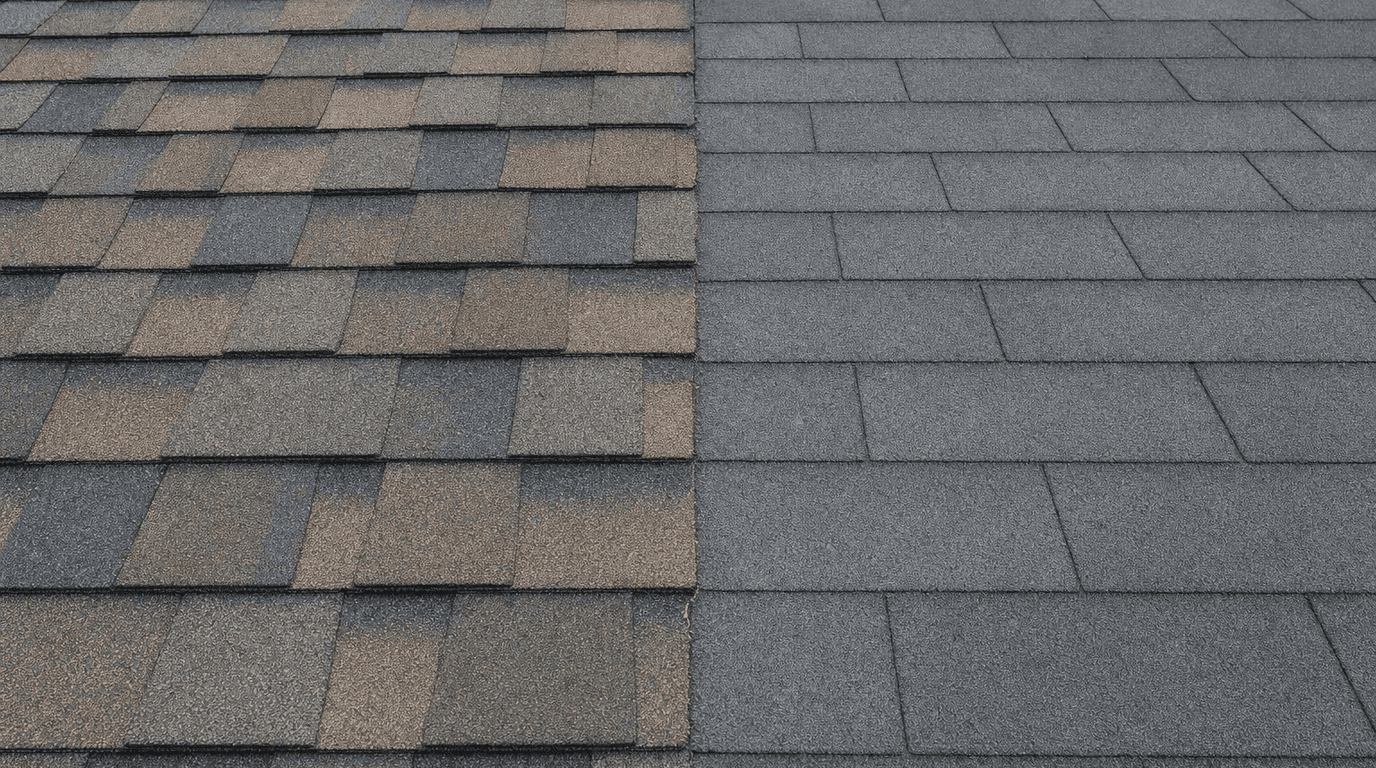
3-tab shingles are the older, simpler design. Each shingle strip has three uniform cutouts (tabs) along the bottom edge, which gives the finished roof a flat, grid-like appearance when viewed from the street. They've been the standard residential shingle for most of the 20th century.
They're made from a single layer of asphalt-saturated fiberglass mat with ceramic granules pressed into the surface. That flat, single-layer construction is what keeps the material cost low.
Typically, 3-tab shingles are rated for winds up to 60 to 70 mph and carry manufacturer warranties in the 20 to 25 year range. In practice, on a Wisconsin home, you can reasonably expect 15 to 20 years out of them before you're seeing granule loss, cracking, or curling that warrants replacement.
They're not a bad product. They're just a product that's mostly been surpassed.
What Are Architectural Shingles?
Architectural shingles — also called dimensional or laminated shingles — are built differently from the ground up. Instead of a single flat layer, they use two or more layers of asphalt bonded together, with a scalloped, contoured profile cut along the lower edge. The result looks more like wood shake or slate from a distance, with a textured, dimensional appearance rather than a flat grid.
Because of that layered construction, architectural shingles are heavier (typically 50% more per square than 3-tab), thicker, and more resistant to wind uplift. Most are rated for 110 to 130 mph winds. Manufacturer warranties commonly run 30 years to lifetime, depending on the specific product.
For asphalt shingle roofing in Wisconsin, architectural shingles are now the industry standard. The price premium over 3-tab has narrowed considerably in the past decade — we're typically talking $15 to $40 more per square, not hundreds — while the performance gap has stayed wide.
The Real Differences: A Head-to-Head Breakdown
Let's get specific, because the generic "architectural shingles are better" line you'll read everywhere doesn't tell you much.
Thickness and Wind Resistance
3-tab shingles are single-layer, which means they flex more and have a larger surface area for wind to grab. In a strong storm, the tabs can lift at the edges, break the adhesive seal strip, and eventually crack or detach entirely.
Architectural shingles are heavier and laminated, which makes them stiffer and harder for wind to lift. The scalloped profile also changes how wind interacts with the surface — instead of a flat plane for gusts to catch, there are overlapping layers that distribute pressure.
For a region that sees spring thunderstorms, occasional severe weather, and winters where ice and heavy snow put mechanical stress on every component of your roof, that extra rigidity is not a luxury.
Lifespan
This is where the cost math gets interesting.
Quality architectural shingles, properly installed, should last 25 to 35 years in Wisconsin. 3-tab shingles on the same home tend to hit replacement territory around the 15 to 20 year mark — sometimes sooner if there have been ice dam issues or hail events.
If you're planning to stay in your home for another 20+ years, the math on architectural shingles is straightforward: you're likely paying for one roof replacement instead of two. Even if architectural shingles cost $800 to $1,500 more on a typical installation, that's a fraction of what a second full roof replacement costs.
Appearance
This one's more subjective, but it matters for resale value.
3-tab roofs look flat. From the curb, they read as a uniform grid of rectangles. It's fine — functional, clean enough — but it doesn't add anything to the home's appearance.
Architectural shingles create shadow lines and visual depth that make a roof look more expensive than it is. They mimic the look of wood shake or slate at a fraction of the cost. Most appraisers and real estate agents will note the difference, and buyers notice it too.
If you're doing a roof replacement on a home you're planning to sell in the next five to ten years, architectural shingles are worth the small premium for curb appeal alone.
Performance in Wisconsin Winters
Ice dams form when heat escaping through a poorly insulated attic melts roof snow, which then refreezes at the cold eaves. The water backed up behind that ice dam works its way under shingles — and how easily it does depends partly on shingle construction.
The extra thickness of architectural shingles provides slightly more resistance to water infiltration from below. They're not a substitute for proper attic insulation and ventilation (that's the real fix for ice dams), but they hold up better when conditions aren't ideal.
3-tab shingles, especially older ones that have lost some flexibility, are more prone to cracking under ice load and thermal cycling. Once a tab cracks, it's an entry point for water.
What About Premium Shingle Lines Like Atlas?
Not all architectural shingles are created equal. Within the architectural category, there's significant variation in quality, warranty terms, and performance specs.
We work primarily with Atlas Roofing products, specifically their Pinnacle Pristine and StormMaster lines. Atlas PRO+ Platinum certification means we can offer enhanced warranty coverage that standard installers can't — including better material AND workmanship protections that transfer to the next owner if you sell.
The StormMaster Shake, for example, is rated for 150 mph winds and carries a Class 4 impact resistance rating — the highest available. For homeowners in areas that see hail (which is more of Brown, Outagamie, and Winnebago counties than people realize), Class 4 shingles can also qualify for insurance discounts. Worth asking your insurer about.
The point isn't that you need a premium shingle on every project. It's that when you're already choosing between shingle types, understanding the full range of roofing types available — from standard architectural to impact-rated products — lets you make a decision that actually fits your situation.
The Cost Breakdown: Upfront vs. Over Time
Here's where a lot of homeowners make a mistake. They see the per-square price difference between 3-tab and architectural shingles and stop the analysis there.
On a 2,000-square-foot ranch with a simple roof, the material cost difference between a mid-grade 3-tab and a solid architectural shingle is typically $300 to $700. Total project cost difference, including labor, usually lands somewhere between $500 and $1,500.
That's real money. But run it out over time:
- 3-tab roof on that same house: replacement around year 18 to 20. Second replacement potentially needed before year 40.
- Architectural roof: replacement around year 30 to 35. Possibly just the one.
The labor cost of a full tear-off and reinstall in our market runs $3,000 to $6,000 on a standard residential roof, before materials. Paying an extra $800 upfront to potentially avoid that entire expense isn't a close call.
And that's before accounting for any damage that happens when an older 3-tab roof starts failing — leaked water, damaged decking, insulation replacement. The cost of deferred maintenance on a failing roof compounds fast.
So Which Should You Choose?
For most Wisconsin homeowners replacing an aging roof, architectural shingles are the right answer. The performance advantage is real, the lifespan advantage is real, and the price premium has gotten small enough that the math works out in most scenarios.
3-tab shingles still make sense in a narrow set of situations:
- You're a landlord replacing a roof on a rental property with a short ownership horizon and need to minimize upfront cost.
- The home is a tear-down or major renovation candidate and you need the roof functional but aren't investing in longevity.
- Budget constraints are genuinely severe and you need a functional roof now, with the understanding you'll revisit it sooner.
Outside those scenarios, we don't recommend 3-tab for primary residences in this climate. We've seen too many of them fail early — cracked tabs after a rough winter, lifting after a spring storm, granule loss that accelerates past what the timeline suggests. Wisconsin is hard on roofing materials, and 3-tab construction doesn't have the same margin.
Questions Worth Asking Any Roofer
If you're getting estimates for a new roof, a few questions that will tell you a lot about who you're dealing with:
Ask them to explain the difference between the shingle lines they're quoting. A good contractor can walk you through wind ratings, warranty terms, and the practical tradeoffs without needing to look anything up. If they can't, that's information.
Ask whether they're a certified installer for the manufacturer they're recommending. Atlas PRO+ Platinum certification, for example, isn't handed out — it requires training, volume thresholds, and ongoing accountability. Certified installers can access enhanced warranty terms that others can't offer.
Ask what the warranty covers if something goes wrong five years from now. There's a difference between a manufacturer warranty on materials and a workmanship warranty from the contractor. You want both.
Ready to Replace Your Roof? Let's Talk.
Pierce Roofing has been doing this work across Brown, Kewaunee, Oconto, Outagamie, Winnebago, and Manitowoc counties for over 30 years. Michael Pierce and his crew are Atlas PRO+ Platinum certified, carry $2 million in liability coverage, and back every installation with a 10-year workmanship warranty.
We'll come out, look at your current roof, and give you an honest assessment of what you're working with — including a clear explanation of which shingle options make sense for your specific home, not just a generic upsell.
Call us at (920) 609-8304 or request a free estimate online. No pressure, no sales games — just straight answers from people who've been doing this long enough to know what works in a Wisconsin winter.