When Should You Replace Your Roof in Wisconsin?
If you're asking this question, you're probably already past the point of hoping the roof holds another winter. Maybe you had a leak this spring. Maybe your shingles are visibly curling and the granules are showing up in your gutters. Maybe you just know — the way homeowners eventually do — that it's time.
The question isn't really whether to replace it. The question is when. And in Wisconsin, that answer matters more than it does in most parts of the country.
Our climate is hard on roofing crews, hard on materials, and hard on installation windows. Get the timing right and you'll have a roof that installs correctly, seals properly, and performs the way the manufacturer intended. Get it wrong and you might be dealing with problems that show up six months later — problems that trace back to a rushed install in bad conditions.
Here's what 30 years of roofing in Northeast Wisconsin has taught us about timing.
The Best Season for Roof Replacement in Wisconsin: Late Summer and Fall
The honest answer: late August through mid-October is the optimal window for roof replacement in the Green Bay area. Not the only window — roofing happens year-round — but the best one.
Here's why those weeks work so well.
Temperature Matters More Than Most People Think
Asphalt shingles — which is what most Wisconsin homes use — need ambient temperatures above roughly 40 degrees to seal correctly. This isn't about comfort for the crew. It's chemistry.
Shingles have a self-sealing adhesive strip on the underside. When the roof warms up under normal conditions, that strip activates and bonds the shingle to the one below it. That bond is what holds shingles down in a 60 mph wind. If the adhesive never activates because temperatures stayed too cold during and after installation, you've got shingles that are mechanically fastened but not thermally bonded. They'll be fine most of the time — until they're not.
Late summer and fall in Green Bay typically sits between 55 and 75 degrees during the day. That's the sweet spot. Shingles are workable, the adhesive activates without issue, and the crew isn't fighting either extreme.
Dry Conditions Make a Real Difference
Roof replacement means your home's decking is exposed during installation. A good crew works fast, but there's always a period where your attic is open to the sky. Fall in Wisconsin tends to be drier than spring — less chance of a surprise afternoon shower turning a one-day job into a two-day headache, and no risk of snowmelt working its way into fresh underlayment.
Contractor Availability Is Better Than You'd Expect
Mid-June through July is actually the busiest period for roofers in this area. Storm season peaks, everyone who procrastinated through spring suddenly calls at once, and good crews book out weeks ahead. Fall is busy too, but the demand curve softens slightly after Labor Day. That means better scheduling, less rushed work, and more attentive installation.
What About Summer Roof Replacement?
Summer isn't a bad time to replace a roof in Wisconsin. It's just not the best.
The main issue is heat, not rain. On a hot July or August day, an asphalt shingle roof surface can hit 150 degrees or higher. That doesn't hurt the final product — the shingles are designed to handle that heat once installed — but it makes the crew's job significantly harder and slower. Heat exhaustion is a real concern. Productivity drops. Jobs that would take one day in September sometimes stretch into two.
There's also a risk that happens less often but is worth knowing: in extreme heat, soft asphalt shingles can scuff or mark during installation if workers aren't careful. A quality crew accounts for this. A crew that's rushing doesn't always.
If summer is the window that works for you, go for it. Just make sure you're working with an experienced contractor who knows how to manage a hot-weather install.
The Truth About Winter Roof Replacement in Wisconsin
Some contractors will tell you winter roof replacement is fine. And sometimes, they're right. A string of mild days in November or early December can absolutely support a quality installation.
But Wisconsin winters are unpredictable. A 50-degree afternoon in late November can turn into a 20-degree night, and if shingles haven't had time to seal before the temperature drops, you're back to the bonding problem described earlier. This is why most reputable roofers in the Green Bay area won't guarantee winter installs the same way they guarantee work done in better conditions.
There's also a practical issue. Ice and snow on the roof deck make installation both harder and more dangerous. Work slows down, which means your home spends more time exposed. And frozen decking can hide moisture that, once temperatures rise, becomes a problem underneath your brand-new shingles.
If your roof is actively failing in January and you're getting water inside, you replace it — obviously. But if you have any flexibility at all, holding off until spring or fall is worth it.
Spring: A Good Option With One Caveat
March through May is the second-best window for roof replacement in Wisconsin, and for a lot of homeowners it makes practical sense. The winter is over, you've had a chance to assess any damage from ice dams and freeze-thaw cycles, and you're motivated to fix things before the summer storm season starts.
The catch is contractor availability. Spring is when everyone calls at once. Homeowners who discovered leaks over winter, property managers catching up on deferred work, contractors scrambling to finish jobs that got pushed from the previous fall. Getting on a good crew's schedule in March or April requires planning ahead.
If you're thinking about a spring replacement, schedule your free roof inspection in February or early March so you're not competing with everyone else for the same two weeks in April.
Why Fall Is the Sweet Spot for Green Bay Homeowners Specifically
Most of what's written online about roof replacement timing treats the whole country as if it has one climate. It doesn't.
Green Bay has one of the harsher Great Lakes climates in Wisconsin. Average high temperatures drop below 40 degrees by mid-November. The first freeze typically hits in October. Snow, when it comes, can come fast. That compresses the viable installation window compared to, say, Milwaukee or Madison.
For homeowners in Brown, Outagamie, Kewaunee, Oconto, Winnebago, and Manitowoc counties, this means late August through mid-October is genuinely the sweet spot. Not just in theory — in practice, the jobs that go smoothest and produce the best long-term results tend to cluster in that window.
There's another reason fall matters here specifically. After a Wisconsin winter, roofs are in their most stressed condition of the year. Spring inspections often reveal damage that accumulated over four or five months of ice, freeze-thaw cycling, and snow load. If your inspection in April shows the roof is at or past the end of its useful life, you want to schedule that replacement before fall, not after it. Going into another winter on a failing roof is a risk that almost never pays off.
Signs You Shouldn't Wait Until Next Year
Timing is important. But it's secondary to condition. If your roof is showing any of these signs, the best time to replace it is as soon as the weather allows — regardless of the season.
Shingles that are curling, cracking, or missing in multiple spots. A shingle or two can be repaired. A roof where the failure is widespread is past the repair stage.
Granules in the gutters in large quantities. All shingles shed some granules. When you're scooping them out of the gutters by the handful, the shingles are near the end of their protective life.
Interior water stains that appeared or grew during the last winter. This means the roof has already let water in. The question isn't whether you have a problem — it's how bad it's gotten.
A roof that's 20 or more years old. Standard 30-year architectural shingles installed in Wisconsin conditions realistically perform well for 20 to 25 years. Beyond that, you're on borrowed time.
Daylight visible in the attic. This is an emergency. Get someone on the roof immediately.
If you're seeing any of these and you're not sure how serious it is, the right move is to get a professional opinion before you make a decision. Our roof inspection process walks you through exactly what we look at and how we assess whether repair or replacement makes more sense.
How to Get on the Schedule Before the Good Weeks Fill Up
Here's the practical reality: the best contractors in the Green Bay area don't have unlimited availability in September and October. The fall installation window is roughly 6 to 8 weeks long. Good roofing crews — the ones who aren't cutting corners, who show up when they say they will, who stand behind their work — are booked out several weeks ahead during that period.
The homeowners who get the best installations are the ones who call in August, not October.
If you suspect you're going to need a replacement this fall, get the conversation started now. A free roof inspection takes about an hour and gives you a clear answer: replace now, repair and monitor, or you've got a few more years. Knowing that early gives you the flexibility to plan the timing on your terms instead of scrambling when the first hard frost arrives.
What a Quality Fall Replacement Looks Like
For what it's worth, here's what a well-planned fall roof replacement actually involves, from start to finish.
First, a thorough inspection that goes beyond just counting bad shingles. We look at the decking, the ventilation, the flashing, and the gutters — because a new roof installed over compromised decking or inadequate ventilation is not going to perform the way it should.
Then material selection. For most Northeast Wisconsin homes, Atlas architectural shingles are the right call. They're manufactured for cold-climate performance, carry strong wind and impact ratings, and are backed by warranties that actually mean something. As an Atlas PRO+ Platinum certified contractor, Pierce Roofing offers warranty coverage that non-certified contractors simply can't.
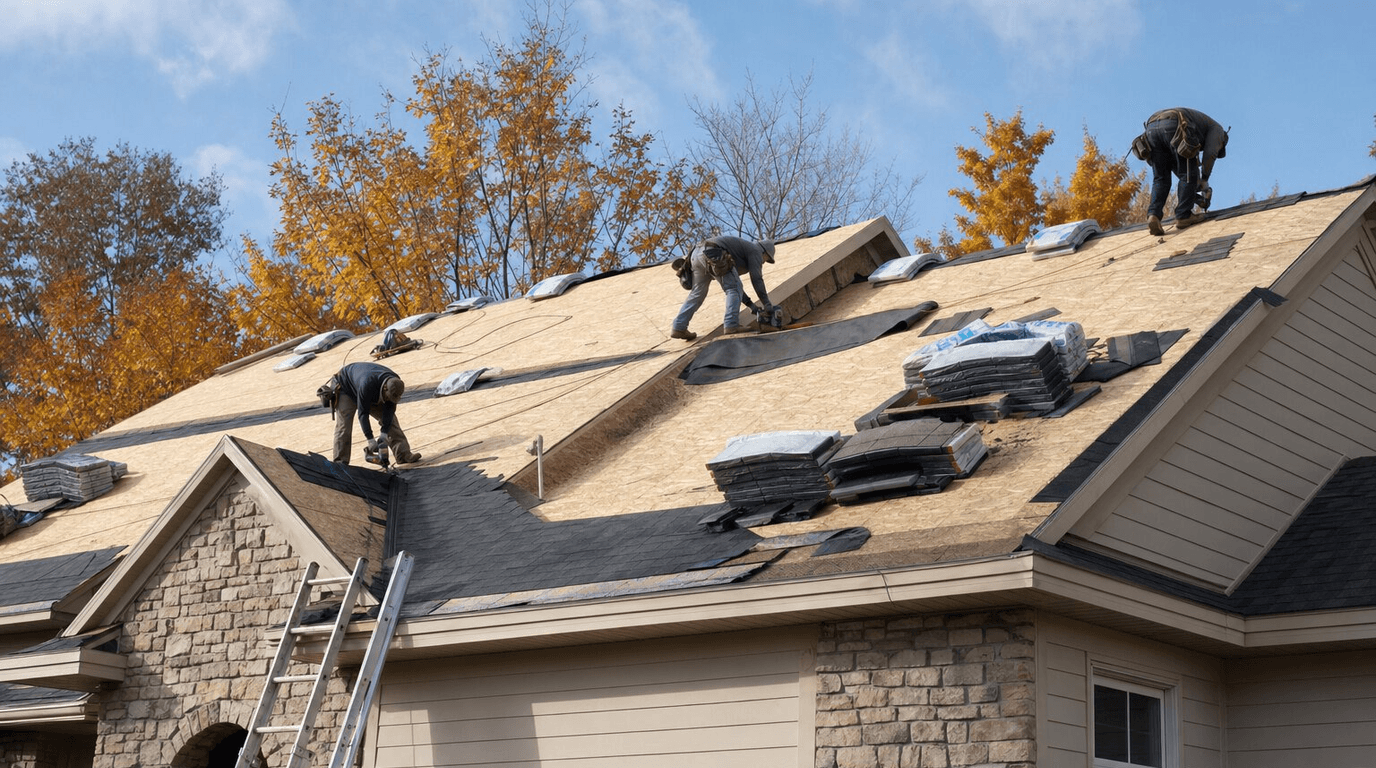
Installation happens in a single, continuous push whenever possible. We don't like to leave a roof partially open overnight. The crew removes the old material, inspects and addresses any decking issues, installs ice-and-water shield at the eaves and valleys, then lays new underlayment and shingles. Flashing gets replaced at every penetration point — not reused. New drip edge along the eaves and rakes. Ridge cap installed last.
The whole job on an average-sized Wisconsin home typically runs one to two days. After that, a full cleanup and a final walkthrough with you.
Ready to Get Your Replacement on the Calendar?
If your roof is due for replacement — or if you're not sure and want a straight answer — call Pierce Roofing at (920) 609-8304. We've been replacing roofs in Northeast Wisconsin for over 30 years. We're Atlas PRO+ Platinum certified, insured to $2 million, and we back every replacement with a 10-year workmanship warranty.
Fall books fast. The easiest way to make sure you get the timing right is to request a free estimate now, before the schedule fills up. We serve homeowners across Brown, Kewaunee, Oconto, Outagamie, Winnebago, and Manitowoc counties.