What Those Granules in Your Gutters Are Actually Telling You
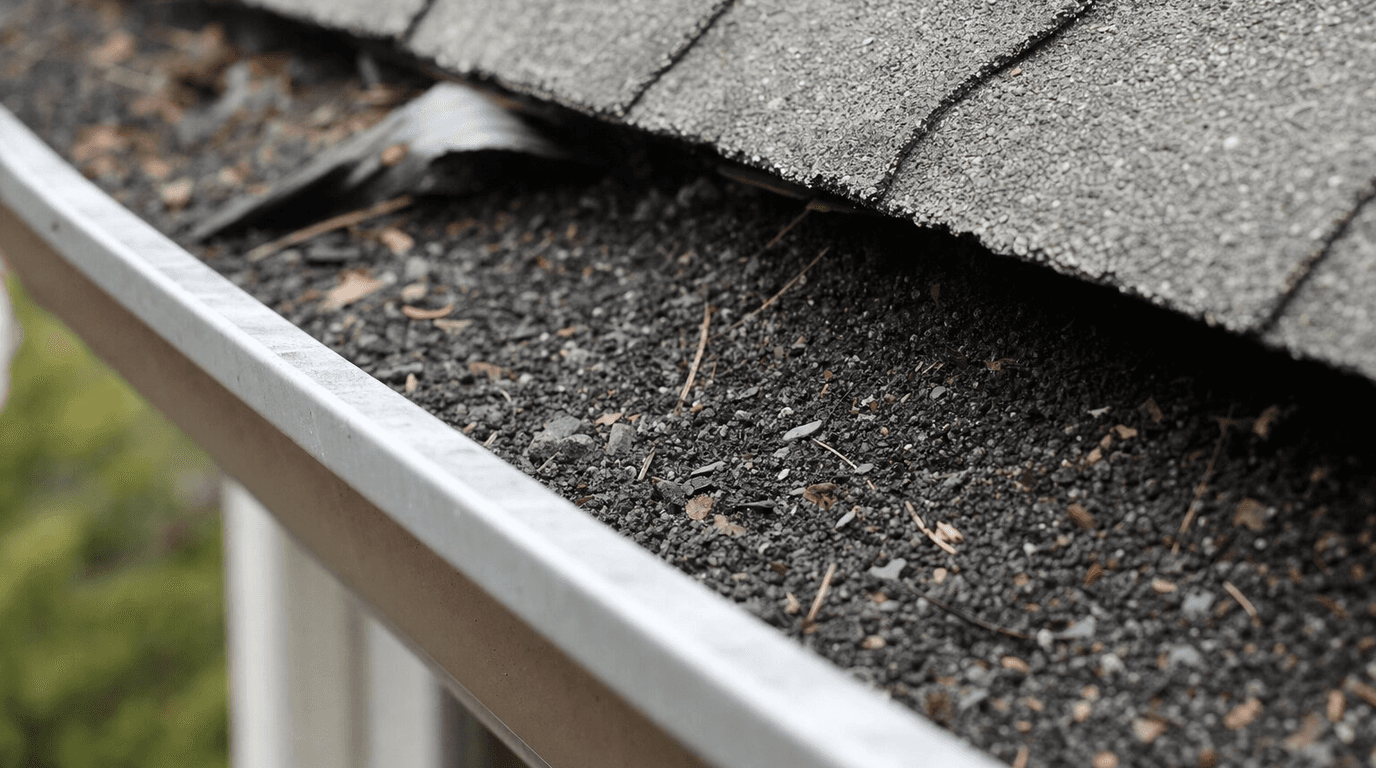
If you've ever cleaned your gutters and found a layer of gritty, sand-like material settled at the bottom — sometimes dark gray, sometimes rust-colored — you've seen asphalt shingle granule loss firsthand. Most homeowners scoop it out and move on without thinking much about it. That's understandable. It doesn't look alarming.
But granule loss in gutters is one of the clearest signals your roof gives you before the real problems start. Understanding what it means — and what it doesn't — can save you from either ignoring a legitimate warning sign or panicking over something normal.
Here's what's actually happening up there.
Why Asphalt Shingles Have Granules in the First Place
Granules aren't decorative. They're functional, and your asphalt shingle roofing system depends on them to work properly.
Asphalt shingles are built in layers: a fiberglass mat base, coated in asphalt, with a layer of ceramic or mineral granules pressed into the surface. Those granules do three things:
They block UV radiation. Direct sunlight degrades asphalt rapidly. The granule coating acts as a shield, slowing that breakdown and extending the shingle's lifespan by years. Remove the granules, and the asphalt underneath starts oxidizing and cracking almost immediately.
They shed water. The rough texture created by granules directs rainfall off the roof surface efficiently. Bare asphalt is much less effective at this — water sits longer, soaks in more, and causes more damage over time.
They add fire resistance. Many shingles use granules rated for Class A fire resistance. That matters for insurance purposes in Wisconsin, and it matters a lot in neighborhoods with close lot spacing.
Once those granules are gone from a section of shingles, the underlying asphalt is exposed. And exposed asphalt degrades fast — especially through Wisconsin's combination of summer UV and winter freeze-thaw cycling.
Normal Granule Loss vs. a Real Problem
Here's where it gets nuanced, and where most guides either oversimplify or scare you unnecessarily.
Some granule loss is completely normal.
Brand-new shingles actually shed a noticeable amount of granules in their first few rainstorms. Manufacturers embed more granules than the shingle needs, knowing that some will wash off during installation and the first weather events. If you've just had a new roof installed and you're seeing granules in your gutters, that's expected. It'll taper off.
Older shingles also shed some granules over time as part of normal aging. Finding a small amount in your gutters during seasonal cleaning isn't cause for alarm on a roof that's 10 to 15 years old.
What's not normal is significant, ongoing granule loss from a mature roof. If you're regularly scooping out large quantities — enough to fill a cup or more per downspout section — or if you can look at your shingles from the ground and see bare, shiny patches where the granule coating used to be, that's a different conversation.
What Causes Excessive Granule Loss?
Several things accelerate granule loss beyond the normal aging rate. Knowing the cause helps you understand how urgent the situation is.
Age and Manufacturer Lifespan
This is the most common cause. Asphalt shingles don't last forever. Standard 3-tab shingles typically run 15 to 20 years in our climate. Architectural (dimensional) shingles are rated for 25 to 30 years, though Northeast Wisconsin's weather tends to push real-world performance toward the lower end of those ranges.
As shingles age, the bond between the asphalt and the granules weakens. Granule loss accelerates in the final years of a shingle's service life — it's one of the clearest indicators that replacement is approaching. If your roof is past the 20-year mark and you're finding significant granule accumulation in your gutters, take it seriously.
Hail Damage
Hail is one of the fastest ways to knock granules off a shingle. A hailstorm doesn't have to leave visible dents on metal components to have damaged your shingles. The impact loosens the granule bond across a wide area, and you'll see the results in your gutters within the next few rainstorms.
Wisconsin gets meaningful hail events most years — particularly in spring and summer across Brown, Outagamie, and Winnebago counties. If you've had a notable storm and you're seeing more granule accumulation than usual afterward, the timing is not a coincidence. That warrants a professional inspection, not because the roof is necessarily failing, but because hail damage is often insurance-eligible and needs to be documented quickly.
Physical Damage and Foot Traffic
Walking on an asphalt shingle roof without knowing what you're doing dislodges granules. A lot of them. Every step on a soft-step shingle surface breaks the bond on dozens of granules. This is one of many reasons that DIY roof inspections should stay at the ladder-and-binoculars level — leaving the surface walking to professionals who know how to do it without causing new damage.
Branch impact from trees does the same thing. A limb dragging across your roof in a storm can abrade a significant swath of granules in a single event.
Improper Installation
This one's less common but worth mentioning. Shingles that were installed incorrectly — over-driven nails, wrong fastener placement, or improper overlap — are more prone to granule loss because the shingle isn't lying flat and is taking impact stress in ways it wasn't designed for. If a newer roof is losing granules faster than it should, installation quality is worth investigating.
How to Check Your Gutters for Granule Loss
You don't need to get on the roof to assess granule accumulation. In fact, you shouldn't need to.
During your next gutter cleaning, pay attention to what's in the channel. Normal leaf and dirt debris has a specific look and texture. Shingle granules look different — they're small, gritty, uniformly shaped, and often dark gray or mixed with flecks of color depending on your shingle type. They settle to the bottom of the gutter channel and downspout basin.
Scoop a small amount out and look at it. If it's clearly granular material in meaningful quantity — not just a trace amount mixed in with dirt — note where you found the most accumulation. Granules concentrate directly below problem areas. Heavy buildup near a specific valley or roof section tells you where to look closer.
Also do a ground-level visual inspection of your shingles. Look for:
- Sections that look shinier or darker than the surrounding area (bare asphalt)
- Uneven color patterns that suggest patchy granule loss
- Areas near ridges or valleys where the texture looks different from the field shingles
Binoculars help. A drone photo, if you have access to one, helps even more.
When Granule Loss Means Roof Replacement
Granule loss is a symptom, not a root cause. The question it's really answering is: how much life does this roof have left?
If your roof is under 10 years old and you're seeing significant granule loss, something specific happened — hail, a bad installation, or physical damage. Get an inspection to find out what, because the underlying issue needs to be addressed, not just observed.
If your roof is 15 to 20 years old and granule loss is accelerating — meaning you're finding more every year, and you can see bare patches from the ground — it's time to start planning for roof replacement. The shingles are telling you they're near the end of their service life. Waiting until active leaks develop just means you're adding interior damage costs on top of the roofing costs.
If your roof is 20-plus years old and you're finding granules regularly, don't wait for a second opinion. The economics almost always favor replacement at that point. Repairs on a roof that age tend to be throwing good money at a system that has one or two winters left in it regardless.
Getting an Inspection Before You Decide Anything
Here's the honest reality: granule accumulation in your gutters is a reason to get an expert assessment, not a reason to immediately sign a contract for a new roof. A good roofer will tell you where you actually stand.
A thorough roof inspection looks at granule retention across all roof sections, checks the condition of the asphalt surface where granules are sparse, evaluates the structural integrity of the shingles, and gives you an honest read on remaining service life. It should also look at your gutters, your flashing, and any other components that interact with your shingle system.
What it should not do is push you toward replacement before you actually need it. If your roof has meaningful life left — even three to five years — a good contractor will tell you that and recommend roof maintenance steps to protect what's there.
At Pierce Roofing, Michael Pierce has spent over 30 years in Northeast Wisconsin roofing. He's seen what age, hail, and Wisconsin winters actually do to different shingle systems, and he gives homeowners straight answers — not upsell pressure.
What Happens If You Ignore It
The math on ignored granule loss is not kind.
Once the granule coating is significantly depleted from a section of your roof, the exposed asphalt starts breaking down. First it gets brittle and starts to crack. Then the shingles curl and cup at the edges. Then water finds its way under the shingle surface. Then you're dealing with a leak — and in Wisconsin, a leak that freezes and thaws through the winter becomes something much worse fast.
The cost difference between catching granule loss early and addressing a roof that's been leaking for a season is substantial. Leak damage to decking, insulation, and interior ceilings can easily add $3,000 to $10,000 or more on top of what you'd pay for the roof replacement alone.
Granule loss in your gutters is the roof asking for attention before it needs emergency care. It's worth listening.
What Pierce Roofing Can Do for You
Pierce Roofing serves homeowners throughout Brown, Kewaunee, Oconto, Outagamie, Winnebago, and Manitowoc counties. We're Atlas PRO+ Platinum certified, carry $2 million in liability coverage, and back every installation with a 10-year workmanship warranty.
If you're finding granules in your gutters and want an honest read on what your roof actually needs, give us a call at (920) 609-8304. We'll do a thorough inspection and tell you exactly where you stand — whether that's a clean bill of health, a maintenance recommendation, or a conversation about planning for replacement before the next Wisconsin winter hits.
You can also request a free estimate online and we'll be in touch to schedule a time that works for you.