What Homeowner's Insurance Actually Covers for Roof Damage in Wisconsin
After a bad storm rolls through Green Bay or anywhere else in Northeast Wisconsin, the first question most homeowners ask isn't "how bad is the damage?" It's "will insurance cover this?"
That's the right question. But the answer is almost never a straight yes or no. Homeowner's insurance policies are written with conditions, exclusions, and definitions that vary from insurer to insurer — and Wisconsin homeowners get caught off guard by those details every time a significant weather event moves through the region.
This guide won't replace reading your actual policy. But it will give you a clear picture of how roof damage claims typically work in Wisconsin, what most standard policies cover, where coverage usually stops, and what you can do right now to protect your position before you ever need to file a claim.
The Basic Rule: Sudden and Accidental Damage Gets Covered
Most standard homeowner's insurance policies cover roof damage that is sudden, accidental, and caused by a covered peril. That language matters. "Sudden and accidental" is doing a lot of work in that sentence.
In practical terms, it means storm damage gets covered. Negligence and age-related wear don't.
The covered perils on a typical Wisconsin homeowner's policy include:
- Wind damage — including damage from straight-line winds, tornadoes, and severe thunderstorms
- Hail damage — one of the most common claims in Wisconsin and a source of significant roof damage
- Snow and ice — ice dams, ice load damage, and damage from a tree or structure collapsing under snow weight
- Falling objects — a tree limb punching through your roof during a storm
- Fire — including fire damage that reaches the roof structure
What doesn't get covered is the wear your roof accumulates over 20 years of Wisconsin winters. Missing granules from normal aging, shingles curling because they're past their lifespan, flashing that's slowly separating — those are maintenance issues, and your insurance company will point that out when they review your claim.
Wind Damage Coverage in Wisconsin
Wisconsin gets hit with some genuinely serious wind events, and wind damage to roofs is one of the most common claims filed across the state. A standard policy covers damage from wind — but there are a few things worth knowing.
First, most policies have a wind/hail deductible that's separate from your standard deductible. In Wisconsin, this is often a percentage of your home's insured value rather than a flat dollar amount. A 1% wind/hail deductible on a $300,000 home means you're paying the first $3,000 out of pocket on any wind or hail claim. That surprises a lot of homeowners who are expecting a $1,000 flat deductible.
Second, insurers will look at whether your roof was properly maintained before the wind event. If they can show that your shingles were already deteriorated and more susceptible to wind damage than a well-maintained roof would have been, they may use that to reduce the payout.
Third, partial roof replacement after wind damage can create headaches. If wind strips shingles from one side of your roof but leaves the other side intact, your insurer may cover only the damaged section — and matching the replacement shingles to the existing ones gets difficult as shingle lines are discontinued or colors shift over time.
For most wind claims, the documentation you do in the first 24 to 48 hours after a storm matters a lot. Photograph everything. Keep records.
Hail Damage Coverage: The Most Contested Claim Type
Hail is responsible for more roofing insurance disputes in Wisconsin than any other peril. The reason is that hail damage is often subtle, slow to show consequences, and genuinely hard for an untrained eye to distinguish from normal aging.
Insurance companies know this. Their adjusters are trained to look for signs that damage is storm-related versus age-related. You should understand what they're looking at.
Legitimate hail damage on a roof shows up as:
- Circular bruising or granule displacement on asphalt shingles, often with a soft, spongey feel at the impact point
- Dents on soft metal components: gutters, flashing, drip edge, ridge vents
- A pattern of damage consistent with storm trajectory (all impacts angled the same direction)
- Corroborating damage on other soft surfaces around the property — AC units, aluminum trim, painted wood
What helps your claim is having all of that documented before the adjuster arrives. What hurts your claim is a roof that was already at the end of its serviceable life — even if the hail was real, an insurer may argue that the pre-existing condition contributed to the damage.
One more thing: Wisconsin generally follows a claims window, meaning you're expected to report storm damage within a reasonable timeframe. Waiting a year after a hail event to file a claim is going to raise questions, even if the damage was real.
What Insurance Doesn't Cover (and Where Homeowners Get Surprised)
This is the section people should read first. Understanding what's excluded prevents the painful moment when you file a claim and get denied for reasons that were buried in your policy.
Normal wear and tear is excluded in virtually every standard policy. A roof that's 22 years old and failing isn't suffering sudden accidental damage — it's aging. If your roof was already at or past its expected lifespan when a storm hit, you may find that your insurer argues the storm only accelerated inevitable deterioration rather than causing new damage.
Lack of maintenance is another exclusion. Clogged gutters causing backed-up water that damages fascia and decking, unaddressed flashing leaks that rot the sheathing, moss and algae left to degrade shingles over years — all of these can be cited as evidence of neglect. Insurers aren't required to cover damage that proper maintenance would have prevented.
Cosmetic damage only may be excluded in some policies, particularly newer ones from certain insurers operating in hail-prone states. If hail left dents in your gutters and scuffing on your shingles but the roof can still function, some policies won't pay for replacement. Read your policy closely on this point, because this exclusion is becoming more common in Wisconsin.
Flooding is a hard stop. Standard homeowner's insurance does not cover roof damage caused by flooding or rising water. If your area floods and water enters through the roof structure as a result, that falls under flood insurance — a separate policy entirely.
Replacement Cost vs. Actual Cash Value: This Difference Matters
If you're going to remember one thing from this article, make it this.
Your policy pays roof claims one of two ways: Replacement Cost Value (RCV) or Actual Cash Value (ACV). Those two approaches can produce wildly different check amounts for the same damage.
Replacement Cost Value pays what it actually costs to replace your damaged roof with a comparable new roof at today's material and labor prices. If a storm destroys your 10-year-old roof and a new roof costs $18,000, RCV coverage pays toward that $18,000 (minus your deductible).
Actual Cash Value pays replacement cost minus depreciation. That same 10-year-old roof on an ACV policy might get valued at 50% of its replacement cost, depending on the depreciation schedule your insurer uses. You'd receive something closer to $9,000 — and you're responsible for the rest.
Many homeowners don't know which type of coverage they have until they're staring at an unexpectedly low settlement offer. Check your declarations page now, before you ever need to file a claim. If you have ACV coverage and your roof is aging, it may be worth upgrading.
How to File a Roof Damage Claim (Without Leaving Money on the Table)
The claims process matters as much as the coverage. Here's how to approach it.
Step 1: Document first, call second. Before you contact your insurer, photograph everything. The exterior roof surface from ground level, all gutters, all soft metal surfaces around the house, any interior water damage. More is better. These photos are your baseline.
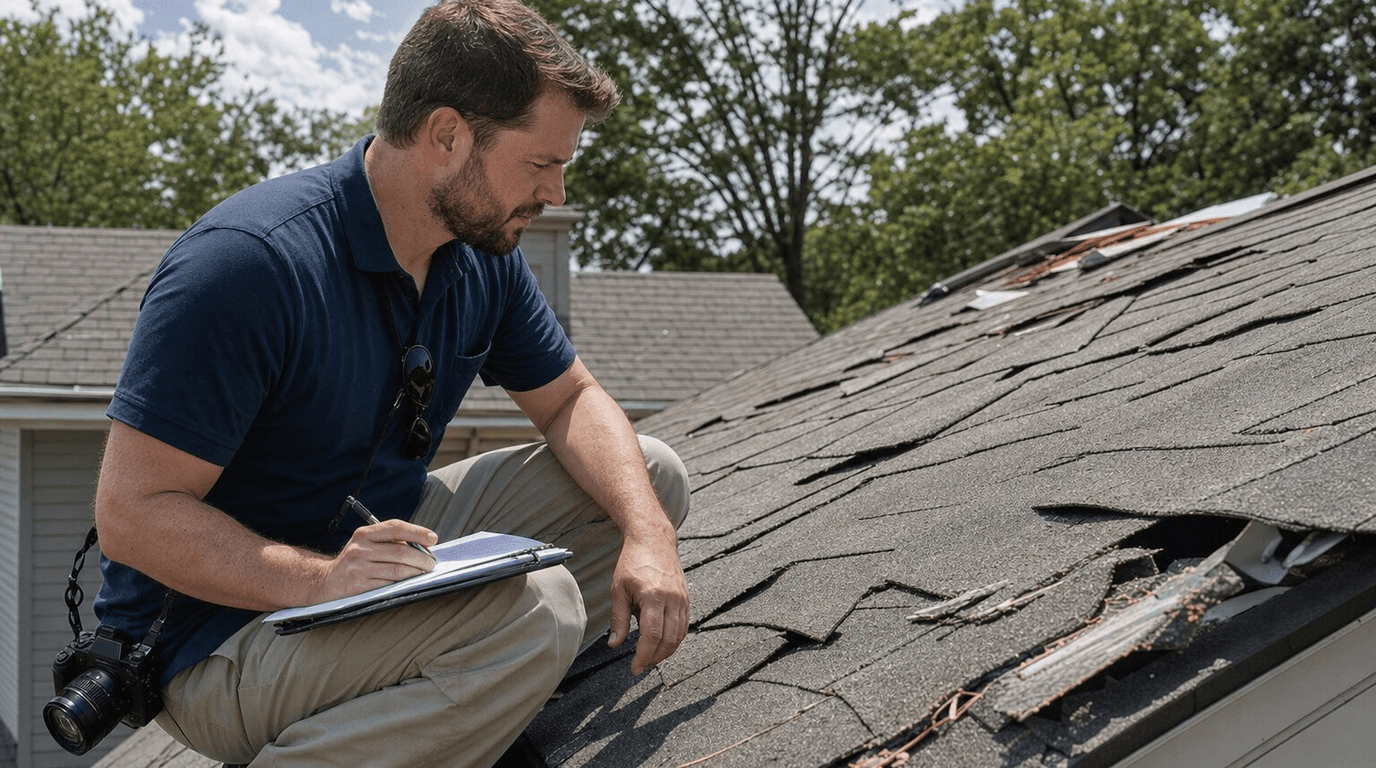
Step 2: Get an independent inspection. A professional roofing contractor who can identify storm-related damage and put it in writing gives you an independent assessment that you can use during the claims process. If the adjuster misses something or tries to attribute damage to aging rather than the storm, you have documentation that says otherwise.
Our storm damage inspection and repair process is built for this. We inspect the full roof system, identify every impact point, and give you a written assessment of what the storm did.
Step 3: File promptly. Report the damage to your insurer within a few days of the storm. Don't wait until you have everything figured out — you can always add documentation after you report. But delayed reporting creates questions about when the damage actually occurred.
Step 4: Be present when the adjuster comes. Walk the roof with them if possible, or have your contractor present. Adjusters are managing large claim volumes after a significant storm event, and having someone there who can point out damage methodically keeps the inspection thorough.
Step 5: Review the settlement offer carefully. If you think the offer is low, you can dispute it. Most policies have an appraisal clause that allows both sides to appoint an independent appraiser to resolve disagreements. That process can take time, but it's there specifically to prevent lowball settlements from standing.
When Insurance Doesn't Cover It: Knowing Your Options
Sometimes a full roof replacement isn't covered because the damage is wear-related, the roof was already past its useful life, or you simply don't have coverage for that type of event. That's a hard position to be in, but it's not hopeless.
A few things worth knowing:
If your roof is beyond its expected lifespan and your insurer is reducing or denying coverage on that basis, the reality is they may be right — and replacing the roof before the next storm is the better investment anyway. Wisconsin winters are not kind to aging roofs.
Financing options exist. A reputable local contractor can walk you through payment plans and financing that make a roof replacement manageable without the insurance payout.
If you're not sure whether damage is covered, get your contractor's written assessment before you file. Filing a claim and having it denied creates a claims history record that can affect your premiums even when nothing was paid out.
A Word About Storm Chasers and Insurance Claims
After a significant hail or wind event, out-of-state roofing contractors flood into Wisconsin. They knock on doors, offer free inspections, and sometimes offer to waive your deductible — which is insurance fraud, full stop.
Beyond the legal issue, the practical problem is that a contractor who blows in after a storm and leaves when the work is done has no stake in your community. If the roof leaks six months later, they're not returning your calls.
Michael Pierce and the Pierce Roofing team have been working in Brown, Kewaunee, Oconto, Outagamie, Winnebago, and Manitowoc counties for over 30 years. We're here before the storm and after it. We're Atlas PRO+ Platinum certified, carry $2 million in liability insurance, and back every job with a 10-year workmanship warranty. Those aren't marketing lines — they're the credentials that matter when an insurer is reviewing your claim and you need a contractor whose work will hold up.
Get a Professional Assessment Before You Guess
The single most common mistake Wisconsin homeowners make after storm damage isn't filing late or documenting poorly — it's assuming they know what their roof looks like from the ground. Real storm damage often isn't visible without getting on the roof and knowing what you're looking at.
If a storm has come through your area recently and you're not certain whether your roof took a hit, don't guess. Call us at (920) 609-8304 and we'll come out, walk the roof, and give you a straight answer. If there's damage worth claiming, we'll document it properly and help you through the process. If there's nothing to worry about, we'll tell you that too.
Ready to find out where you stand? Request a free estimate and we'll schedule an inspection at your convenience.