How Long Does a Roof Replacement Actually Take?
Most homeowners ask this question expecting a one-sentence answer. One to two days, right?
Sometimes. But it depends on factors that vary from job to job — roof size, pitch, the condition of the decking underneath, the material you're using, and whether Wisconsin decides to throw a week of rain at you mid-project.
The actual installation of a standard asphalt shingle roof on a typical ranch or two-story home in Green Bay usually takes one full day, occasionally two. But that's just the on-site work. The full process — from your first call to a roofer to the day you're done and the crew is gone — typically runs two to four weeks.
Here's how it actually breaks down.
The Full Roof Replacement Timeline, Start to Finish
Week 1: Estimate, Assessment, and Scheduling
Before anyone sets foot on your roof, the right contractor comes out to look at it.
A thorough estimate isn't something that happens in fifteen minutes from the driveway. A roofer who gives you a number without getting on the roof is guessing. The inspection should include measuring the roof area, checking the pitch and complexity of the layout, looking at the condition of the current shingles and flashing, and — if there are any signs of prior leaks — checking what's going on with the decking underneath.
At Pierce Roofing, we offer free roof inspections that include all of this. You get a written estimate with the scope of work, materials, and timeline spelled out before you decide anything.
Once you accept the estimate and sign the contract, materials get ordered and the job gets scheduled. In busy seasons — late spring through early fall — most crews are booked one to three weeks out. That's normal. A contractor who can show up tomorrow in the middle of peak roofing season is worth asking about.
Timeline at this stage: 3 to 10 days from first contact to signed contract, then 1 to 3 weeks to your scheduled start date.
Day 1: Tear-Off and Decking Inspection
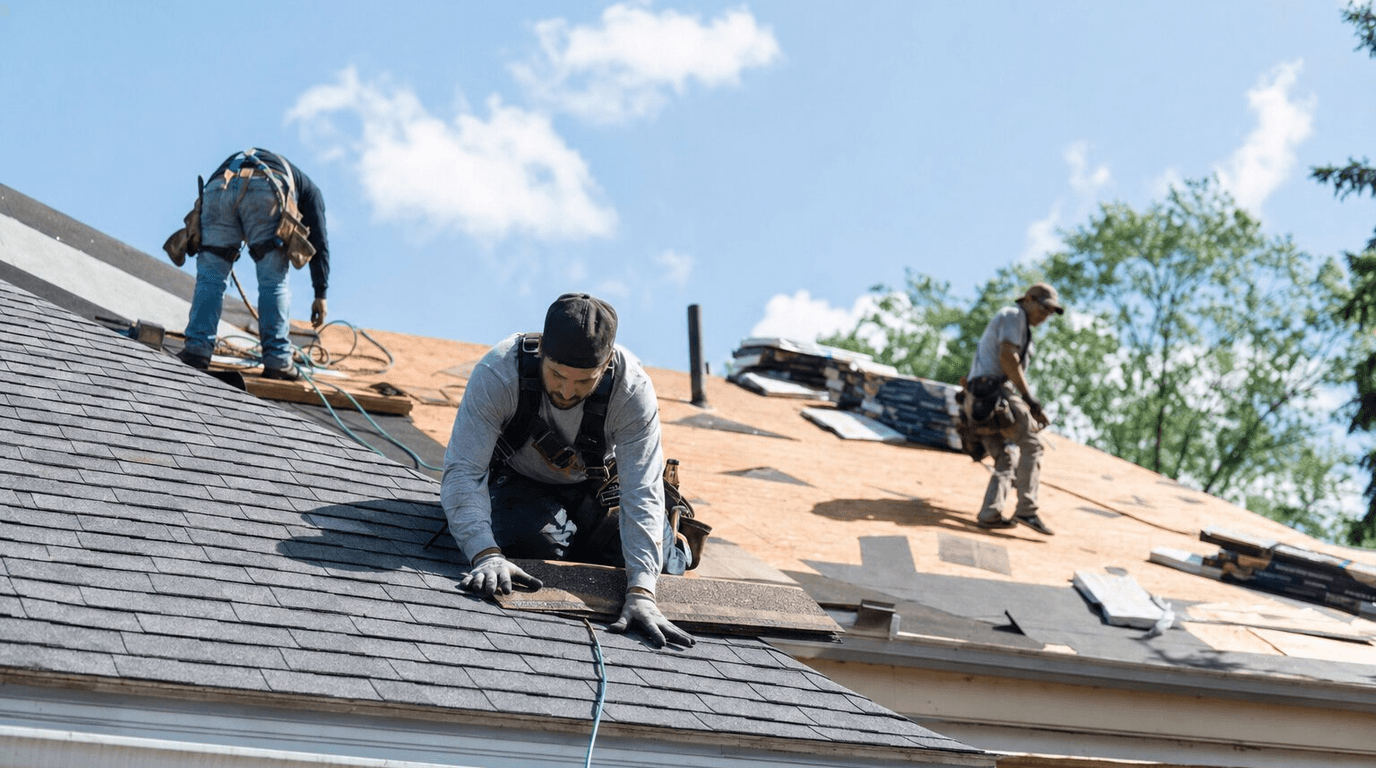
This is the day most homeowners think of when they picture a roof replacement. The crew arrives early — usually between 7 and 8 a.m. — sets up tarps to protect your landscaping and foundation plantings, and starts tearing off the old roofing.
Tear-off is loud. Plan for it.
On a typical residential roof, an experienced crew can strip the old shingles and underlayment in two to four hours. What happens next is the part that surprises a lot of homeowners: the decking inspection.
Once the old material is off, the decking is exposed. That's the wood sheathing that forms the structural base of your roof. On older homes especially, you'll sometimes find soft spots, rot, delaminated plywood, or sections of OSB that have absorbed enough moisture over the years to compromise them. None of that is visible with the old shingles in place.
If decking damage exists, it has to be replaced before anything new goes down. Skipping this step is how you end up with a 20-year shingle over a 5-year deck. A good contractor shows you what they find, explains what needs to come out, and adjusts the scope accordingly. This is also why reputable contracts include language about decking repair being billed separately at a per-sheet rate — it protects both parties when something unexpected turns up.
After decking is confirmed solid (or repaired), the crew installs the drip edge along the eaves, lays the ice and water shield — which in Wisconsin is non-negotiable along the first few feet of every eave and in every valley — and then rolls out the synthetic underlayment across the field of the roof.
By end of day, on a straightforward home, you typically have a fully dried-in roof. The old material is in the dumpster, the new protective layers are down, and your home is weathertight even before a single shingle goes on.
What you'll notice: noise, a dumpster in the driveway, workers moving fast. Plan to be home or have someone available in case questions come up about the decking.
Day 2: Shingle Installation
Day two — or the second half of day one on a smaller roof — is when it starts to look like a new roof.
Shingles go on in courses from the eaves up to the ridge. The crew works in sections, nailing each course with pattern and nail placement that follows manufacturer specifications. This matters more than it sounds. Atlas's Platinum Protection warranty requires specific nailing patterns and fastener placement. Deviate from the spec and you don't just risk a voided warranty — you risk shingles lifting in the kind of wind that comes off Green Bay in a November storm.
Flashing goes in around every penetration: pipe boots, chimney, skylights, any wall intersections. This is where a lot of inferior work shows up years later. Flashing done wrong is the number one source of roof leaks that develop a few years after a replacement. It's also the area you can't see well from the ground, which is exactly why cheap contractors cut corners there.
The ridge cap goes on last. A properly installed ridge cap with ventilation built into it — not just cap shingles over a solid deck — is part of what keeps your attic breathing correctly through Wisconsin winters.
For a standard 2,000 square foot home with moderate roof complexity, the shingle installation typically runs six to eight hours for a seasoned crew.
What you'll notice: it's quieter than tear-off, but there's still nail gun activity all day. By late afternoon, the roof should be largely complete.
Day 2 (Afternoon) or Day 3: Cleanup, Final Walk, and Inspection
A job isn't done when the last shingle is nailed. Cleanup is part of the work.
The crew should be running a magnetic roller (or equivalent) across your yard to pick up stray roofing nails. They should be clearing all debris from your gutters, sweeping the driveway, and removing the dumpster. Landscaping that was covered by tarps should be checked. Any marks on siding or trim from equipment contact should be noted.
After cleanup, your project manager or crew lead should do a final walk of the roof with you — or at minimum give you a full verbal rundown of what was done, what was found, and what the warranty terms are. You should receive paperwork documenting the materials installed, the warranties (both manufacturer and workmanship), and any permit sign-off.
Speaking of permits: in Green Bay and most Northeast Wisconsin municipalities, a roof replacement requires a building permit. A legitimate contractor pulls that permit before the job starts and handles any required inspection afterward. If your contractor skipped this step, it can create issues when you sell the home. This is one of the things we walk through in detail on our Our Process page.
Timeline at this stage: by end of day 2 or morning of day 3, the job is done and the crew is out.
What Can Make a Roof Replacement Take Longer?
The one-to-two-day install timeline is realistic for a straightforward job. But several things can extend it.
Weather. Wisconsin doesn't cooperate on command. Shingles can't be installed in rain or on wet decking — the adhesive strips won't seat properly, and you risk trapping moisture under the material. A crew that starts a tear-off and gets rained out mid-job will typically tarp the roof and return the next dry day. This is the right call, not a problem. Any contractor willing to push through rain to stay on schedule is taking shortcuts you'll pay for later.
Significant decking damage. If a large portion of the decking needs replacement, that's a half day of additional framing and sheathing work before the waterproofing layers even go down. On older homes — especially anything built before 1980 in neighborhoods like Green Bay's west side — decking surprises aren't unusual.
Roof complexity. A simple gable roof on a ranch home is fast. A roof with multiple dormers, steep pitch sections, skylights, and a chimney is not. More penetrations mean more flashing details. More angles mean more cutting and fitting. A complex roof can easily take twice as long as a simple one of the same square footage.
Material type. Asphalt shingles install fastest. Metal roofing — especially standing seam — takes longer because panels have to be cut and seamed precisely. If you're looking at a metal roof replacement, budget for a two-to-four-day installation depending on size and complexity. The trade-off is a product that routinely lasts 40 to 70 years in this climate.
A Quick Reference Timeline
- Days 1-7: Inspection, estimate, contract signed
- Days 7-21: Materials ordered, job scheduled
- Installation Day 1: Tear-off, decking inspection and repair, ice/water shield, underlayment
- Installation Day 2: Shingles, flashing, ridge cap
- End of Day 2 / Day 3: Cleanup, final walk, permit inspection
- Days 3-7 post-installation: Permit closed out, warranty documentation delivered
For most homeowners in Brown, Outagamie, or Winnebago County, the full process from first call to final paperwork runs two to four weeks. The actual disruption to your daily life is one to two days.
Timing Your Roof Replacement in Wisconsin
If you have the luxury of planning ahead rather than reacting to storm damage, late summer through early fall is the best window for a roof replacement in Northeast Wisconsin.
Shingle manufacturers specify a temperature range for installation — most asphalt shingles need temperatures above 40°F for the sealant strips to activate properly. September in Green Bay usually cooperates. October is workable but you're starting to push it. November through March is possible but comes with weather risk and more scheduling complexity.
Spring is often busy for contractors catching up from winter damage. Summer books up fast in a good storm year. If you're planning a replacement and want the best shot at your preferred schedule, getting an estimate in May or June and booking for August or September is a smart move.
That said — if your roof is actively leaking or was damaged in a recent storm, don't wait for optimal weather. Get it inspected now. A roof replacement in Green Bay should happen on your timeline, not weather's ideal schedule.
What to Do While the Work Is Happening
A few practical things that make the day go more smoothly:
Move vehicles out of the driveway before the crew arrives — they'll need the space for equipment and the dumpster. If you have a detached garage, plan to park away from the house during the day since vibration from nail guns can knock items off garage shelving.
Let your neighbors know. It's a loud day. A quick heads-up goes a long way.
Keep pets inside. Roofing crews move fast and your fence doesn't account for a gate that gets left open by a materials delivery.
Plan to be reachable by phone. Decking decisions usually need a quick answer, and you don't want the crew sitting idle because they couldn't reach you to approve a $200 repair.
Ready to Get Started?
If your roof is due for replacement — or you're just not sure where it stands — the first step is an honest inspection. Michael Pierce has been doing this in Northeast Wisconsin for over 30 years. We hold Atlas PRO+ Platinum certification, carry $2 million in liability coverage, and back every installation with a 10-year workmanship warranty. We pull every permit and hand you the paperwork.
Call us at (920) 609-8304 or request a free estimate online. We'll get on the roof, tell you exactly what we find, and give you a straight answer about what it needs — and how long it'll take to get it done right.