Wisconsin winters don't care about your roof. We get freeze-thaw cycles that can run through a dozen iterations in a single week, ice dams that back water up under shingles, and wind-driven snow that finds every gap it can. If your roof was installed without proper ice and water shield — or with a bargain-brand product — you may already have moisture working its way into your roof deck without knowing it.
This post covers what ice and water shield actually is, where it belongs on a Wisconsin roof, what happens when it's skipped, and how to know whether your existing roof has it.
What Is Ice and Water Shield?
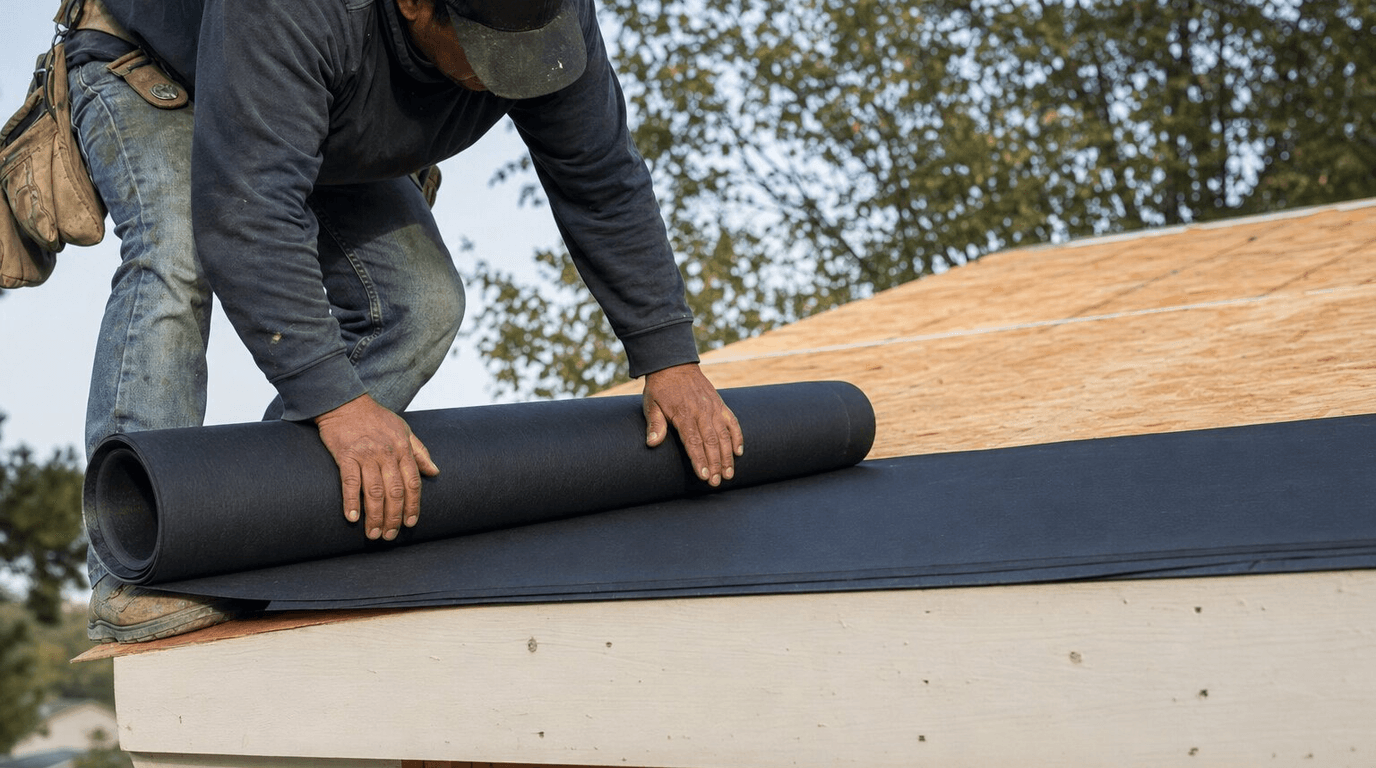
Ice and water shield (sometimes called ice and water barrier or simply "self-adhering underlayment") is a rubberized asphalt membrane that bonds directly to your roof deck. Unlike standard felt or synthetic underlayments, it's self-sealing — meaning if a nail punctures it, the membrane closes around the fastener and prevents water from sneaking through.
It's installed beneath your shingles, not on top of them. So it's never visible once the roof is finished. But it's working constantly.
The two things it protects against are the two biggest winter threats in Northeast Wisconsin: ice dams and wind-driven rain.
Ice Dams: The Specific Problem Ice and Water Shield Solves
An ice dam forms when heat escaping from your living space warms the middle of your roof, melting snow. That meltwater runs down toward the cold eaves, refreezes, and builds up a ridge of ice. Once that ridge is thick enough, water starts pooling behind it — and pooled water will find its way under shingles, through nail holes, and eventually into your attic or walls.
Shingles alone can't stop this. They're designed to shed moving water, not handle standing water forced upward by hydrostatic pressure. Ice and water shield is the layer that actually prevents that backed-up water from reaching your roof deck.
Our guide on ice dams and prevention in Green Bay goes deeper on the full picture — but the short version is that ice and water shield is your last line of defense once an ice dam has already formed.
Where Does It Go on the Roof?
This is where a lot of budget contractors cut corners, so it's worth understanding the code minimums versus what actually protects a Wisconsin home.
Code Minimum
Wisconsin follows the International Residential Code, which requires ice and water shield to extend from the eave edge up to a point at least 24 inches inside the interior wall line. In practical terms, that's usually the first 3 to 6 feet of the roof, depending on your roof pitch and overhang.
That's the minimum. It's not always enough.
What We Actually Install
On most roof installations in Green Bay and the surrounding counties, Pierce Roofing runs ice and water shield in four places:
- The full eave zone — at minimum 3 to 6 feet from the drip edge, more on low-slope sections
- All valleys — where two roof planes meet is where water concentrates, and standard underlayment there is not adequate in a Wisconsin winter
- Around all penetrations — chimneys, skylights, pipe boots, dormer intersections
- Rakes on wind-exposed sides — wind-driven snow and rain regularly work up the rake edge on homes in open areas
Skipping valley coverage, in particular, is something we see on a lot of re-roofing jobs where the previous contractor did the bare minimum. Valleys are the single most common source of leak calls in our service area.
Does Your Current Roof Have It?
If your home was built before the mid-1990s and has never had a full roof replacement, there's a decent chance it has no ice and water shield at all. The product existed but wasn't widely used or required. If it was replaced in the 2000s by a lower-cost contractor, it may have the eave coverage but nothing in the valleys.
You can't see it from the ground and you can't see it from inside your attic — it's sandwiched between the deck and the shingles. The only reliable way to know is to have someone who knows what they're looking at do a free roof inspection and review the installation records if they exist.
Signs that you may be lacking adequate ice and water protection:
- Water stains on attic sheathing near the eaves or valleys after winter weather
- Interior ceiling stains that appear in late January or February (classic ice dam timing)
- A roof that was installed by the lowest bidder with a very fast turnaround
- Shingles that have lifted or curled at the eave edge
Not All Ice and Water Shield Is the Same
This part gets glossed over in most articles. The product category is "ice and water shield" but there's a wide range in quality, thickness, and performance.
Granulated surface products work better under metal and in high-heat climates. Smooth products bond better to each other when overlapped. High-temperature formulations are designed for steep-slope sections that get intense summer sun. Cold-weather variants stay flexible during installation in near-freezing temps — which matters a lot here, since we're often installing in March and April when it's still cold.
At Pierce Roofing, we're Atlas PRO+ Platinum certified, which means we use Atlas products that are spec'd for the actual conditions of a Wisconsin install — not just whatever's cheapest at the supply house that week.
What Happens Without It
Let's be direct about this: the consequences of inadequate ice and water protection are not hypothetical in Northeast Wisconsin. They happen every winter.
A roof deck that has absorbed moisture will delaminate, rot, and lose its fastener-holding ability. Mold can develop in attic spaces within weeks of a water intrusion event. Once water gets through the deck, it can track horizontally and appear on a ceiling far from the actual breach — which makes it harder to diagnose and fix.
The repairs are expensive. We've seen full decking replacements required because of preventable ice dam leaks. The cost of doing the ice and water shield right during a roof replacement is a fraction of what remediation costs after the fact.
Ice and Water Shield and Your Roof Warranty
This matters if you're dealing with manufacturer warranty claims. Atlas Roofing, for example, specifies minimum underlayment requirements for warranty coverage. If your roof was installed without meeting those specs — no matter who installed it — you may find a claim denied.
When we install asphalt shingle roofing, we document what goes on the roof: underlayment type, ice and water shield coverage, shingle lot numbers, and installation photos. That documentation protects you if you ever need to file a warranty claim. A lot of homeowners don't find out their previous contractor skipped required components until they're standing in an adjuster's office.
Common Questions We Hear
Does ice and water shield replace underlayment?
No. It works alongside standard underlayment. Ice and water shield goes in the high-risk zones (eaves, valleys, penetrations) and the rest of the roof deck gets covered with standard synthetic or felt underlayment before shingles are installed.
Can ice and water shield be installed over an existing roof?
Generally no, and most manufacturers won't warrant it in that configuration. It needs a clean, flat substrate to bond correctly. This is one more reason why a proper tear-off and re-deck (when needed) matters — you can't cut this corner and get the same result.
What about metal roofing?
Yes, metal roofing installations also require ice and water shield in Wisconsin — particularly at the eaves and any penetrations. The thermal expansion and contraction of metal panels can create movement at fastener points, and ice and water shield provides the redundant seal there.
How long does it last?
High-quality ice and water shield is rated to last as long as the shingles above it — typically 25 to 50 years depending on the product. It's not something you replace independently; it gets replaced when the roof system gets replaced.
The Bottom Line for Wisconsin Homeowners
If someone bids your roof replacement and doesn't mention ice and water shield — or tells you it's not needed, or only covers the minimum code strip — ask questions. In Green Bay, Brown County, and the rest of Northeast Wisconsin, this material isn't an upgrade. It's baseline protection against conditions we deal with every year.
See our roof maintenance guide for more on what to watch for between full replacements, especially heading into late winter when ice dam season peaks.
Ready to Know What's Actually on Your Roof?
Pierce Roofing offers free roof inspections across all six counties we serve — Brown, Kewaunee, Oconto, Outagamie, Winnebago, and Manitowoc. We'll tell you exactly what underlayment and ice and water shield coverage is in place, what's missing, and what it would take to bring your roof up to standard.
Call us at (920) 609-8304 or schedule your free inspection online. No pressure, no upsell — just a straight answer about what's protecting your home.