The Hidden Factor That Determines How Long Your Roof Actually Lasts
If you ask most homeowners what affects their roof's lifespan, you'll hear the usual answers: shingle quality, installer skill, storm damage. Those things matter. But there's a factor that gets almost no attention at the point of sale, and it quietly determines whether your new roof makes it to 30 years or fails at 17. That factor is attic ventilation.
Proper attic ventilation and roof lifespan are directly connected in ways that most people don't fully appreciate until they're staring at a roof that aged wrong. In Northeast Wisconsin's climate (real winters, real summers, freeze-thaw cycles that repeat dozens of times between October and April), an attic that can't breathe is an attic that slowly and expensively destroys the roof above it.
This post breaks down exactly how that happens and what you can do about it.
What Attic Ventilation Is Actually Supposed to Do
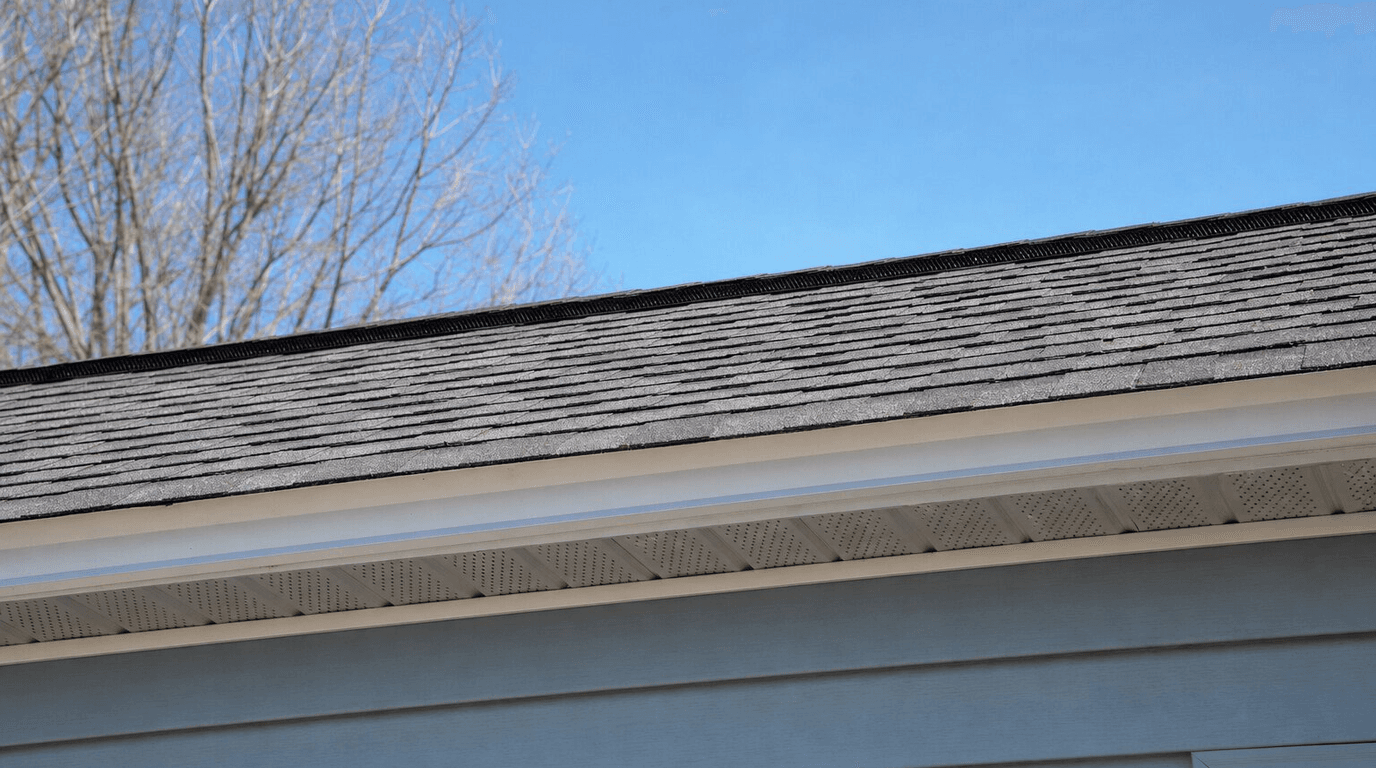
A functioning attic ventilation system has one straightforward job: move air continuously through the attic space. Outside air enters through intake vents at the soffits (the underside of your roof overhang), travels across the underside of the roof deck, and exits through exhaust vents at or near the ridge. That's it.
But that simple airflow does three distinct things that matter enormously to your roof:
Winter: It keeps the deck cold. When heat from your living space sneaks into the attic, it warms the underside of the roof deck unevenly. Snow on the warmer sections melts, the water runs to the cold eaves, and refreezes into ice dams. Proper ventilation flushes that warm air out before it can do damage.
Summer: It exhausts the heat. An unventilated attic in July can reach 150 to 160 degrees Fahrenheit. That heat attacks your shingles from below while the sun attacks them from above. It's a compounding assault that breaks down the asphalt binders in your shingles years ahead of schedule.
Year-round: It controls moisture. Humid air from your living space constantly migrates upward. Without airflow to carry it out, that moisture condenses on cold wood surfaces: your rafters, your decking, your insulation. Over a Wisconsin winter, the buildup becomes visible frost. Over several winters, it becomes rot.
When one of these three functions breaks down, the others usually follow. A ventilation failure is rarely a single isolated problem.
How Ventilation Problems Shorten Roof Life in Wisconsin
The specific damage mechanisms are worth understanding, because they change how you think about what a roof costs over time.
Heat Degradation of Shingles
Asphalt shingles are manufactured to last a certain number of years under standard testing conditions. Those conditions assume a ventilated attic maintaining reasonable temperatures beneath the deck. When you remove that assumption and replace it with a 150-degree attic, you change the performance math entirely.
Heat accelerates the oxidation of the asphalt binders that hold the granules in place and give the shingle its flexibility. As those binders break down, shingles become brittle, lose granules, and start to curl or cup at the edges. A 30-year shingle in an overheated attic may behave like a 20-year shingle in practical terms, or worse.
You can sometimes see this directly. Check your gutters after a heavy rain. If you're finding heavy granule deposits in a roof that's less than 15 years old, heat stress from poor ventilation is a likely cause. South-facing slopes, which take the most direct sun, usually show the damage first.
Ice Dams: The Winter Amplifier
If you've dealt with ice dams in Green Bay, you already know the surface-level problem: ice builds at the eaves, water backs up under shingles, ceilings stain, sometimes drywall gets soaked. The repair bills range from manageable to serious depending on how bad and how long the backup was.
What most people don't realize is that ice dams are partly a ventilation problem. Heat escaping from the living space into a poorly ventilated attic is what creates the uneven roof deck temperature that allows selective snowmelt and refreezing. Fix the ventilation (and insulation, which works alongside it), and ice dams become far less frequent or stop entirely.
Left unaddressed, ice dams are one of the more efficient ways to damage a roof structure. Water that infiltrates past lifted shingles doesn't stop at the shingle layer. It gets into the decking, the insulation, the framing, and eventually your ceiling. The cumulative damage from repeated ice dams over 10 winters can make a roof replacement necessary years before it otherwise would be.
Moisture Rot in the Decking
This is the quiet one. You won't see it from the street, and you often won't notice it until someone gets on the roof.
When attic moisture condenses repeatedly on the roof sheathing, the wood absorbs water and releases it over and over through the seasons. That cycling weakens the wood's structural integrity. Eventually you get soft spots: areas where the sheathing has lost enough strength that it no longer holds fasteners reliably. At that point you're replacing decking along with the shingles, which adds significant cost to what might have been a straightforward job.
In a climate like Brown County's, where attic moisture exposure is high and winters are long, this process can move faster than homeowners expect. It's one of the reasons we always inspect decking condition during our free roof inspections rather than assuming the existing substrate is sound.
What "Proper Attic Ventilation" Actually Means
There's a lot of imprecise language around this topic. "Good ventilation" gets used to mean all kinds of things. Here's the practical standard for a Green Bay home:
The industry standard is 1 square foot of net free ventilation area for every 150 square feet of attic floor space, with that ventilation split roughly evenly between intake (soffit) and exhaust (ridge or near the peak). In practice, this usually means a continuous ridge vent running the length of the peak, paired with continuous soffit vents on both sides of the roof.
The intake-to-exhaust balance matters more than most people realize. A system with too much exhaust and too little intake will pull air in through gaps in the roof structure rather than through the designed intake path. That creates negative pressure in the attic and can draw conditioned air out of the house. Balanced systems work with the way air naturally wants to move.
Some attic configurations (low-slope sections, complex rooflines, finished attic spaces) require different approaches. There's no universal one-size answer for every home, which is why a real inspection beats any generalized rule of thumb.
The Energy Efficiency Connection
Attic ventilation is one of the most underrated home energy factors. In summer, a properly ventilated attic dramatically reduces the heat load on your cooling system. Instead of 150-degree air radiating through your ceiling into the upstairs bedrooms, you have air closer to ambient temperature that the attic exhausts passively. That difference shows up in electricity bills.
In winter, proper ventilation works alongside insulation to keep your heating costs in check. An attic where moisture has compressed or saturated the insulation has less effective R-value. It doesn't insulate as well as it should, which means more heat escaping from your living space, which costs you more to replace.
If you've been exploring energy-efficient roofing options, a ventilation assessment should be part of that conversation. New shingles with better reflective performance won't hit their projected efficiency gains if the system underneath them isn't performing. The roof has to work as a system, not a collection of independent parts.
Common Attic Ventilation Problems in Northeast Wisconsin Homes
In 29 years of working on roofs across Brown, Kewaunee, Oconto, Outagamie, Winnebago, and Manitowoc counties, we've seen the same ventilation failures come up again and again.
Blocked soffit vents. This is the most common problem, and one of the easiest to miss. Insulation pushed against the eaves during a previous attic insulation job cuts off airflow at the intake. The rest of the ventilation system may be fine, but without intake air, it stalls. The fix is adding attic baffles to maintain a clear channel between the insulation and the roof deck. It's not complicated, but it has to be done.
No ridge vent at all. Older homes in Green Bay and throughout Northeast Wisconsin were built before continuous ridge ventilation became standard. They may have a few box vents or a turbine vent near the peak, which is far less effective. The ridge is where exhaust should happen because hot air rises there naturally. Fighting that physics instead of working with it is inefficient.
Bathroom or kitchen fans venting into the attic. This one causes significant moisture damage and it's surprisingly common. Exhaust fans are supposed to route humid air to the exterior, not dump it into the attic space. When they terminate in the attic, all that moisture from showers and cooking goes directly where it will do the most harm.
Improperly balanced systems. More exhaust than intake, or intake concentrated in one area of the attic while another section has none. These imbalances create dead zones where air doesn't move and moisture accumulates.
What Good Roof Maintenance Includes
Proper attic ventilation is one component of a broader roof maintenance approach that extends the service life of your roof. The others (keeping gutters clear, addressing flashing issues early, catching shingle damage before it opens the deck to water) all matter. But ventilation is unique because it operates invisibly and continuously, affecting your roof every single day rather than only during storms.
A home with properly maintained gutters, well-functioning flashing, and quality shingles but inadequate attic ventilation will still fail prematurely. A home with a balanced ventilation system and attentive maintenance will consistently outperform its warranty expectations. That's not a small difference in real money.
The math: if poor ventilation takes 10 years off a roof that should last 30, and a roof replacement in Northeast Wisconsin costs $15,000 to $25,000 depending on the home, that's a loss of $5,000 to $8,000 in prematurely consumed roof life. Addressing the ventilation on the front end, or at the time of replacement, is a fraction of that cost.
When to Have Your Ventilation Assessed
Some situations call for an immediate look. If you're seeing any of these, don't wait:
- Ice dams every winter, rather than only in exceptional years
- Shingles on a roof less than 20 years old that are curling, cupping, or losing granules heavily
- Visible frost or moisture staining on attic framing in winter
- Upstairs rooms that are significantly hotter than the rest of the house in summer
- Any mold or mildew smell in the attic space
- A roof that was installed without anyone discussing ventilation with you
Beyond those specific triggers, it's worth having your attic ventilation evaluated any time you're considering a roof replacement. Getting new shingles installed over a system with chronic ventilation problems is a common and costly mistake. The new shingles won't fix what's happening underneath, and you'll get fewer years out of a new roof than you should.
Pierce Roofing's Approach to Ventilation
When Michael Pierce's crew gets on your roof for an inspection, ventilation is part of what we look at, not an add-on or an upsell opportunity. We check the intake-to-exhaust ratio, confirm that soffit vents are unobstructed, look at what exhaust system is in place, and assess whether the attic geometry is being served by the current setup.
If there's a problem, we explain what it is and what it takes to correct it. If the ventilation is fine, we tell you that too. The goal is an accurate picture of your roof system, not a reason to sell you something.
Michael has been working on roofs in Green Bay and across Northeast Wisconsin for 29 years. The team is Atlas PRO+ Platinum certified, carries $2 million in liability insurance, and backs every installation with a 10-year workmanship warranty. When we say a ventilation system is balanced and correct, that assessment comes from 29 years of seeing what works in this climate.
Get a Real Answer About Your Attic Ventilation
If you're not sure whether your attic ventilation is adequate, or if you already suspect it isn't, the right move is a professional inspection: an actual set of experienced eyes on your specific roof and attic rather than a Google search.
We offer free roof inspections to homeowners throughout Brown, Kewaunee, Oconto, Outagamie, Winnebago, and Manitowoc counties. There's no obligation and no pressure. We come out, we look at your roof system the way it should be looked at, and we give you an honest assessment.
Call us at (920) 609-8304 or request a free estimate online. If attic ventilation is shortening your roof's lifespan, the sooner you know, the more options you have.