What Clogged Gutters Actually Do to Your Home
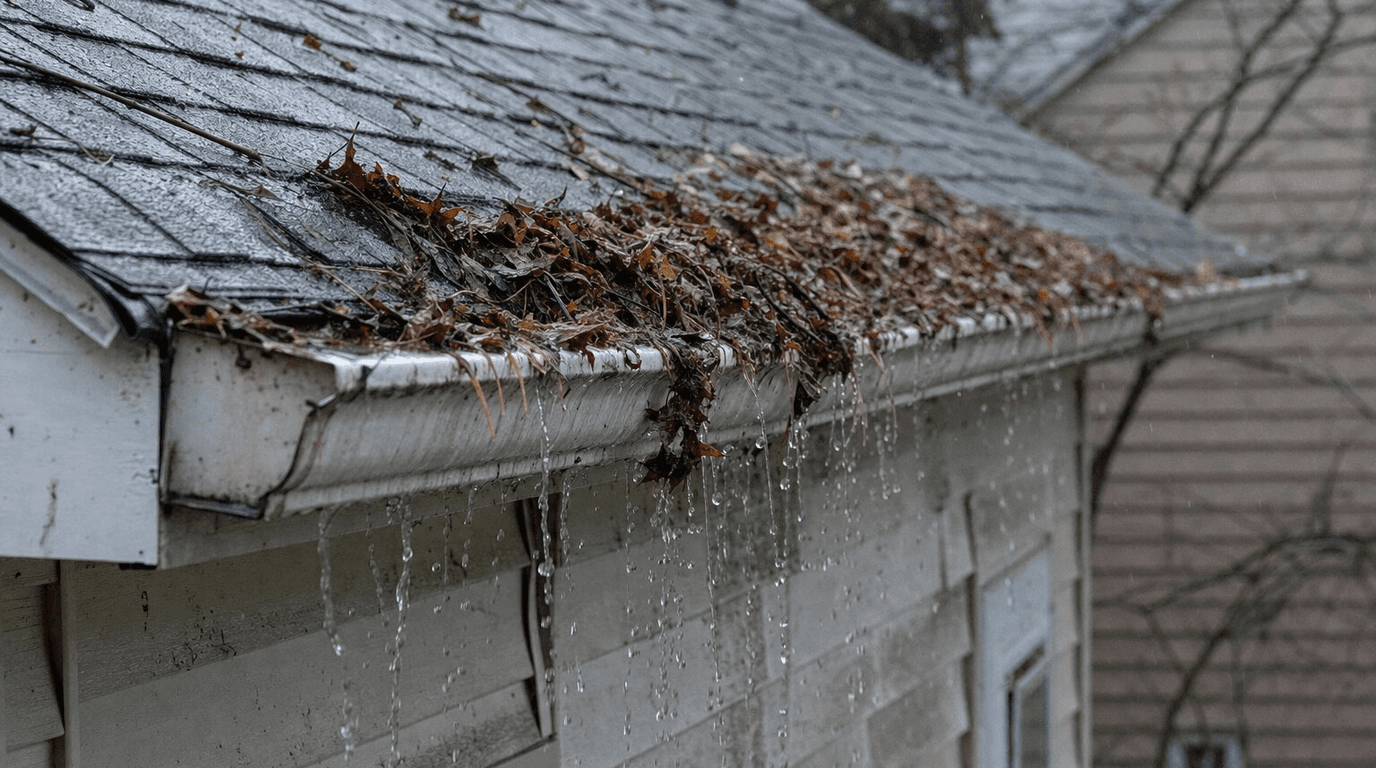
Gutters have one job: move water away from your house. When they're full of leaves, shingle grit, and compacted debris, that job doesn't get done. The water backs up, pools, overflows, and then finds somewhere else to go — and none of those somewhere elses are good.
The damage from clogged gutters doesn't announce itself. There's no alarm that goes off. Instead, you get rot in the fascia board you can't see from the ground, water working its way under the shingles along your eaves, and moisture collecting against your foundation for months before anything inside the house looks wrong. By then, the repair bills are already stacked up.
This is one of those problems that's genuinely easy to prevent and genuinely expensive to ignore.
The Roof Takes the First Hit
Most people assume clogged gutters are a drainage problem. They are — but the damage starts at the roofline, not the ground.
When a gutter fills up and water can't move through it, that standing water sits against the lowest edge of your roof. In a Wisconsin summer, it sits there every time it rains. Over time, it saturates the fascia board the gutter is mounted to, seeps under the starter course of shingles, and begins rotting the roof deck underneath.
This is the part of the roof that's hardest to see and hardest to repair once it goes. Replacing a rotted section of decking isn't a simple patch — it means pulling shingles, cutting out damaged wood, installing new sheathing, and re-roofing that section. What started as a clogged gutter becomes a roofing project.
There's also the ice dam problem, which matters a lot in Northeast Wisconsin. Our winters are long enough that debris-filled gutters going into October are setting homeowners up for trouble by January. Clogged gutters prevent proper drainage during freeze-thaw cycles — ice builds up, backs water under the shingles, and the damage moves from the eaves toward the interior of the house. We've written about how ice dams form and how to prevent them in more detail, and gutters are a big part of that conversation.
If your gutters are pulling away from the fascia, sagging, or visibly overflowing during rain, the roofline damage may already be underway. Gutter repair done early is almost always cheaper than what comes after.
Then the Fascia and Soffit Go
Fascia boards run along the edge of your roofline and support the gutters. Soffits are the horizontal panels underneath the eaves. Both are made of wood on most older homes — and wood and standing water are a bad combination.
When gutters overflow or sit full of water, the fascia directly behind them absorbs moisture continuously. The paint peels first. Then the wood softens. Then it rots. Rotted fascia can't hold gutters properly, so the gutters start to pull away — which makes the overflow worse, which accelerates the rot. It's a self-reinforcing cycle once it gets going.
Soffits get it from the splash-back below and from moisture migrating through the fascia above. Once soffit rot sets in, you're also dealing with potential entry points for insects and small animals looking for a way into the attic. That's a separate problem entirely.
Replacing fascia and soffit isn't catastrophically expensive on its own. But it's usually not done in isolation — it tends to come with gutter replacement and sometimes shingle repair at the eaves. The total adds up fast.
How Full Gutters Damage Your Foundation
This is the one that surprises most homeowners. The connection between gutters and foundation damage feels indirect — but it's not.
When downspouts are clogged or gutters are overflowing, water pours off the edge of your roofline and lands in a concentrated band right next to your house. We're talking about hundreds of gallons during a single rainstorm hitting the same strip of ground, every storm, all season long.
That water saturates the soil around your foundation. And saturated soil does several things that are all bad:
It puts lateral pressure on foundation walls. Wet soil is heavy. Expanded, waterlogged clay soil pushes against basement walls and crawl space walls with significant force. Over time, that pressure causes cracking, bowing, and in severe cases, wall failure.
It creates conditions for basement flooding. Water that pools right next to the house has nowhere to go but down and in. Even poured concrete foundations develop hairline cracks over time, and those cracks are the path water follows when the soil beside them is saturated.
It accelerates freeze-thaw damage to the foundation itself. Wisconsin winters turn that saturated soil into a block of ice. When it thaws, the ground shifts. Repeated cycles of heaving and settling put stress on foundation footings that adds up over years.
Foundation repair is expensive — often more expensive than the entire gutter system that would have prevented it. We're talking $5,000 to $15,000 or more depending on the extent of the damage, compared to a gutter cleaning or a new gutter installation that's a fraction of that cost.
The Landscape and Siding Get Hit Too
It's worth mentioning two other damage paths, even if they're less dramatic than foundation failure.
Overflowing gutters destroy landscaping. The same concentrated water that saturates the soil also erodes mulch, kills plants from overwatering, and carves channels in your lawn that get worse every storm. If you've got flower beds along the front of your house that seem to die every summer no matter what you do, check whether your gutters are overflowing onto them.
Siding is also vulnerable. Water sheeting off an overflowing gutter hits the siding below it directly. On vinyl siding, this usually causes staining and premature aging. On wood siding, it causes rot. On fiber cement, it can work into seams and joints if the caulking isn't maintained. Any of these issues get worse when the overflow is happening consistently rather than just during heavy storms.
What Triggers a Clog in the First Place
The most obvious answer is leaves — but it's not the whole story.
Leaves are the primary cause in fall, obviously. But gutters can clog from shingle granules that wash off aging roofs and accumulate over the years, from seed pods and helicopter seeds that compact into a dense mat, from bird nests built in the corners near downspouts, and from downspouts that are undersized for the roof area they're draining.
In Wisconsin, spring is actually the second big clogging season. Thawing debris from winter, pine needles that drop year-round, and any material that accumulated under snow all becomes a blockage problem in March and April. Homeowners who clean gutters once a year in the fall often don't realize their downspouts are blocked by the time the spring rains arrive.
Twice a year is the minimum for most homes. Homes with overhanging trees or older asphalt shingles that are shedding granules heavily may need cleaning three times a year.
If you're tired of the maintenance cycle, seamless gutters with a quality guard system can dramatically reduce how often cleaning is needed — though no guard eliminates it entirely.
Signs Your Gutters Are Causing Problems Right Now
You don't have to wait for rot or flooding to see that something is wrong. These are the signs to look for:
- Water pouring over the edge of gutters during rain (not through the downspouts)
- Gutters sagging in the middle or pulling away from the fascia
- Staining on the siding below the gutters from overflow
- Soil erosion or mulch displacement in beds along the foundation
- Water pooling near the foundation after storms rather than draining away
- Paint peeling on the fascia boards above the gutters
- Visible plant growth — moss, weeds, small seedlings — growing inside the gutters
Any one of these is a sign that your gutters aren't doing their job. More than one means damage is already happening somewhere.
What to Do If You're Seeing These Problems
First: don't get on the roof yourself if you're not sure what you're doing. Gutter work looks simple and isn't always — especially on two-story homes or steep-pitched roofs.
If the issue is a simple clog, a professional cleaning and downspout flush will usually solve it. If the gutters are sagging, pulling away, or have damaged sections, gutter repair addresses that without replacing the whole system. If the gutters are old, undersized, or failing at multiple points, replacement with a properly sized seamless system is usually the smarter investment.
And if you're not sure what condition your roof is in after dealing with gutter overflow for a while, a roof maintenance inspection is the right next step. Catching soft spots in the decking or damaged shingles at the eaves early makes the repair much simpler.
We also offer gutter installation for homes that need a full system upgrade — sized correctly for the roof area, properly pitched, with downspouts positioned to move water well away from the foundation.
Don't Let a Small Problem Turn Into a Big One
Clogged gutters are one of those home maintenance items that feel easy to defer. They're not dramatic. The damage is slow. Nothing happens right away.
But across Northeast Wisconsin, we see the results of deferred gutter maintenance every season — rotted fascia, damaged rooflines, and basement walls that are showing the effects of years of improper drainage. It's almost always more expensive to fix than it would have been to prevent.
If you're in the Green Bay area and want a professional set of eyes on your gutters and roofline, call Pierce Roofing at (920) 609-8304. We've been serving Northeast Wisconsin for over 30 years, we're Atlas PRO+ Platinum certified, and we back every job with a 10-year workmanship warranty. We'll tell you exactly what's going on and what it's going to take to fix it — no guesswork, no pressure.