This Question Has Real Money Riding on It
After a hailstorm moves through Green Bay, a lot of homeowners start doing the same thing — walking around the yard, squinting up at the roof, wondering if that storm actually did something or if what they're seeing was already there. It's a fair question. And it's one that matters, because hail damage vs. wear and tear is exactly what your insurance company is going to be asking when you file a claim.
Get it wrong, and you either leave money on the table or spend time fighting a denial. So let's break down what each one actually looks like, how a professional tells them apart, and what you should do if you're not sure.
What Hail Damage Actually Looks Like on Shingles
Hail impact leaves specific, identifiable marks. Not all of them are obvious from the ground, but a trained eye on the roof can spot them quickly. Here's what we're looking for:
Random bruising pattern. Hail falls from the sky, which means it hits your roof at more or less the same angle across the whole surface. The resulting damage appears in a scattered, random pattern — no clear concentration along edges or valleys. If you see impact marks that look like they could have been caused by foot traffic or debris, that's a different story.
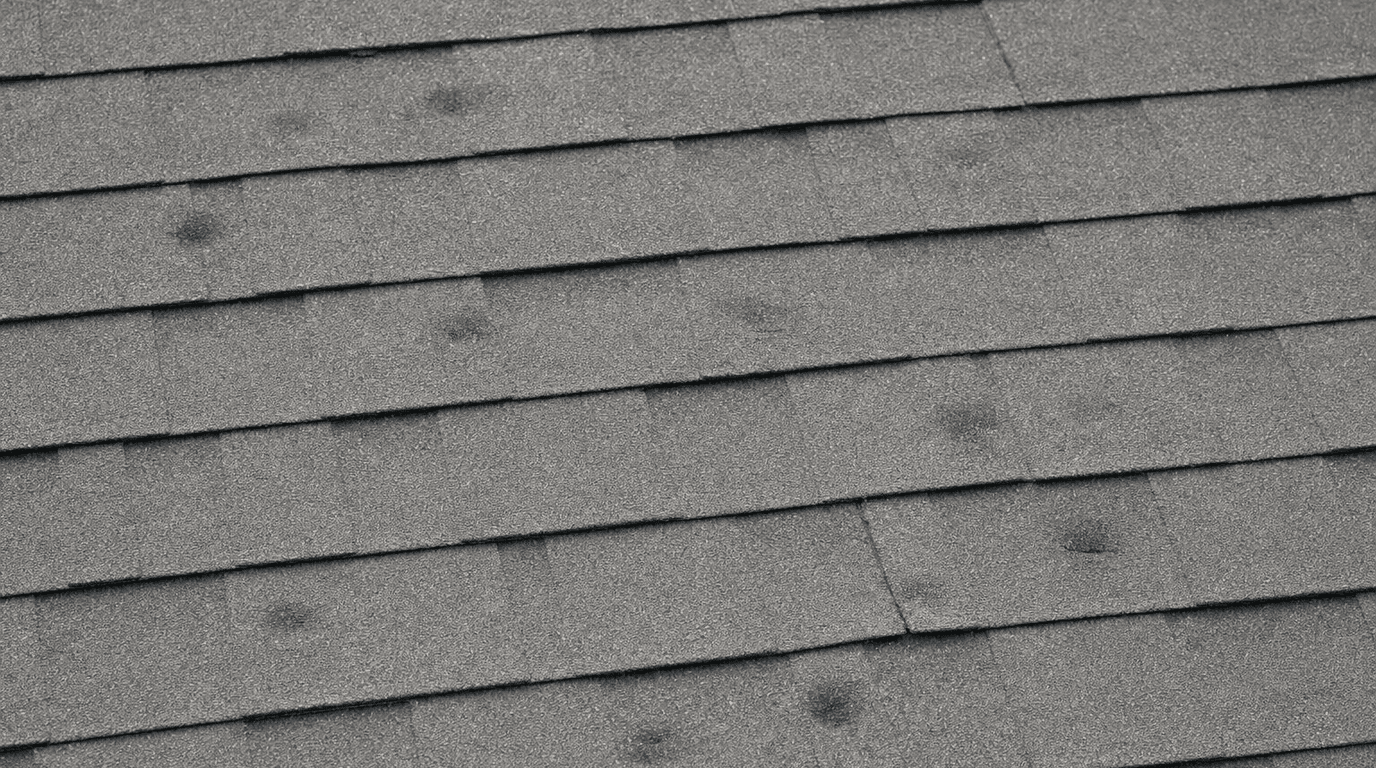
Loss of granules with dark, exposed mat underneath. This is the clearest visual tell on asphalt shingles. When hail hits, it dislodges the protective granule layer and exposes the asphalt mat below. You'll see dark spots that look almost like bruises. Press your thumb into one — if it feels soft or the mat gives a little, the fiberglass reinforcement beneath has been compromised.
Dents on soft metals. Walk around your home and check the gutters, downspouts, aluminum fascia, and any metal flashing around vents or the chimney. Hail leaves small, distinct circular dents in soft metals. This is some of the most useful evidence because metal doesn't lie — those dents didn't come from age, they came from impact. If your gutters are dinged up, your shingles likely took hits too.
Cracked or fractured shingles. Larger hailstones — anything over an inch — can crack shingles outright. You'll see straight or irregular fractures that don't follow any granule loss pattern. These are impact fractures, not stress cracks from thermal cycling, which look distinctly different.
New impact marks on painted surfaces. Windowsill trim, painted wood siding, and exterior AC units all show fresh hail marks that contrast sharply with surrounding weathering. If everything around the mark looks uniformly aged and the mark itself looks fresh, that's impact.
What Normal Wear and Tear Looks Like
Wear and tear is a slow accumulation of age, weather, and sun exposure. It's not dramatic. But it can look alarming to homeowners who haven't been paying close attention to their roof for years.
Even, widespread granule loss. Old shingles lose granules gradually and uniformly across the entire surface. You'll often see heavy granule accumulation in your gutters or at the base of your downspouts — that's normal aging. The key difference from hail: there's no concentrated impact point. The surface looks faded and thin all over, not pitted in random spots.
Curling and cupping at the edges. Shingles that curl upward at the corners or cup in the middle are reacting to years of moisture cycling and UV breakdown. This is classic aging, especially on roofs approaching 20-plus years in Wisconsin's climate. Hail doesn't cause curling — it causes impact marks.
Cracking from thermal stress. Wisconsin temperatures swing from well below zero in January to 90-degree summers. Over time, that cycling causes asphalt to dry out and develop fine cracks across the surface. These stress cracks follow no particular pattern and often appear along the length of a shingle rather than as a concentrated fracture point.
Algae and moss staining. Dark streaks running down the roof are algae (Gloeocapsa magma), not damage — though moss that's allowed to grow unchecked can eventually lift shingles. Neither one is hail-related.
Exposed nail heads and lifting tabs. Fasteners work loose over years of expansion and contraction. You might see nail pops or tabs that have lifted enough to let wind get underneath. Age-related, not storm-related.
The Confusing Part: When Both Exist at the Same Time
This is where things get genuinely complicated — and where insurance companies sometimes use wear and tear as a reason to deny otherwise valid claims. A 15-year-old roof that took a real hailstorm can have both fresh impact damage and pre-existing aging. That doesn't make the hail damage less real.
Adjusters are trained to point at wear and flag it. A good roofer is trained to document the distinction clearly. The hail marks have specific characteristics — the granule displacement pattern, the soft bruised feel of the mat, the matching dents on metal — that are not replicable by aging alone.
If you've had a recent hailstorm and your roof is older, don't assume the damage will be written off. Get a professional inspection from someone who knows how to separate the two. That documentation is what protects your claim.
Our post on how to document roof damage for an insurance claim walks through exactly how to build that case before an adjuster arrives.
How Roofers Officially Test for Hail Damage
When a qualified inspector gets on your roof after a storm, they're not just eyeballing it. There's a process.
First, they'll note the hailstone size from any available data — storm reports, NOAA records, or neighbor accounts. Hailstone size matters because half-inch hail behaves very differently from inch-and-a-quarter hail, and the damage patterns reflect that.
Then they'll do a hands-on inspection of each roof plane, marking impact points as they go. A standard test square (typically a 10x10-foot section) gives an idea of hit density. Eight or more hits per square is generally considered functionally damaging — the threshold varies by insurer, but that's the common benchmark.
They'll also check the age and manufacturer of the shingles against the impact pattern. Newer shingles should show less granule loss from the same size hailstone than older, degraded ones. If a newer roof shows heavy impact damage, that's a clear claim. If an older roof shows damage consistent with a recent storm event rather than gradual aging, a skilled inspector can still make that case.
This is exactly what our free roof inspection covers after a storm. We document everything: impact marks, hit density, affected areas, metal damage, and a comparison against the storm event data.
What to Do Right After a Hailstorm in Green Bay
Don't go on your roof. That's the first thing. A freshly impacted asphalt shingle surface is slippery, the damage may have weakened the deck in ways you can't see, and if you get up there and slip, now you have a different problem entirely.
Here's what you can safely do yourself:
Check the gutters and downspout splashguards for fresh dents. Inspect window screens and AC condenser fins — both show hail damage clearly. Look for shingle granules in significant quantities at the base of your downspouts. Check any painted wood surfaces at eye level for fresh impact marks.
Then schedule a hail damage roof inspection with a roofer who has documented storm damage claims before. Not every roofer has the same experience with the insurance process, and that experience matters when your claim is being reviewed.
Open a claim with your insurance company promptly. Wisconsin homeowners should know that most policies have a deadline for reporting storm damage — often one year from the event, sometimes less. Don't wait.
Why the Distinction Matters More Than You Think
Here's the thing that catches homeowners off guard: your insurance company doesn't just look at whether your roof is damaged. They look at whether the damage was caused by a covered event. Normal wear and tear is explicitly excluded from standard homeowners policies in Wisconsin. Hail damage from a specific storm is covered.
So when an adjuster walks your roof and sees a mix of aging and fresh impact marks, they have an incentive to attribute as much as possible to wear and tear. That's not a conspiracy — it's how the claims process works. Your job (and your roofer's job) is to document the distinction clearly enough that it holds up.
That's also why choosing a contractor with real storm damage experience matters. We've helped hundreds of Green Bay homeowners navigate this process and get fair claim outcomes. We know what adjusters look for, how to document impact patterns correctly, and how to write a scope that addresses actual damage rather than lumping everything together.
For a broader look at what Wisconsin hail season looks like and how to stay ahead of it, see our post on hail season in Wisconsin and how to spot damage early.
When Wear and Tear Has Gone Too Far
Sometimes a homeowner calls us after a storm, we get on the roof, and the honest answer is: your shingles were already near the end of their life. The hail may have accelerated things, but the roof needed attention regardless.
That's not a bad outcome to know. A roof that was a year or two from failing anyway is one that needed replacement soon — and depending on your policy, a storm event can still be the covered trigger for that replacement, even if the underlying shingles were aged. The inspection and documentation still matters.
If you've been wondering whether your roof is closer to repair or replacement territory, our storm damage services page covers how we assess that question and what the decision typically comes down to.
Get a Clear Answer from Someone Who's Done This for 30 Years
You shouldn't have to guess whether you're looking at hail damage or age. And you definitely shouldn't let an insurance adjuster be the only expert opinion in the room when that question gets answered.
Michael Pierce and the team at Pierce Roofing have been doing this in Green Bay and Northeast Wisconsin for over 30 years. We're Atlas PRO+ Platinum certified, carry $2 million in liability coverage, and stand behind every repair with a 10-year workmanship warranty. When we say it's hail damage, we can show you exactly why — and we'll document it in a format that supports your claim.
Schedule your free roof inspection or call us directly at (920) 609-8304. We'll get on your roof, give you a straight answer, and help you figure out the right next step — whether that's a repair, a replacement, or a call to your insurance company.