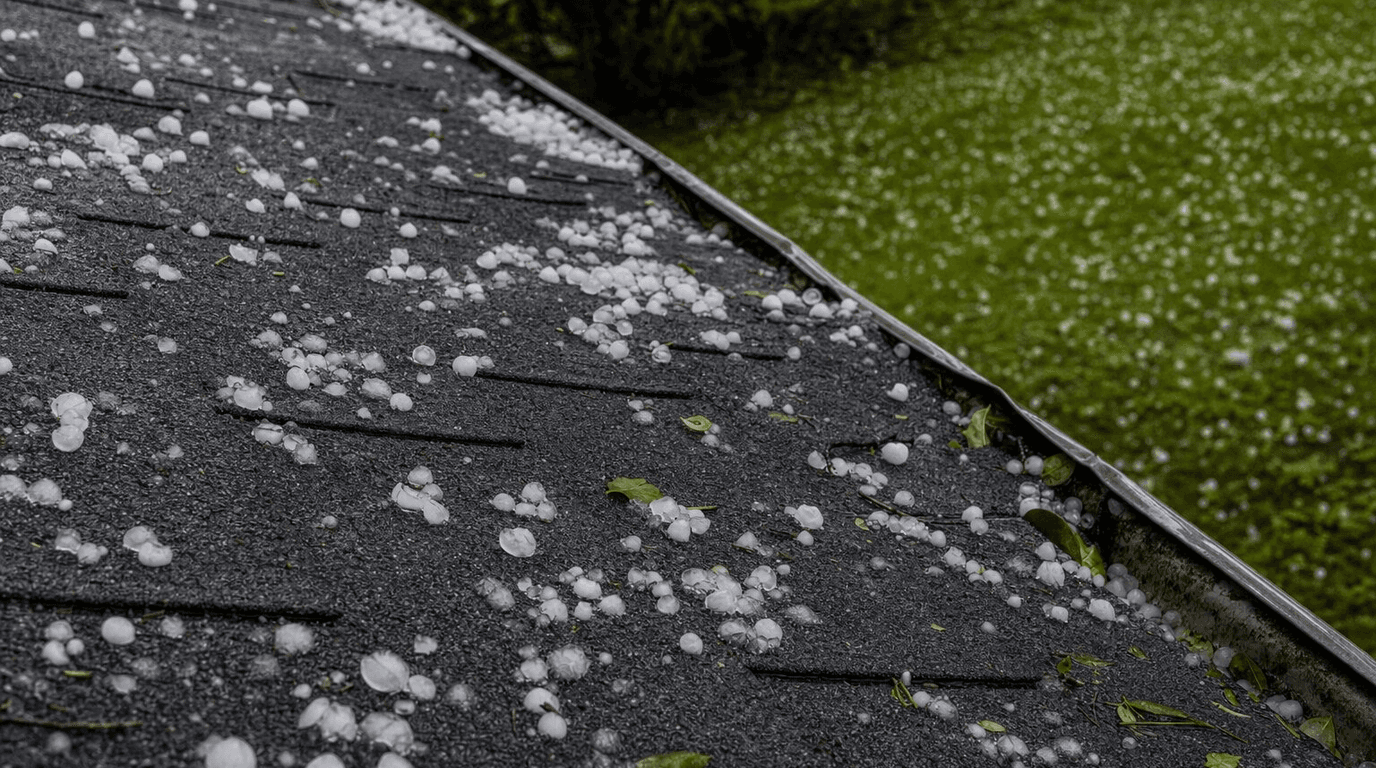
Wisconsin's Hail Season Is Longer Than Most People Think
Ask most Green Bay homeowners when hail season is, and they'll say "summer." That's partially right. But hail in Wisconsin can show up as early as late April and as late as October. The peak window — late May through August — is when the big storms roll through, but the season around that window is real and underestimated.
Northeast Wisconsin sits in a part of the country that gets meaningful hail activity every year. Not every storm drops marble-sized hail. A lot of the damage that ends up on insurance claims comes from stones between 1 and 1.5 inches — large enough to crack and bruise asphalt shingles, but small enough that homeowners don't always connect the dots between the storm they sat through and the roof damage they're now looking at.
The problem is that hail damage doesn't announce itself. You don't get water on the ceiling the next day. You get a compromised roof that slowly loses its ability to protect your home, and by the time it's obvious, the storm that caused it is long forgotten.
If you already know you had a significant storm come through your area, you can schedule a free roof inspection now and let us do the heavy lifting. But if you want to understand what you're dealing with first, keep reading.
What Hail Actually Does to a Roof
This matters before you go outside with your phone camera. If you don't know what you're looking for, you'll either miss damage entirely or mistake normal wear for storm damage. Both mistakes are costly.
Hail hits an asphalt shingle and does one of a few things depending on the size of the stone, the age of the shingle, and the angle it hits at:
Granule displacement is the most common result. The surface of an asphalt shingle is covered in mineral granules that protect the asphalt layer below from UV degradation. When hail knocks those granules loose, it creates a soft, circular depression — sometimes called a bruise — where the asphalt is now exposed. You can't always see this from the ground, but you can see the aftermath in your gutters (more on that below).
Cracking happens when hail hits at high velocity or hits older, more brittle shingles. You'll see hairline fractures or outright breaks through the shingle body. These are immediate water entry points.
Fiberglass mat fracture is more serious and not always visible from the outside. The internal fiberglass mat in a modern asphalt shingle can crack from impact without leaving an obvious surface mark. This type of damage shortens shingle life significantly and doesn't always show up in a visual inspection without a trained eye.
Flashing and metal component damage is something a lot of homeowners and even inexperienced contractors overlook. Gutters, ridge caps, roof vents, and flashing are often made of aluminum or steel. Hail leaves dents in soft metals — and those dents are actually some of the best evidence you have when filing an insurance claim, because they're unambiguous.
How to Spot Hail Damage From the Ground
Before you get on a ladder or call anyone, do a full walk around your home. You're not trying to diagnose everything from here — you're building a preliminary picture.
Check the Gutters First
Gutters are your best starting point. After a hailstorm, look for:
- Dents along the outer face of the gutter — small, circular impressions that weren't there before
- An unusual amount of granules accumulated at the bottom of downspouts or in the gutter channel itself
- Bent or dented gutter hangers or end caps
A lot of granule loss showing up in gutters right after a storm is a significant indicator. New roofs don't shed much. Old roofs shed some year-round. But a surge of granules immediately after a hailstorm means the storm caused it.
Look at Soft Metal Surfaces Around Your Home
Aluminum window trim, AC unit fins, outdoor HVAC covers, and metal flashing visible from the ground all show hail hits very clearly. If your AC unit looks like it went through a golf ball machine, your roof likely did too. These metal surfaces are the "control group" that insurance adjusters use to confirm storm activity.
Scan the Roof Plane From Multiple Angles
With binoculars if you have them, walk to each corner of your property and look at the roof from a low angle. You're looking for:
- Dark spots or patches that look different from the surrounding shingles
- Areas where the shingle surface looks dull or matte compared to the rest (lost granule surface reflects light differently)
- Any visible cracking or broken shingles
- Ridge cap shingles that look fractured or displaced
Sun angle matters here. Try to look when the sun is hitting the roof from the side — low raking light shows surface depressions that are invisible when the sun is directly overhead.
How to Document Hail Damage Before You Call Insurance
This is where homeowners lose money. They call their insurance company, an adjuster comes out, and the homeowner has nothing to show for themselves beyond "I think the storm did it." Good documentation changes that dynamic entirely.
We go into much more detail on this in our post on documenting roof damage for insurance claims, but here's the core of what you need:
Record the Date and the Storm
Insurance claims are date-specific. You need to tie the damage to a specific weather event. Start here:
- Screenshot a weather report or radar showing hail in your area on the storm date
- Keep any hail you collected or photograph it next to a ruler or coin for scale
- Note the approximate time the storm hit
The National Weather Service keeps historical records. Your insurance company will pull them. You should have the same information they do.
Photograph Every Piece of Evidence
On your phone, create a folder specifically for this claim. Then photograph:
- The gutters (exterior face and interior channel) — date-stamped
- Every soft metal surface around your home showing dents
- Any visible damage on the roof from the ground
- Your downspout discharge area — granule accumulation here is telling
- The general condition of the yard (dented cars, damaged plants, or stripped tree leaves are all corroborating evidence)
Take more photos than you think you need. Wide shots establish context; close-ups show damage detail. Both are useful.
Get a Professional Inspection Before the Adjuster Arrives
This is the step most homeowners skip, and it's the most important one. A professional roofing inspection done before the insurance adjuster visit gives you an independent assessment of what's actually damaged. That matters for two reasons.
First, you'll know what to point out when the adjuster walks the roof. Adjusters are often looking at dozens of claims from the same storm. Having a contractor present who can identify and explain each damage point keeps the inspection thorough.
Second, if the adjuster misses something, you have documentation that the damage existed before they visited.
Our storm damage inspection service is built for exactly this situation. We've worked through hundreds of insurance claims across Green Bay and Northeast Wisconsin, and we know what adjusters are looking for.
What Hail Damage Looks Like on Different Roofing Materials
Not every roof responds to hail the same way, and knowing what to look for on your specific material helps you document it accurately.
Asphalt shingles show the granule displacement and bruising described above. On three-tab shingles, damage often appears in a pattern that follows the hail trajectory. Architectural (dimensional) shingles can absorb more impact, but they still show cracking and bruising at the impact points.
Metal roofing shows denting on softer panels (steel and aluminum). Standing seam metal can hold up better, but hail will still leave marks on the panels and exposed fasteners. The good news: metal roofs almost never have the water intrusion issues that asphalt shingles develop after a hail hit.
Flat roofing membranes are often ignored in hail inspections, but TPO, EPDM, and modified bitumen systems all take hits. Punctures and tears around seams are common on older membrane systems after significant hail.
If you're not sure what your roof is made of or how hail affects it specifically, a professional assessment is the right call. The hail damage repair process varies by material, and what's right for an asphalt system isn't necessarily right for a metal or flat roof.
Timing Matters: Why You Shouldn't Wait
Insurance policies have reporting windows. Wisconsin homeowners are generally expected to file claims within a reasonable time after a storm — what counts as "reasonable" depends on your policy, but waiting six months after a significant hail event is not going to help your case.
Beyond the insurance angle, hail damage that isn't addressed gets worse. A bruised shingle loses its weather resistance. The UV degradation that would have taken years of normal wear now happens in one or two seasons. By the time you notice a leak, the roof has been compromised for a while.
A lot of homeowners in Green Bay also make the mistake of letting a storm chaser from out of state inspect their roof after a big weather event. We've written about why that's a problem — the short version is that contractors who blow through town after a storm aren't accountable to your community the way a local roofer is. We're here before the storm and after it.
Serving Green Bay and All of Northeast Wisconsin
Pierce Roofing has been working roofs in this region for over 30 years. We're Atlas PRO+ Platinum certified, carry $2 million in insurance, and back our work with a 10-year workmanship warranty. When a hailstorm hits Green Bay or anywhere across Brown, Outagamie, Kewaunee, Oconto, Winnebago, or Manitowoc County, we're the crew that shows up and stays accountable.
If you had a storm come through recently and you're not sure what shape your roof is in, don't guess. Call us at (920) 609-8304 or request your free inspection online. We'll tell you exactly what we find — and if there's nothing to worry about, we'll tell you that too.