The Knock on the Door You Should Be Suspicious Of
A big hailstorm rolls through Green Bay. Maybe it was a quick 20 minutes of chaos, maybe it lasted longer. Either way, you saw the dents on your car, heard it hammering the roof, and now you're wondering what shape things are in.
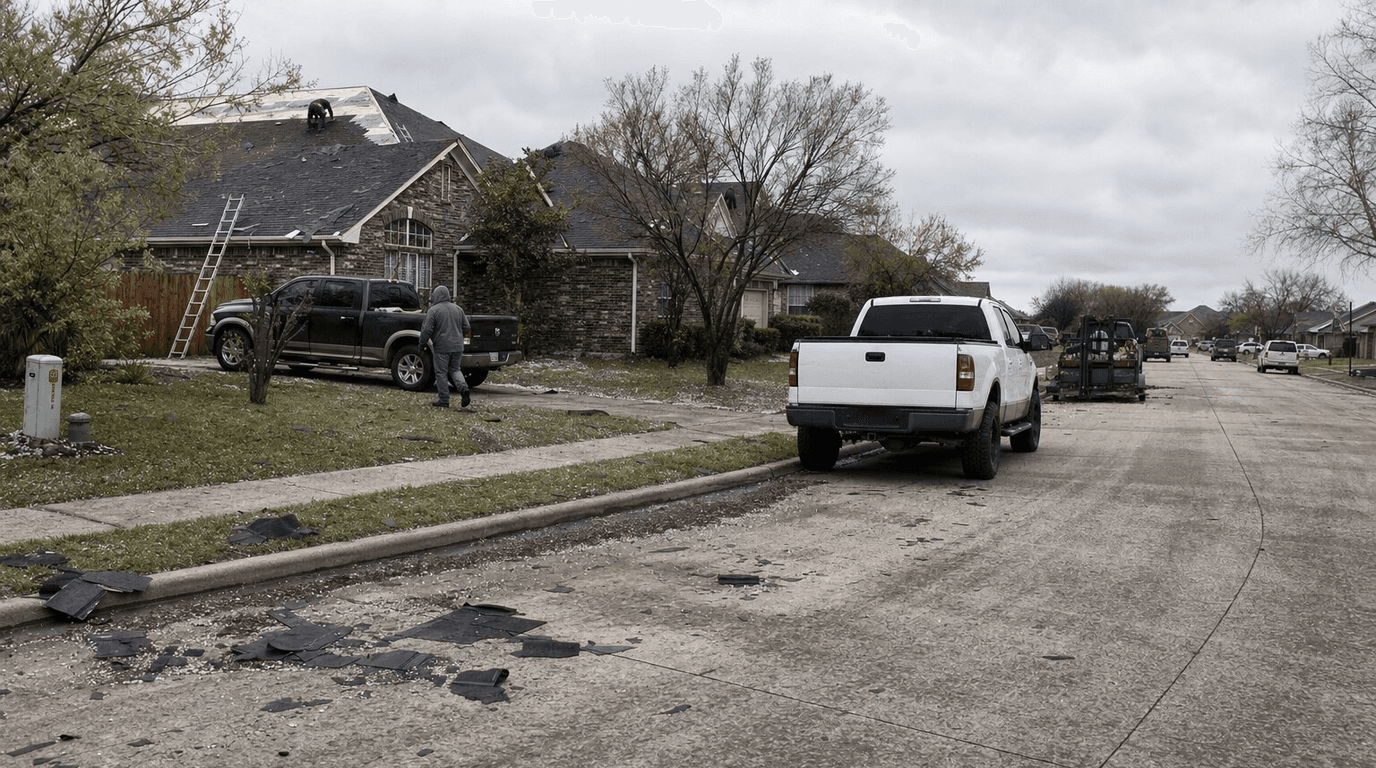
Within 24 to 48 hours, someone knocks on your door. They have a truck with an out-of-state plate, a clipboard, and a very confident pitch about how they can work directly with your insurance company and get you a new roof for free. They want you to sign something before they leave.
That's a storm chaser roofer. And if you sign that paper, you've made one of the most expensive mistakes a homeowner can make after hail damage.
This isn't a fringe problem. It's predictable, it's organized, and it follows major storms across the Midwest every single year. Green Bay has been hit with it before and will be hit with it again. Knowing what you're dealing with before it happens is the difference between a straightforward insurance claim and a months-long nightmare.
What Is a Storm Chaser Roofer, Exactly?
The term gets used loosely, so let's be specific. A storm chaser roofer is a contractor — sometimes a legitimate-seeming company with a real website and decent marketing — that deploys crews to storm-affected areas immediately after a significant weather event. They're not based in Wisconsin. They don't have a local presence before or after the storm. They're there because there's money to be made, and they plan to move on once it dries up.
Some of them are outright scammers. Others do real work but do it badly, knowing they won't be around to deal with the consequences. The business model depends on volume and speed: sign as many homeowners as possible, do the installs fast, collect insurance checks, and leave before the callbacks start.
The "Assignment of Benefits" contract they want you to sign is worth understanding. When you sign it, you're transferring your right to the insurance payout directly to the contractor. That means the contractor negotiates with your insurance company — not you. And once you've signed, pulling out is difficult and sometimes legally messy.
Storm chasers know that most homeowners don't read those documents carefully when there's adrenaline from a storm still running through the conversation.
Green Bay Gets Hit Every Summer. That's Not an Accident.
Northeast Wisconsin sees meaningful hail activity most years. Brown County, Outagamie, Kewaunee, Manitowoc — these areas are right in the path of the storm systems that build over the upper Midwest and track northeast. Storm chaser operations monitor the same weather data that forecasters do. When a significant cell drops hail across a metro area, they're already routing crews.
By the time you're back from work the day after a storm, there may be a dozen or more out-of-state roofing trucks working your neighborhood. It looks like an industry response. It feels urgent. That's intentional.
The urgency is manufactured. Your roof isn't going to collapse between now and next week if it took hail hits last night. A tarp situation is different — if you have active water intrusion, that does need attention fast. But signing a contract with the first person who knocks on your door is never the right call, regardless of how the pitch is framed.
What Goes Wrong With Storm Chaser Repairs
Let's talk about actual outcomes, because this is where the real cost shows up.
Shingle quality is often the first cut. Storm chasers operating on thin margins will specify whatever shingles hit their target cost. That might mean mid-grade products where your home needs something better, or worse, products that don't meet your county's building code requirements. You won't know until an inspector catches it — or until your next roof inspection years later.
Installation shortcuts are common. Proper shingle installation in Wisconsin requires specific fastening patterns, appropriate underlayment for our freeze-thaw cycle, and careful attention to flashing at every penetration point. Crews under pressure to move through jobs quickly cut corners on the details that hold up over a Wisconsin winter. Ice damming, blow-offs, and premature failures can often be traced back to poor initial installation.
Workmanship warranties are worthless if the company doesn't exist. A 10-year workmanship warranty from a company that won't be in business in 18 months is a piece of paper. When something fails at year two, you have no recourse. No local office, no phone number that still works, no one to hold accountable.
Insurance claim complications can follow you. Signing over your assignment of benefits gives someone else control over your claim. If they negotiate poorly, inflate costs inappropriately, or make representations to your insurer that create disputes, you're the policyholder at the end of that chain. Untangling those situations takes time, money, and sometimes legal help.
We've seen all of this play out for homeowners across the Green Bay area. It's not hypothetical.
What a Local Roofer Offers That a Storm Chaser Can't
Here's the honest version of this: a genuinely qualified local roofer costs about the same as a storm chaser after insurance. The difference isn't price. It's accountability, quality, and what happens after the job is done.
They were here before the storm. Pierce Roofing has been working in Brown County and across Northeast Wisconsin for over 30 years. We know the local building departments, the permit requirements, the common roof configurations in neighborhoods across Green Bay. We're not learning your market while we're installing your roof.
They'll be here after the storm. This is the one that matters most. If something goes wrong at month 14 — a flashing failure, a leak at a valley, a ridge cap that didn't get set right — you can call us. We're local. We answer. We come back.
Manufacturer certifications require ongoing accountability. Pierce Roofing holds Atlas PRO+ Platinum certification, which is one of the highest levels available from Atlas Roofing. That certification isn't handed out to transient crews running storm volume. It requires training, installation standards, and a track record. It also backs our 10-year workmanship warranty with an actual manufacturer-supported guarantee, not just our word.
Local roofers navigate your insurance claim with you, not for you. A local contractor who works your market regularly knows how the claims process runs with the major Wisconsin insurers. We help you understand what's covered, what documentation you need, and how to make sure the scope is right. The goal is a fair settlement that gets your roof done properly — not a maximum payout that creates a dispute.
How to Tell the Difference at the Door
Someone shows up after a storm. Maybe they're legit, maybe they're not. Here are the questions that separate one from the other quickly:
Where is your company located? A real answer is a specific address you can look up — not a city name, not a P.O. box, not "we have offices all over." A storm chaser's honest answer is they're based in Texas or Oklahoma or wherever they operate out of.
Are you licensed in Wisconsin? Wisconsin requires roofing contractors to be registered with the state. You can verify a registration at the Wisconsin Department of Safety and Professional Services website. Ask for their number. A legitimate contractor gives it to you immediately.
Do you pull building permits? Most roofing projects in Wisconsin require a permit. A contractor who says permits aren't necessary, or that you don't want one because it'll slow things down, is either wrong or trying to avoid the inspection that would catch their work.
Can you provide local references from the past 12 months? Not testimonials on a website — actual homeowners you can call who had work done in the Green Bay area recently. Storm chasers can't provide this because they weren't here 12 months ago.
What does the warranty cover, and who backs it? Get specifics. What's the workmanship term? What does the manufacturer warranty cover on the materials? Who do you call if there's a problem in three years?
If the answers are evasive or the pressure ramps up when you ask these questions, that tells you everything you need to know.
What to Do Instead After a Hailstorm in Green Bay
The right sequence is straightforward, and none of it requires you to make fast decisions.
First, document what you can see from the ground. Dented gutters, marks on soft metal surfaces around the house, any obvious damage visible from the yard. Date-stamped photos on your phone are sufficient.
Second, call a local roofer you trust and schedule an inspection. If there's active water intrusion, that moves up in priority — but even then, you have time to choose who comes out. Our storm damage inspection process is built specifically for post-storm situations. We assess the damage, document it thoroughly, and give you a straight answer on what's there.
Third, contact your insurance company and open a claim. You don't need a contractor to do this step. Just call and report the storm and the potential damage. They'll assign an adjuster.
Fourth, have your contractor present or available when the adjuster comes. A local contractor who knows what hail damage looks like and how it's documented is a real asset during an adjuster visit. They can point out things the adjuster might move past quickly and make sure the scope of damage is captured accurately.
If you're a homeowner in Green Bay or Brown County, that process looks exactly the same for you as it does for someone out in Kewaunee County or down in Winnebago. The storms don't care about county lines, and neither do we.
A Note on Pressure and Urgency
Storm chasers are good at one thing: making the moment feel urgent. They're trained to get you to sign before you've had time to think or ask questions. The pitch often includes some version of "this offer is only good today" or "we can only take on a few more jobs in your neighborhood."
None of that is real. Roof installations are scheduled days to weeks out regardless of who does them. The urgency exists to short-circuit your judgment. Don't let it.
You have time to make the right call. The roof that took hail hits yesterday will still be there next week. The right decision is worth taking a day to make.
Pierce Roofing Has Been Doing This for Over 30 Years
Michael Pierce started this company with his hands and has kept it built on straightforward work and local accountability. Atlas PRO+ Platinum certified. $2 million insured. A 10-year workmanship warranty that means something because we're still here to back it.
If you had a storm come through and you want to know what shape your roof is in, call us directly at (920) 609-8304. No pressure, no clipboard, no high-pressure pitch at your front door — just a real inspection from a crew that's been working Green Bay roofs for three decades and plans to keep doing it.
You can also request a free estimate online anytime. We'll get back to you fast and schedule at your convenience.