The Short Answer — Then We'll Get Into the Details
For most homeowners, a professional roof inspection once a year is the right frequency. Twice a year is better if your roof is older, your property has a lot of overhanging trees, or you've had significant storm activity. And any time something happens — a major hail event, a tree branch contact, a visible leak — you get an inspection immediately, regardless of when the last one was.
That's the summary. But if you're reading this, you probably want to understand the reasoning, because "just get it inspected" without context doesn't tell you much. So let's break down what actually drives inspection frequency and what a Wisconsin roof faces between visits.
Why Roof Inspection Frequency Matters More in Northeast Wisconsin
Not every climate puts the same demands on a roof. Here in the Green Bay area, a single calendar year puts your roof through a remarkable amount of stress.
Winter brings freeze-thaw cycles that work at every small crack and open seam. Heavy snow loads stress the decking. Ice dams form along the eaves and push water backward under shingles. Then spring arrives with wind-driven rain and the occasional severe storm. Summer brings UV exposure that ages asphalt shingles steadily. And fall drops debris — leaves, seeds, branches — that holds moisture against your roofing materials for weeks at a time.
Four seasons of genuinely different damage mechanisms. That's why the "once every few years" approach that might be acceptable in a mild climate is a liability here. A lot can change in 12 months on a Wisconsin roof, and even more can change in 24.
The inspections that catch problems early are almost always cheaper conversations than the ones that happen after water has been getting in for a season or two.
Once a Year: The Baseline for Most Homes
For a roof that's in reasonable condition — let's say under 15 years old, no major storm events, good material quality — an annual roof inspection is the right baseline. One thorough visit per year, done by a professional who knows what to look for, catches the vast majority of developing problems before they turn expensive.
The best timing for that single annual inspection is spring or fall. Both work well for different reasons.
Spring inspections make sense because they come right after your roof's hardest season. Winter in Wisconsin is genuinely punishing, and a spring inspection lets you assess what the cold months did: lifted flashings, cracked caulk, granule loss from ice movement, damage at the eaves from ice dams. You find out early in the year what needs attention, so you can get repairs scheduled before the busy summer season.
Fall inspections work because they let you head into winter in the best possible shape. You catch any damage from summer storms, make sure your gutters and drainage are clear, and verify that your flashings are sealed before freeze-thaw cycles start working on them again. Our fall roof maintenance checklist for Wisconsin homeowners covers what a proper pre-winter check-up should include.
Honestly? If budget allows, one inspection each season — spring and fall — is better than one. But once a year is the floor, not the ceiling.
Twice a Year: When You Should Go More Often
Certain conditions push the appropriate frequency up to twice per year, regardless of your roof's age.
Your roof is more than 15 years old. Asphalt shingles have a finite service life, and in Wisconsin's climate, most installations start showing meaningful wear after 15 years. The degradation isn't always obvious from the ground, and it isn't always linear — a roof can look fine until it doesn't. Twice-yearly inspections in this range catch the inflection points before they become emergency repairs or premature replacement decisions.
You've had storm activity. Hail damage is notoriously invisible to anyone who isn't looking for it specifically. A hailstorm that seemed minor from inside your house may have bruised hundreds of shingles, damaged flashing, and dented your drip edge. After any significant storm event, an inspection isn't optional — it's how you find out what actually happened and document it for insurance purposes if needed. Our team handles storm damage inspections for exactly this reason.
Heavy tree coverage over your roof. Trees are a constant source of slow damage. Branches scratch and lift shingles during wind events. Leaves and debris accumulate and hold moisture. Moss and algae get their start under organic debris sitting against your shingles. If you have trees with branches reaching over your roof, semi-annual inspections give you better visibility into what's accumulating between visits.
You've had previous water intrusion. If your home has had a leak — even one that was repaired — the area around that repair deserves closer attention. Twice a year makes sense until you're confident the fix held and no adjacent damage developed.
After a Major Event: Inspect Immediately
Schedule-based inspections are the baseline. But certain events should trigger an inspection on their own timeline, separate from whatever annual or semi-annual cadence you're on.
Get an inspection promptly after:
- Any hailstorm with hail larger than about 3/4 inch (roughly the size of a dime)
- Straight-line winds above 60 mph — the kind that knock branches down
- A tree limb or branch making contact with your roof, even a glancing blow
- Any visible lifting, buckling, or missing shingles you can see from the ground
- Water stains appearing on interior ceilings or walls
- Significant ice dam formation followed by an ice removal event
Don't wait for your next scheduled inspection in these cases. The whole point of the schedule is to catch gradual wear before it becomes a problem. An acute event changes the picture entirely.
Pierce Roofing offers free roof inspections for Green Bay area homeowners, including post-storm assessments. There's no reason to guess at the condition of your roof after a significant weather event.
What a Professional Inspector Is Actually Looking For
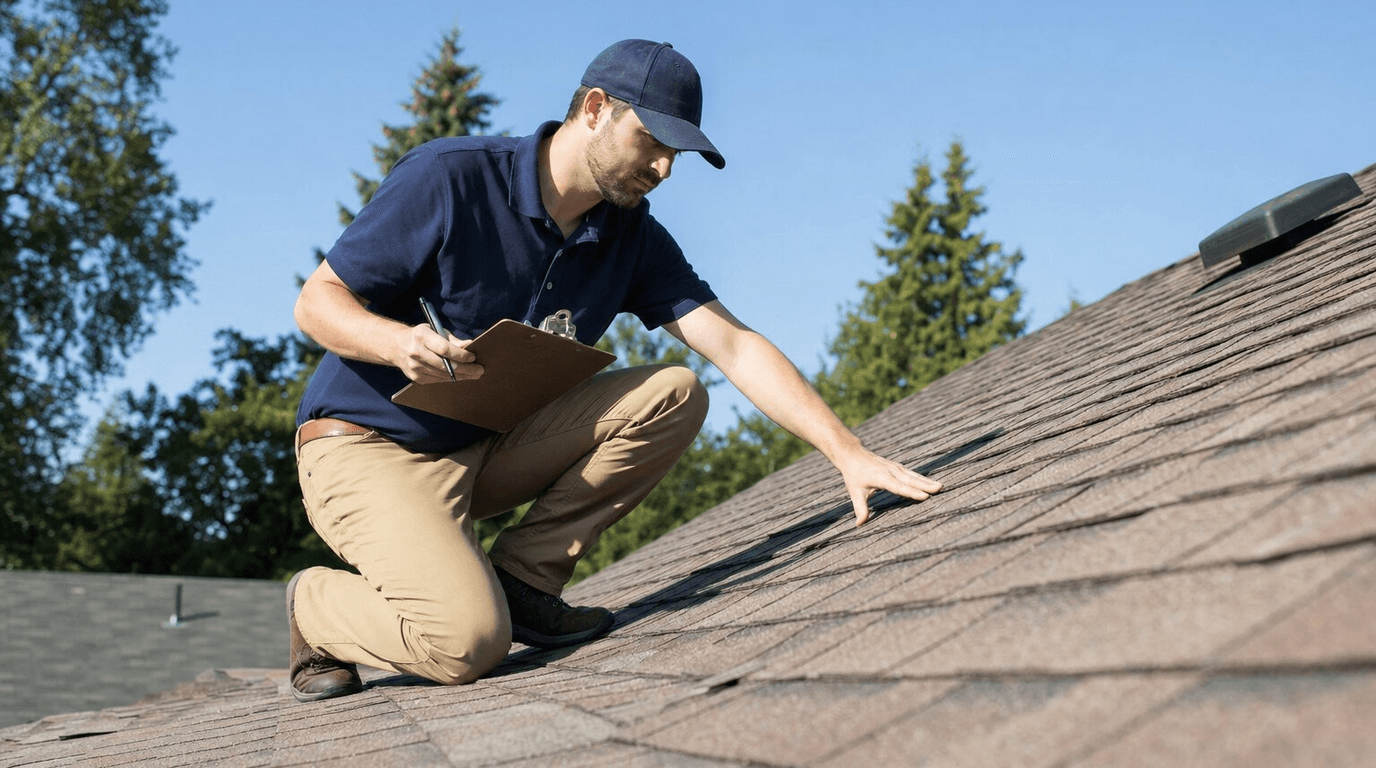
This matters, because "inspection" means different things from different contractors. A thorough professional inspection is not a visual scan from the driveway. It involves getting on the roof and examining things up close.
A proper inspection covers the shingle field for granule loss, cracking, cupping, and bruising. It examines every flashing point — around chimneys, skylights, vents, and where the roof meets vertical walls — because flashing failures are one of the most common sources of leaks. It checks the ridge, the hips, and the eaves. It looks at the condition of drip edge and any exposed underlayment. And it assesses gutter condition and drainage, since poor drainage causes problems at the eave line over time.
Attic access matters too. A good inspector checks for signs of moisture intrusion, adequate insulation coverage, and proper ventilation — because some of the most important things to know about a roof can only be seen from inside the attic. Our post on what a professional roof inspection covers goes deeper on each of these areas if you want the full picture.
If you want to do your own preliminary walk-around between professional visits, we put together a DIY roof inspection checklist for homeowners with the ground-level and accessible things you can safely check yourself.
The Cost Argument for Regular Inspections
Let's be direct about money, because that's often what makes homeowners skip inspections.
A professional roof inspection typically costs between $150 and $300 in the Green Bay area, depending on the size and complexity of the roof. Some contractors offer free inspections as part of their service model — Pierce Roofing does.
A minor roof repair — sealing a few lifted flashings, replacing a handful of damaged shingles, resealing a pipe boot — typically runs a few hundred dollars.
A roof repair that's been deferred until water has been getting into the decking? You're looking at potentially thousands of dollars, depending on how far the rot has spread and how much decking needs to be replaced.
And a full roof replacement on an average Green Bay home runs $10,000 to $20,000 or more, depending on size, pitch, and materials.
The math on regular inspections is not complicated. Catching a failed flashing seal at year two versus year five is the difference between a $200 repair and a $4,000 one. The inspection cost is noise compared to what it prevents.
A Note on New Construction and Recently Replaced Roofs
If your roof is brand new — either on a new build or a recent replacement — the first few years don't require the same scrutiny as an aging roof. But that doesn't mean you skip inspections entirely.
We recommend an inspection in the first year after installation, primarily to verify that the installation itself was done correctly and that no issues developed during the first winter. Workmanship problems, if any, show up early. After that, you can follow the standard annual schedule with confidence.
For homes with newer roofs installed by Pierce Roofing, our 10-year workmanship warranty covers defects in installation. But the warranty doesn't remove the value of knowing what condition your roof is in — it just means that if an inspection turns up an installation issue, you're covered.
Roof Inspections as Part of a Broader Maintenance Plan
An inspection is a diagnostic tool, not a maintenance task on its own. What you do with the findings is what actually protects your roof.
For most homeowners, we recommend pairing annual inspections with a basic roof maintenance plan that addresses the things inspections turn up: keeping gutters clean, trimming overhanging branches, sealing small penetrations before they grow, replacing failing caulk and sealants around flashings. These are inexpensive interventions that extend roof life significantly.
The homeowners who get the most years out of a roof are the ones who treat it like any other major system in the house: scheduled attention, small repairs when needed, and an honest assessment of when the system is approaching end of life. Not the ones who wait for a drip.
For a full walkthrough of how we approach ongoing care for residential roofing in Northeast Wisconsin, including what a maintenance plan actually looks like, reach out and we're happy to talk through your specific situation.
Schedule Your Inspection Before the Rush
Spring is the busiest season for roofing contractors in Green Bay, and inspection slots fill up fast once the weather breaks. If you're due for an annual inspection — or overdue — the best time to schedule is now, before the calendar fills.
Michael Pierce and the Pierce Roofing team have been inspecting and repairing roofs in Brown County and across Northeast Wisconsin for over 30 years. Atlas PRO+ Platinum certified, $2M insured, and backed by a 10-year workmanship warranty on every job.
Call us at (920) 609-8304 or schedule your free roof inspection online. We'll tell you exactly what we find and what, if anything, needs attention — no pressure, no upsell.