Most Homeowners Don't Know Their Roof Is Suffocating
Your roof doesn't just sit there looking solid. It's a system — and one of the most important parts of that system is airflow. When your attic can breathe, your roof lasts longer, your energy bills stay reasonable, and your home stays drier. When it can't, problems compound quietly for years before they announce themselves.
Poor roof ventilation is one of the leading causes of premature roof failure in Northeast Wisconsin. We see it constantly at Pierce Roofing: homeowners who replaced their shingles eight or ten years ago, now dealing with a roof that looks years older than it should, wondering what went wrong. A lot of the time, ventilation is the answer.
The frustrating part is that the warning signs are usually visible well before things get serious. You just have to know what to look for.
What Good Ventilation Actually Does
Before we get into the warning signs, it helps to understand what a functioning ventilation system is supposed to do. The goal is continuous airflow through the attic space: cool, dry outside air enters through intake vents at the soffits, travels across the underside of the roof deck, and exits through exhaust vents at or near the ridge.
That airflow does three things. In winter, it keeps the roof deck cold and uniform, which prevents ice dams from forming. In summer, it flushes out superheated air that would otherwise cook your shingles from the inside out. And year-round, it controls moisture, which protects your decking, your insulation, and your framing from rot.
When that airflow is blocked or inadequate — whether from blocked soffit vents, a missing ridge vent, or an attic that was never properly designed — all three of those functions break down. The damage is slow at first. Then it's not.
Sign 1: Ice Dams Every Winter
If you've been fighting ice dams every winter, your ventilation system is almost certainly part of the problem.
Ice dams form when heat escapes from your living space into the attic, warms the roof deck unevenly, and melts snow near the peak. That meltwater runs down the slope and refreezes at the cold eaves, building up a ridge of ice that blocks drainage and forces water back under your shingles. The damage that follows — stained ceilings, lifted shingles, wet insulation — is one of the more destructive things a Wisconsin winter can do to a home.
Proper attic ventilation keeps the roof deck consistently cold, so the snow melts uniformly (or not at all) rather than selectively. If ice dams are a recurring event at your house, not just an occasional bad winter, that's a sign your attic isn't getting the airflow it needs. Our related post on ice dams in Green Bay and how to prevent them goes deeper on the mechanics, but the short version is: insulation and ventilation working together is the only real solution.
Sign 2: Your Energy Bills Keep Climbing Without Explanation
This one surprises people. Poor attic ventilation doesn't just damage your roof — it makes your whole house more expensive to operate.
In summer, an attic without adequate exhaust ventilation can reach temperatures between 140 and 160 degrees Fahrenheit. That heat radiates down through the ceiling into your living space, forcing your air conditioning to work harder. Your upstairs rooms feel warmer than they should. Your energy bills go up. And most people blame the AC unit rather than the roof.
In winter, the problem flips. A poorly ventilated attic traps warm, moist air that should be exhausted outside. That moisture condenses on cold surfaces, degrades insulation, and eventually compromises the thermal barrier between your living space and the outdoors. Again, heating costs go up.
If your energy bills have been rising year over year without a clear explanation, it's worth asking whether your attic ventilation is doing its job. If you're considering upgrades, energy-efficient roofing options can address both the ventilation system and the shingle performance at the same time.
Sign 3: Shingles That Are Aging Faster Than They Should
This is one of the clearest poor roof ventilation signs, and one of the most underappreciated.
Asphalt shingles are rated for a certain lifespan under normal conditions. But "normal conditions" assumes a properly ventilated attic underneath. When heat builds up in a poorly ventilated attic in July and August — and in Green Bay, those months get hot — that heat attacks the shingles from below while the sun attacks them from above. The result is premature brittleness, accelerated granule loss, and shingles that fail years ahead of schedule.
If your roof is less than 15 years old but the shingles look visibly weathered, curling at the edges, or losing granules heavily, heat stress from inadequate ventilation is a likely cause. Walk around and check your gutters after a rain. Heavy granule buildup in gutters on a relatively young roof is a red flag worth investigating. So is any visible curling or cupping on shingle tabs, especially on south-facing slopes that get the most direct sun.
Sign 4: Moisture, Frost, or Mold in the Attic
Get a flashlight and spend five minutes in your attic. What you find might change your timeline on calling a roofer.
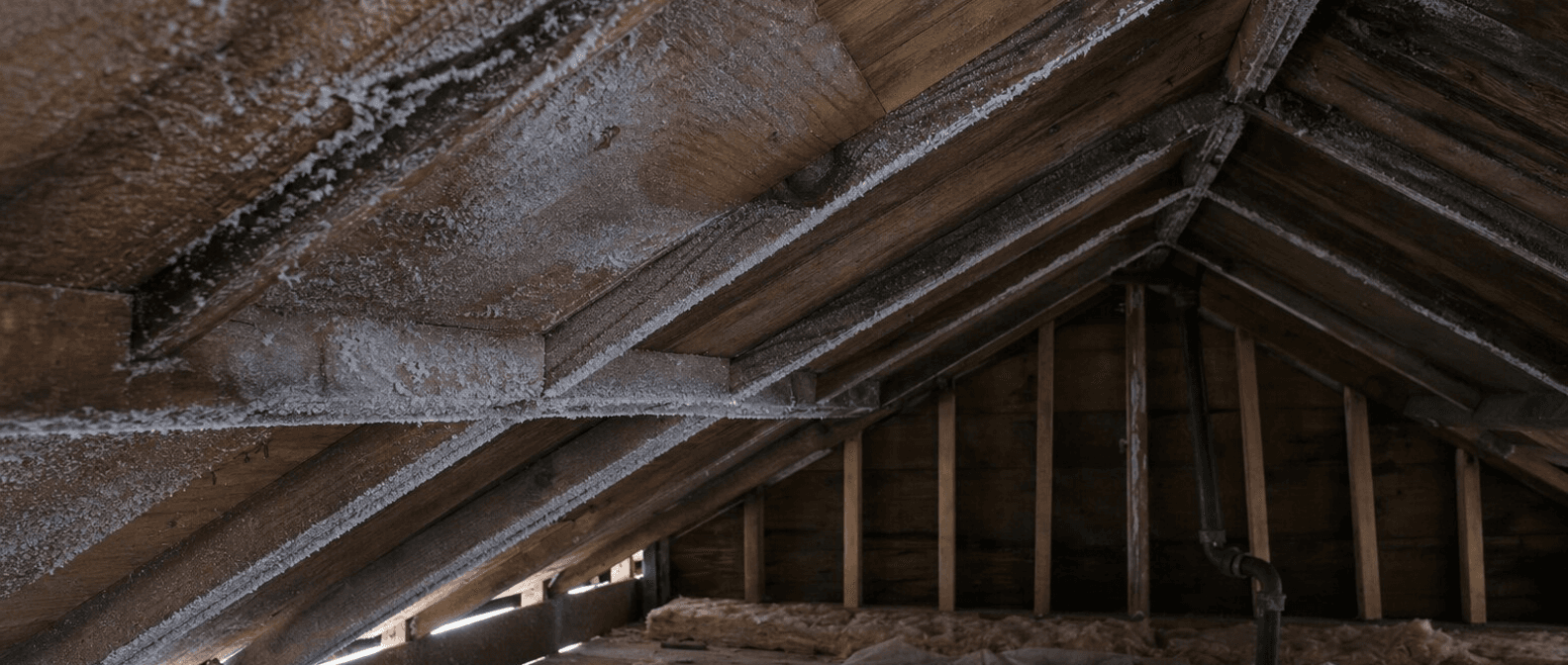
In winter, a poorly ventilated attic allows warm, humid air from your living space to rise and condense on cold wood surfaces. Over a full Wisconsin winter, that moisture builds up. You may see frost on the underside of the roof sheathing on cold days, or moisture staining on rafters and joists as temperatures warm. In severe cases, mold and mildew colonies form on the wood.
None of this is normal. Frost in the attic is a failure, not a quirk. Wood that repeatedly gets wet and dries out loses structural integrity over time. Mold creates indoor air quality problems and can spread to wall cavities if left unchecked. And compressed or wet insulation loses R-value, which feeds the heat-loss cycle that created the moisture problem in the first place.
This is one of the reasons routine roof maintenance matters so much in a climate like ours. A professional attic inspection catches these conditions early, when a ventilation correction or modest repair is all that's needed — before the decking rots and the repair bill multiplies.
Sign 5: A Hot, Stuffy Second Floor in Summer
If your upstairs rooms are noticeably hotter than the rest of the house during summer, and closing vents doesn't help, you're likely feeling the effect of a poorly ventilated attic directly overhead.
Superheated attic air radiates through the ceiling into the rooms below. The closer those rooms are to the roofline — think bedrooms with a vaulted or low-pitched ceiling above them — the more pronounced the effect. In older Green Bay homes with limited insulation and marginal soffit coverage, this can make second-floor rooms genuinely uncomfortable from June through August.
The fix isn't always complicated. Sometimes blocked soffit vents are the entire problem — insulation pushed against the eaves cuts off intake airflow and the whole ventilation system stalls. Adding proper baffles and clearing the vents restores airflow without major expense. Other situations require adding exhaust capacity at the ridge, or in some cases redesigning the ventilation system for the attic geometry. A proper inspection sorts out which situation you're in.
Sign 6: A Roof That Has No Ridge Vent (or Inadequate Soffit Vents)
Sometimes poor attic ventilation isn't a symptom — it's visible right from the start. Look at your roofline.
A properly ventilated roof in Green Bay should have continuous or regularly spaced intake ventilation along the soffits, and exhaust ventilation near the peak — typically a ridge vent running along the length of the ridge. If you don't see a ridge vent, or your soffits are fully solid without any vents at all, your attic is almost certainly under-ventilated regardless of how everything looks on the inside.
Older homes in Northeast Wisconsin frequently have this problem. They were built to codes that didn't require what we know today about ventilation balance. Over time the industry has come to understand that the ratio of intake to exhaust ventilation matters, that balanced systems outperform systems heavy in one direction, and that a continuous soffit-to-ridge path is the gold standard.
If you're not sure what your roof has, that's exactly the kind of thing our free inspection identifies. There's no need to guess.
What Poor Ventilation Costs You Over Time
Let's put some numbers behind it. A typical asphalt shingle roof in Wisconsin should last 25 to 30 years with good installation and proper conditions underneath. A roof running on an inadequate ventilation system may fail in 15 to 18 years — sometimes less. That's a replacement cycle that arrives years ahead of schedule.
Add to that the energy cost increases, the moisture damage to framing and insulation, and the potential for ice dam damage every winter, and the total cost of poor attic ventilation over a decade easily runs into the thousands. Sometimes tens of thousands, if structural damage has been accumulating quietly.
Fixing ventilation is usually not a major project on its own. But addressing it as part of a roof repair or replacement is straightforward — and it changes what you can realistically expect from the new roof going forward. That's why we always assess ventilation as part of our process.
What Northeast Wisconsin Demands from a Roof System
Green Bay's climate is unforgiving. We get real winter: sustained cold, heavy snow, freeze-thaw cycles that repeat dozens of times between November and April. We get summer heat that pushes attic temperatures to extremes. A roof system that handles both of those extremes well has to be designed and installed with the climate in mind — not just the shingles, but the underlayment, the ice and water shield, and the ventilation system beneath all of it.
We have seen the full range of what happens when ventilation is ignored. Decking that's rotted through on a 12-year-old roof. Attic mold infestations that spread to wall cavities. Ice dams that caused five-figure interior damage. And we've seen what a properly ventilated roof does: it holds up. It performs the way it's supposed to. It lasts.
For a deeper look at how ventilation directly affects how long your roof lasts, our post on attic ventilation and roof lifespan in Wisconsin covers the subject in detail.
Get a Straight Answer About Your Attic Ventilation
If any of the signs above sound familiar — ice dams, rising energy bills, aging shingles, a hot second floor, moisture in the attic — the right next step is a professional inspection. Not a sales call. An actual look at what's happening up there.
Michael Pierce and the team at Pierce Roofing have been inspecting and roofing homes across Brown County and Northeast Wisconsin for over 30 years. We're Atlas PRO+ Platinum certified, carry $2M in insurance, and back our work with a 10-year workmanship warranty. When we find a ventilation problem, we tell you what it is, what's causing it, and what it'll take to fix it — in plain language, without pressure.
Schedule your free roof inspection online, or call us directly at (920) 609-8304. We serve homeowners throughout Green Bay and the surrounding area, and we're happy to take a look at your residential roofing system any time of year.