The "It's Just a Small Drip" Problem
Every homeowner who's ever had a serious roof leak says roughly the same thing when you ask how it started: "It was just a small drip. I figured I'd deal with it later."
Later has a way of getting expensive fast.
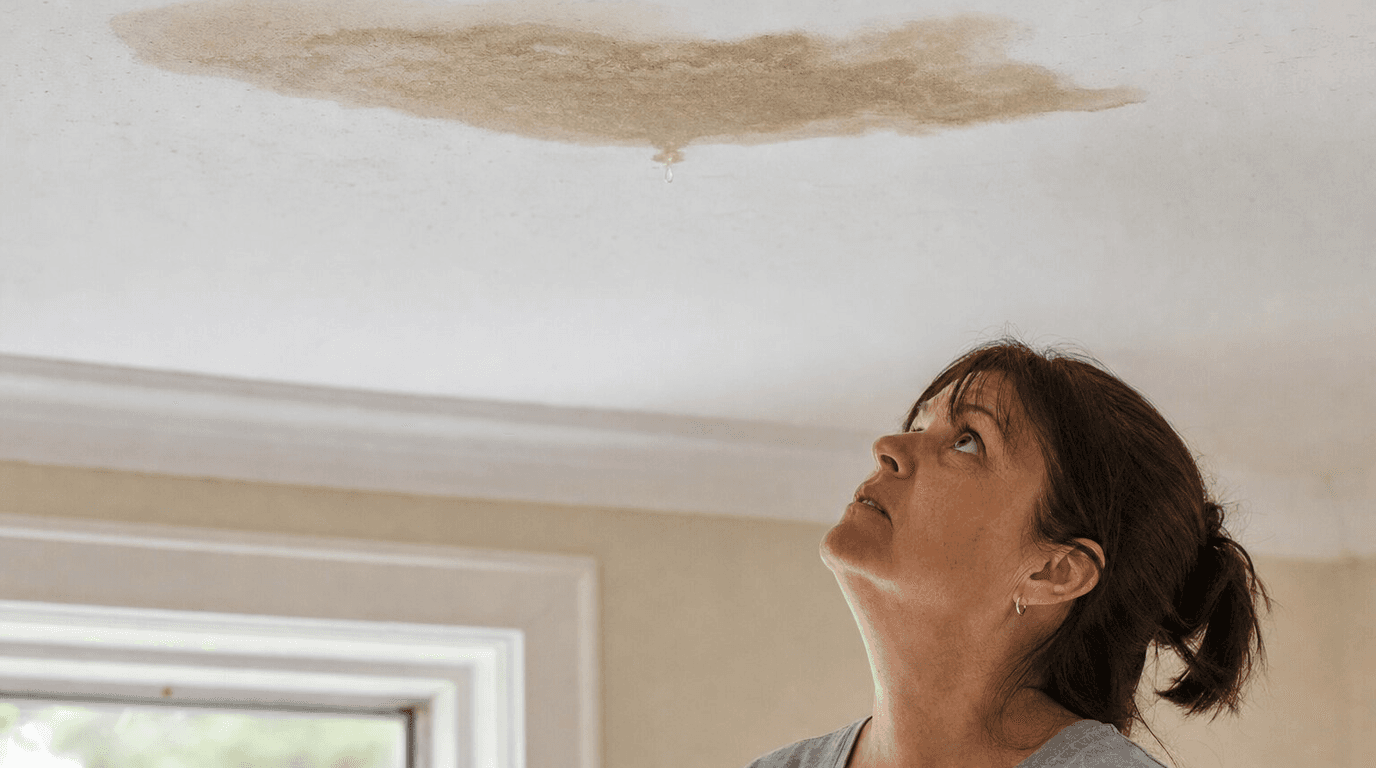
A small roof leak in Green Bay is not a stable situation. It doesn't stay small. The same water that found one path into your home will find more, and the damage it causes along the way compounds quietly until one day you're looking at a ceiling stain the size of a dinner plate, or a contractor telling you that your roof deck has rotted through in two places.
This post is about why that happens — the actual sequence of damage a small, ignored roof leak causes — and why fixing it now is almost always dramatically cheaper than fixing it in six months.
How a Small Leak Turns Into a Big Problem: The Timeline
Water is patient. It doesn't care that you meant to call a roofer. It follows gravity, finds the path of least resistance, and keeps moving.
Here's what the progression typically looks like, and how fast each stage arrives.
Week 1-2: The leak starts. You notice a small water stain, or maybe you hear a drip during a heavy rain. The entry point might be a cracked shingle, a failed flashing seal around a chimney or pipe boot, a missing piece of underlayment — any number of things. The water that's getting in is soaking into your insulation and roof deck. You can't see this yet.
Month 1-2: The deck gets wet. Your roof decking — usually OSB or plywood — absorbs water every time it rains. Wood that gets wet and dries out repeatedly starts to weaken. It loses structural integrity gradually. This phase is invisible from inside your home unless you get into the attic.
Month 2-4: Mold shows up. Wet insulation and wet wood are ideal conditions for mold. Mold can begin growing within 24 to 48 hours of a water intrusion event, and once it's established in your attic or wall cavity, it spreads. At this point, a simple roof repair has potentially become a roof repair plus mold remediation.
Month 4-6: Structural damage. Rotted decking can no longer hold fasteners properly. In bad cases, it starts to sag. Rafters that have been repeatedly wet can develop rot at the ends. At this stage, you're looking at costs that dwarf what the original leak repair would have cost.
Beyond 6 months: Interior damage compounds. Ceiling drywall, insulation, light fixtures, stored belongings in the attic — all of it is now at risk. Some homeowners reach this point and discover they're looking at a partial roof replacement rather than a repair at all.
None of this is inevitable. Every stage on that timeline is a point where catching the leak and fixing it stops the damage from progressing further.
The Specific Damage a Roof Leak Causes (That People Don't Think About)
Most people think about the obvious stuff: wet ceilings, water-stained drywall. Those are real problems. But the hidden damage is what drives the cost.
Insulation saturation. Wet insulation loses most of its R-value. Fiberglass batts that have absorbed water clump and compress. Once saturated, they often can't be dried out effectively and need to be replaced. This is a cost most homeowners don't anticipate.
Decking rot. OSB decking is particularly vulnerable to moisture. Once the glue that holds the strands together starts breaking down, the panel swells, delaminates, and loses its load-bearing capacity. Replacing a few sections of decking on top of a repair adds several hundred dollars. Replacing large areas adds thousands.
Mold remediation. This one is a budget surprise for almost everyone. Professional mold remediation in an attic space runs anywhere from $1,500 to $5,000 or more depending on how far it's spread. Your homeowner's insurance may or may not cover it, depending on your policy and how long the leak has been active.
Electrical hazards. Water and wiring don't mix. If a leak reaches electrical boxes, recessed lights, or junction boxes in your attic, you now have a safety issue on top of a moisture issue. Remedying this means an electrician in addition to a roofer.
Interior finishes. Drywall, paint, crown molding, hardwood floors below the leak — all of this can be damaged. Replacing finished surfaces in a living room or bedroom is not cheap, especially when you factor in painting, texture matching, and trim work.
None of these problems exist in the first week or two. They develop because the leak was left alone.
Green Bay's Weather Makes Waiting Even Riskier
Waiting on a roof leak is always a gamble. In Northeast Wisconsin, the odds are particularly bad.
Our springs come with heavy, sustained rain events that push water through even minor vulnerabilities. A small gap that barely drips during a light shower becomes a real problem during a two-inch rainfall in 24 hours. Summer brings afternoon thunderstorms that can be surprisingly intense. And once fall arrives, you're heading into ice dam season — which is its own category of roof damage entirely.
There's rarely a good "quiet season" in Wisconsin where a small leak just sits there harmlessly. Something is always pushing water at your roof. That makes the window between "small leak" and "expensive problem" shorter here than it would be in a drier climate.
If you know you have a leak — or suspect you might — the time to act is now, not when the calendar feels more convenient. A free roof inspection costs you nothing and tells you exactly what you're dealing with before it gets worse.
What It Actually Costs to Wait
Let's put some rough numbers to this, because abstractions like "it gets expensive" aren't as useful as real figures.
A typical minor roof repair in the Green Bay area — replacing a few damaged shingles, resealing failed flashing, patching a small area of underlayment — generally runs in the range of $300 to $800 depending on the scope.
Add in decking rot that requires a few panels to be replaced, and you're looking at $1,200 to $2,500.
Add mold remediation, and you might be at $3,000 to $6,000.
If the delay has been long enough that the leak has damaged interior drywall, insulation, and created a structural concern, you can be looking at $8,000 to $15,000 or more — and potentially at a point where a partial roof replacement makes more financial sense than continued repairs.
Those numbers aren't meant to scare you. They're meant to show you that the cost of a small repair is a small fraction of the cost of an ignored one. The math is not subtle here.
"But I Don't Know If It's Really a Leak"
Some homeowners wait not because they're choosing to but because they're not sure. They see a ceiling stain but aren't certain it's an active leak. They heard a drip once but can't find the source.
This is worth addressing directly: uncertainty is not a reason to delay, it's a reason to get someone up there and look.
If you've found signs that concern you, our post on how to find a roof leak step by step can help you do some initial investigation from the ground and inside your attic. But when in doubt, a professional inspection is always going to give you more reliable information than guessing from below.
A good roofer can tell you in a single visit whether you have an active leak, how it's getting in, how much damage has already occurred, and what it'll take to fix it. That information is valuable regardless of what the answer turns out to be.
When a Leak Needs Same-Day Attention
Most small leaks can be scheduled as normal repair jobs within a week or two. But some situations need to move faster.
If water is actively dripping into your living space during a storm, if you can see daylight through your attic, if you've got a large wet area spreading on your ceiling, or if the leak is near electrical fixtures — that's a situation for emergency roof leak repair. Waiting for a regular appointment isn't the right call when the damage is actively accelerating.
Pierce Roofing handles emergency leak situations for homeowners across the Green Bay area. Temporary tarping, emergency repairs, and fast assessments — we can get someone there quickly when it matters.
Why Small Repairs Are Worth Doing Right
One thing worth saying: not every small repair needs to be a cheap patch. Some leaks are happening because one component failed while everything around it is still in good shape. A proper repair to that one component, done right, can last for years.
But some leaks are a symptom of a roof that's reaching the end of its life. In that case, chasing individual leaks with patches is an expensive strategy. You fix one spot, another opens up in six months, and you're spending repair money repeatedly while the underlying condition gets worse.
A good inspection tells you which situation you're in. If the roof has years of life left and the damage is isolated, repair it and move on. If it's aging out and starting to fail in multiple places, that's a different conversation — and knowing it sooner means you can plan and budget rather than react in an emergency.
Michael Pierce has been doing this work in Green Bay for over 30 years. He's seen both situations thousands of times. Pierce Roofing holds Atlas PRO+ Platinum certification, carries $2M in liability insurance, and backs every job with a 10-year workmanship warranty. When we tell you what we find on your roof, it's a straight answer based on what's actually there — not what generates the most work for us.
Don't Let a Small Problem Get Bigger
If you've got a leak — or even just a suspicion of one — the worst thing you can do is hope it resolves itself. It won't. Water doesn't stop on its own, and every rain event is another opportunity for the damage to spread further.
Get it looked at. Get it fixed. The cost difference between acting now and acting in six months is significant, and it only goes in one direction.
Call Pierce Roofing at (920) 609-8304 or schedule your free roof inspection online. We'll tell you exactly what's going on and what it'll take to fix it — no runaround, no pressure, just honest answers from a contractor who knows Northeast Wisconsin roofs.