The Short Answer (and Why It's Not That Simple)
If someone asks whether seamless or sectional gutters are better for a Wisconsin home, the honest answer is: seamless gutters win on almost every practical measure. Fewer leaks, less maintenance, longer lifespan, cleaner look.
But the longer answer matters too. Sectional gutters aren't inherently bad. They have real use cases — specific situations where they make sense financially or logistically. Understanding both options is how you make a decision you won't regret five winters from now.
This comparison is written specifically for homeowners in Northeast Wisconsin. What works fine in a mild climate can fail fast in Green Bay's freeze-thaw cycles, heavy snow loads, and ice dam season. That context changes the calculus.
What Are Sectional Gutters?
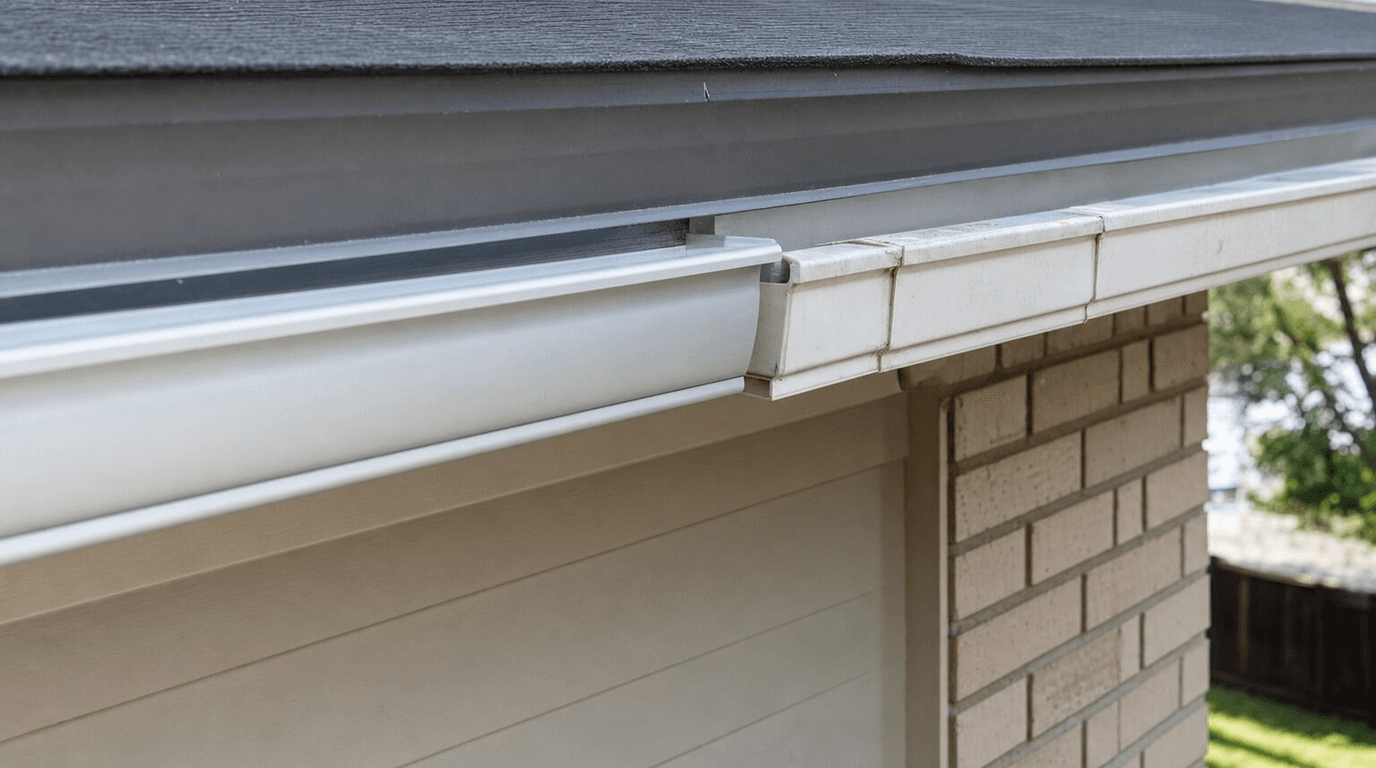
Sectional gutters are exactly what they sound like: pre-cut lengths of gutter material, typically 10 to 20 feet long, that get pieced together on-site with connectors and sealant. You've seen them at every hardware store. They come in vinyl, aluminum, and steel, and a reasonably handy homeowner can install them over a weekend.
That accessibility is the main selling point. Lower material cost. No special equipment needed. Easy to replace individual sections if something gets damaged.
The downside is built into the design. Every joint between sections is a potential leak point. And in Wisconsin, those joints take a beating.
Freeze-thaw cycles work on sealant the same way they work on concrete: expand, contract, expand, contract. Over a few seasons, the sealant at each joint either cracks or loses its bond. Once a joint starts leaking, water gets into the wood behind it — the fascia board, the soffit — before most homeowners notice anything is wrong.
We see this pattern constantly in the Green Bay area. Sectional gutters installed five or six years ago, joints starting to separate, fascia boards silently rotting. What started as a $300 gutter job turns into a $1,200 repair that includes wood replacement.
What Are Seamless Gutters?
Seamless gutters are fabricated on-site from a continuous roll of aluminum using a portable forming machine. A contractor pulls up to your house, feeds the coil into the machine, and produces a single gutter run cut to the exact length of your roofline. No joints. No seams. Except at corners and downspout connections, there's nothing to leak.
That's the core advantage. It's not marketing language — it's physics. You can't have a seam leak if there's no seam.
Installation is faster than most homeowners expect. A full house can typically be done in a day. And because the gutter is formed to fit your home precisely, you don't get the minor waviness and misalignment that comes from piecing together pre-cut sections.
Our seamless gutter installation uses 0.032-inch aluminum, which is heavier gauge than the stock material sold at hardware stores. It holds its shape better under ice and snow weight, and it doesn't oil-can (that rippling effect you see on thinner aluminum gutters exposed to temperature extremes).
Seamless vs. Sectional Gutters: A Direct Comparison
Let's get specific. Here's how the two types compare across the factors that actually matter for Wisconsin homeowners.
Leak Potential
This isn't close. Sectional gutters have a joint every 10 to 20 feet. A typical ranch-style home might have 150 to 200 linear feet of gutter, meaning 8 to 15 joints. Each one is a future leak.
Seamless gutters have joints only at corners and downspout outlets — usually 4 to 8 total on a full house, regardless of its size. That's a dramatic reduction in failure points.
For Wisconsin homeowners specifically, this matters more than it would in, say, Arizona. Ice formation at joints accelerates the sealant breakdown process. What might last eight years in a mild climate might fail in three here.
Maintenance Requirements
Both gutter types need cleaning. Leaves, seeds, and debris accumulate the same way regardless of how the gutters were manufactured. That part doesn't change.
But sectional gutters also require periodic resealing at every joint — typically every three to five years in our climate. If you skip it, or miss one joint, you're going to have a leak. Seamless gutters largely eliminate that maintenance task.
You can read more about what proper gutter maintenance looks like in our post on gutter maintenance for Wisconsin homeowners. The short version: the simpler the gutter system, the easier it is to keep up with.
Lifespan
Well-maintained aluminum seamless gutters typically last 20 to 30 years in Northeast Wisconsin. Sectional aluminum gutters, under the same conditions, tend to run 10 to 15 years before joint failures make replacement the more economical option than continued repair.
Vinyl sectional gutters are even shorter-lived in our climate. Vinyl becomes brittle in sustained cold and can crack from ice pressure. We generally don't recommend vinyl gutters for homes in Wisconsin — the material just isn't suited for the temperature range we deal with.
Appearance
Seamless gutters look cleaner. That's subjective, but it's also consistently what homeowners notice after installation. No visible joints, no hardware at mid-span, no color variation where sections meet.
For homes where curb appeal matters — whether for personal satisfaction or resale value — seamless gutters are the better choice. They also come in a wider range of colors, since they're made to order rather than stocked in generic options.
Cost
Here's where sectional gutters have a real advantage. Material costs are lower, and a homeowner with basic skills can install them without professional help.
Seamless gutters require professional installation — you can't replicate a gutter forming machine at home. Labor adds to the total cost.
The installed price difference is typically $3 to $6 per linear foot. On a 200-linear-foot installation, that's $600 to $1,200 more for seamless upfront.
But run the numbers over a 20-year period and the math flips. If sectional gutters need joint resealing every four years and partial or full replacement at year 12 to 15, the total cost over two decades often exceeds the seamless option — sometimes significantly. That's before accounting for any fascia or soffit damage caused by joint leaks.
When Sectional Gutters Actually Make Sense
We're not here to dismiss sectional gutters entirely. There are situations where they're a reasonable call.
If you're a landlord managing a rental property with a limited budget and a short ownership horizon, the lower upfront cost of sectional gutters may make sense. You're not optimizing for 25-year performance — you're managing cash flow.
If a single section of seamless gutter gets damaged (say, a tree branch falls on one run), replacing that section is straightforward. Sectional gutter material is widely available and easy to match if you're making a localized repair.
And for small outbuildings, sheds, or garage additions where aesthetics don't matter much, sectional gutters are perfectly functional.
For primary residences in Green Bay and the surrounding counties, though? Seamless is the smarter long-term investment.
The Wisconsin Factor: Why Climate Makes This Decision Easy
Homeowners in more temperate climates sometimes get good mileage out of sectional gutters. Our climate doesn't give them that room for error.
Northeast Wisconsin gets an average of 45 to 50 inches of snow per year. Ice dam formation is a real annual risk for homes without proper attic insulation and ventilation. Ice forming inside gutters exerts outward pressure on joints. Freeze-thaw cycles — sometimes happening multiple times a week in March and early April — stress sealants far harder than a single cold season would.
If clogged or failing gutters are already a concern, that problem compounds fast. We wrote a detailed post on what clogged gutters actually do to your roof and foundation — the short version is that it's not just a cosmetic issue. Failed gutters redirect water into your fascia boards, along your foundation, and potentially into your basement.
Seamless gutters don't solve every drainage problem, but they eliminate one of the most common failure modes entirely.
What to Expect From a Professional Gutter Installation
If you've decided seamless is the right direction, here's what a professional gutter installation actually looks like.
A crew arrives with the forming machine on a trailer. They measure your roofline, select the appropriate gutter profile (usually 5-inch or 6-inch K-style for residential homes in our area), and begin forming the runs on-site. Each section is cut precisely to length before going up.
Hangers get installed every 18 to 24 inches — closer spacing than the hardware-store recommendation, which is important for handling snow and ice loads. Downspout placement is positioned to move water well away from the foundation.
A full house typically takes one day. Cleanup is minimal since there's no cutting, trimming, or excess material to deal with.
After installation, the crew will do a water test to confirm drainage is working correctly and there are no connection issues at corners or outlets.
If you're also dealing with existing gutter problems — gaps, sagging, sections pulling away from the fascia — our gutter repair team can assess whether repair or full replacement makes more sense before any new material goes up.
Signs It's Time to Replace Your Current Gutters
Not sure if your existing gutters have enough life left? A few things worth looking for:
- Water stains or rot on the fascia boards directly behind the gutters
- Sections that are visibly pulling away from the house, sagging in the middle, or no longer pitched toward the downspout
- Paint peeling on the exterior siding near the roofline (a sign of water overflow or leakage)
- Visible gaps or rust at the seam connections
- Gutters that overflow during normal rainstorms even when they've just been cleaned
If any of those sound familiar, read our post on signs it's time to replace your gutters for a more complete breakdown. It covers the specific damage patterns we see most often in Green Bay and when repair vs. replacement is the right call.
Get a Seamless Gutter Estimate in Northeast Wisconsin
Pierce Roofing has been installing and repairing gutters across Brown, Kewaunee, Outagamie, Oconto, Winnebago, and Manitowoc counties for over 30 years. Our gutter services cover everything from full seamless installations to downspout repositioning, fascia repair, and seasonal cleaning.
We're Atlas PRO+ Platinum certified, insured to $2 million, and we back our work with a 10-year workmanship warranty. When something goes wrong — and in our climate, gutters take real abuse — you want a contractor who stands behind what they install.
Call (920) 609-8304 to schedule a free estimate. We'll take a look at your current gutters, give you an honest assessment, and walk you through your options without the sales pressure.