Your Gutters Are Doing More Work Than You Think
Gutters are the most underappreciated part of any home's exterior. Nobody really notices them until something goes wrong — and by then, the damage has usually already started.
A properly functioning gutter system moves thousands of gallons of rainwater away from your roof edge, fascia, soffits, siding, and foundation every year. When that system starts failing, the water has to go somewhere. And it almost always goes somewhere you don't want it.
The tricky part: most gutter failures don't announce themselves. They happen gradually. A section starts pulling away from the fascia. A seam opens up at a joint. A downspout gets partially blocked and starts overflowing during heavy rain. Each one seems minor. Together, they add up to real structural damage.
Here's what the signs actually look like — and what each one is telling you about the health of your gutter system.
Sign 1: Gutters Pulling Away From the Fascia
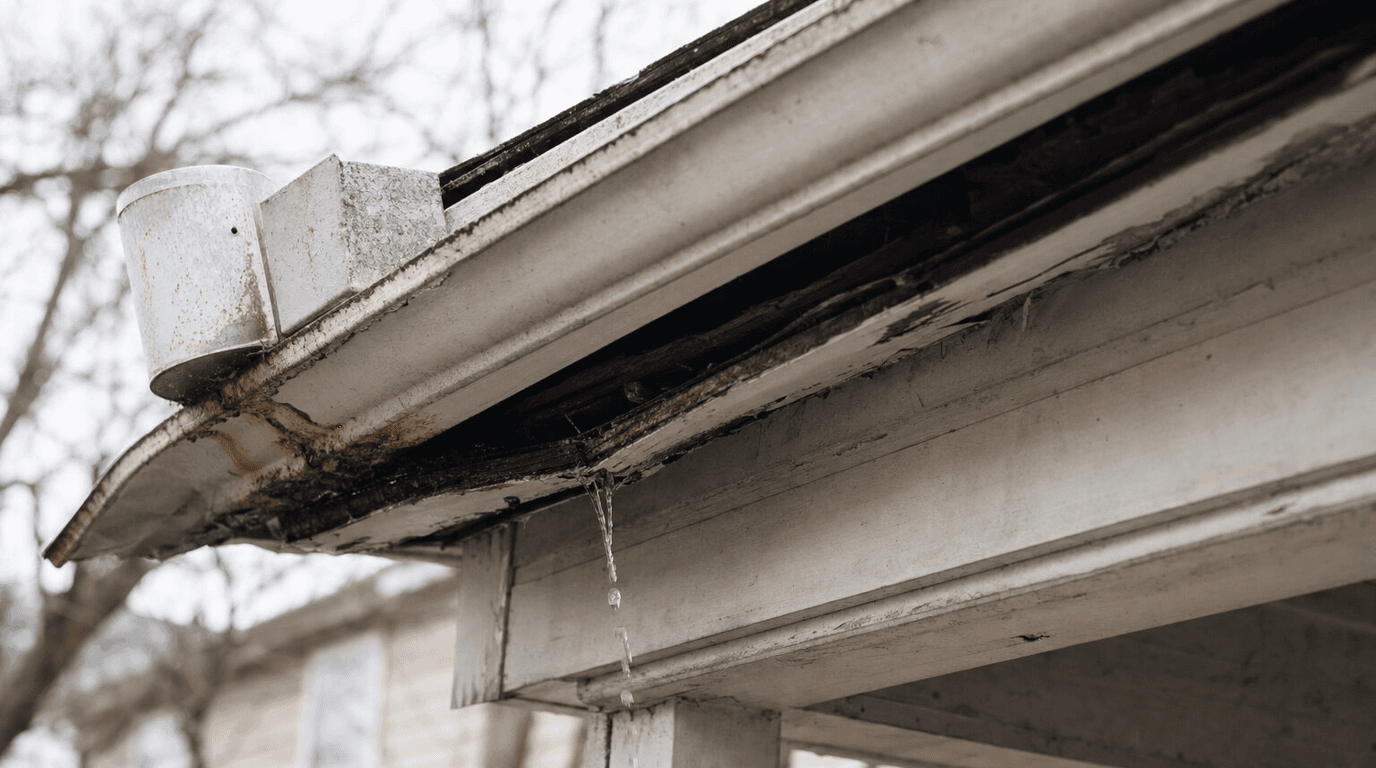
This is probably the most visible sign, and also one of the most serious. If you look at your gutters from the ground and see gaps between the back of the gutter and the fascia board, or sections that are visibly sagging or tilting outward, that gutter is no longer doing its job.
When gutters separate from the fascia, two things happen. First, water that should drain through the system now runs directly down the fascia and into the wood behind it. Second, the fascia itself is getting wet repeatedly, which leads to rot that spreads further than the gutter damage you can see.
This usually happens for one of two reasons: the hangers (the hardware that holds the gutter to the fascia) have failed, or the fascia board itself has rotted to the point where there's nothing solid to anchor to. The first problem is fixable. The second means the fascia needs to go before new gutters can be installed.
A professional gutter inspection can tell you which situation you're dealing with.
Sign 2: Visible Cracks, Splits, or Holes
Small cracks in gutters are almost always ignored because they're hard to see from the ground. But even a hairline crack at a joint lets water drip out at exactly the wrong place — typically right against the fascia or foundation wall below.
Over time, small cracks become splits. Aluminum and vinyl gutters both get brittle with age, especially after years of Wisconsin winters. Freeze-thaw cycles expand and contract the material repeatedly, and eventually the seams give out. Steel gutters rust through. Older sectional gutters develop joint failures even when the sections themselves look fine.
A crack you can cover with a finger today is the same crack that will be draining water into your fascia by next spring. If your gutters are showing multiple cracks or splits at several locations, repair patches are a short-term fix at best. That's usually the point where gutter replacement makes more financial sense than continuing to patch.
Sign 3: Peeling Paint or Rust Stains on the Exterior
Gutters that are overflowing or leaking at the seams will leave evidence on the walls below them. Peeling paint along the exterior directly under the gutter line is almost always a water problem. Orange rust stains dripping down vinyl or wood siding tell you the gutters themselves are rusting from the inside out.
Neither of these is just a cosmetic issue. Persistent moisture against siding leads to rot and mold behind the surface. If you're seeing widespread staining across multiple sections of your exterior, the gutter problem has likely been going on long enough to cause hidden damage worth investigating.
Before repainting or replacing siding, it's worth having the gutters evaluated. Fixing the paint before fixing the source of the water is a waste of money.
Sign 4: Water Pooling Near Your Foundation After Rain
This one matters a lot in Northeast Wisconsin, where heavy spring rains and summer storms dump significant water on roofs in short windows. Gutters and downspouts are supposed to move that water at least 6 feet away from your home's foundation.
When they're not working — because they're sagging, clogged, cracked, or undersized — the water falls straight off the roof edge and pools at the base of your home. Over time, that consistently wet soil puts hydrostatic pressure on foundation walls. That's how basements get water intrusion. That's how slab foundations develop cracks. That's how landscaping directly against the home becomes a liability.
If you notice water pooling against your foundation after a rainstorm and your gutters are more than 15 years old, the gutters are almost certainly part of the problem. We cover this in more depth in our post on how clogged and failing gutters damage your roof and foundation — it's worth reading before you decide whether to wait on this.
Sign 5: Mildew or Water Stains in the Basement
Speaking of foundation damage — interior water stains on basement walls are often traced back to gutter failure, not plumbing or groundwater. When downspouts dump water right at the foundation repeatedly, it eventually finds its way in through gaps, cracks, or the natural permeability of block and concrete.
If your basement has a musty smell or visible staining and you haven't had the gutters looked at recently, that's worth investigating before spending money on interior waterproofing. Fixing the source costs a fraction of what remediation costs after the fact.
Sign 6: Gutters Overflowing During Normal Rainstorms
This is one homeowners often dismiss as a clogging problem. Sometimes it is. But sometimes the gutters are simply too small for the roof area they're serving, or they're sagging in the middle and the water has nowhere to drain.
Standard residential gutters in older homes were often installed with 4-inch or 5-inch sections at a time when rooflines were simpler and square footage was smaller. Modern homes — or older homes with additions, dormers, and steeper pitches — frequently need 6-inch gutters to handle peak flow during heavy storms.
If your gutters overflow consistently even when they're clean, the system was probably undersized to begin with. Upgrading to seamless gutters sized correctly for your roof is the permanent fix. Sectional gutters that overflow will continue to overflow regardless of how often you clean them.
Sign 7: Gutters That Are 20 or More Years Old
Age alone isn't a reason to replace gutters. But age combined with any of the other signs above? That's a different conversation.
Aluminum gutters — the most common type installed in Northeast Wisconsin — have a realistic service life of 20 to 30 years with regular maintenance. Sectional gutters with multiple joints wear faster because the joints are the weak point. Seamless gutters last longer because they have fewer of those failure points.
If your gutters are approaching or past 20 years old and you're already dealing with sagging, leaks at the seams, or water stains on your exterior, you're past the point of cost-effective repairs. The math usually works out in favor of replacement at that stage — especially when you factor in what deferred replacement costs in fascia repair, foundation work, or roof edge damage.
Not sure whether yours can be salvaged? Our gutter repair service includes a full assessment of what's worth fixing and what isn't. We'll give you an honest answer.
What Happens When You Wait Too Long
The direct cost of gutter replacement is easy to understand. The hidden cost of waiting is harder to see until it shows up.
Fascia board replacement adds hundreds of dollars to any gutter job. Soffit repair adds more. Roof decking damage at the eaves — caused by water backing up under shingles from overflowing or improperly sloped gutters — can turn a $1,500 gutter replacement into a $4,000 to $6,000 repair once the decking is addressed. That's before you get into any foundation-related costs.
We see this pattern regularly. A homeowner puts off gutter replacement for two or three seasons because the gutters are "still kind of working." By the time we get there, the fascia is rotted, the drip edge is compromised, and we're repairing the roof edge before we can even install the new gutters.
Gutters protect your roof as much as your roof protects your home. If you're not sure where yours stand, a free roof and gutter inspection is the fastest way to find out.
When Repair Makes Sense — and When It Doesn't
Not every gutter problem calls for full replacement. A single cracked section, a loose hanger, a downspout that's come apart at a joint — those are repairs. Fast, inexpensive, done.
Replacement makes sense when:
- Multiple sections are pulling away from the fascia
- Seam failures are recurring across several joints
- The gutters are 20+ years old and showing wear across the whole system
- The system is undersized for the home and overflows regularly
- The fascia has rotted to where gutters can't be properly reattached
The comparison between repair and replacement is something we looked at in detail in how long do gutters last and how to know when to repair vs. replace. If you're on the fence, that post walks through the decision clearly.
Gutter Replacement in Green Bay and Northeast Wisconsin
Pierce Roofing has been installing and replacing gutters across Green Bay and the surrounding counties for over 30 years. We handle everything from single-section repairs to full seamless gutter system installations — all backed by our 10-year workmanship warranty.
We're Atlas PRO+ Platinum certified, insured to $2 million, and we treat every job the same way whether it's a gutter repair or a full roof replacement. You get an honest assessment, no pressure, and work done right the first time.
If your gutters are showing any of the signs above — or if you just haven't had them looked at in a few years — call us at (920) 609-8304 or request your free inspection online. We serve Brown, Outagamie, Kewaunee, Oconto, Winnebago, and Manitowoc counties.