How Long Do Gutters Actually Last?
It depends more than most people expect. The material matters. The climate matters. And how well the gutters were installed in the first place matters more than either of those.
Here's the general lifespan breakdown by material:
- Aluminum gutters: 20 to 30 years. The most common type in Northeast Wisconsin. They hold up well but will corrode over time, especially in areas with a lot of ice and road salt in the air.
- Galvanized steel gutters: 20 to 25 years. Strong, but they rust from the inside out once the protective coating fails. That process accelerates here.
- Copper gutters: 50+ years, sometimes 100. Beautiful, expensive, and genuinely long-lasting. You won't see them on many homes in the Green Bay area, but when you do, they're almost never the problem.
- Vinyl gutters: 10 to 20 years. The weakest performer in cold climates. Vinyl gets brittle in freezing temperatures, cracks under ice loads, and tends to sag and separate at the seams. If your home has vinyl gutters, replace them with aluminum when they start showing problems.
- Seamless aluminum gutters: 25 to 35 years on the high end. Fewer joints means fewer failure points, which is why we typically recommend them over sectional systems. You can read more about that in our seamless vs. sectional gutters comparison.
So the short answer: most homeowners in Green Bay are working with aluminum gutters that will last 20 to 30 years — assuming they were installed correctly and maintained along the way. Wisconsin's freeze-thaw cycles eat into that lifespan faster than the national averages suggest.
What Actually Shortens Gutter Lifespan in Wisconsin
The national averages for gutter lifespan are based on moderate climates. We are not in a moderate climate.
Green Bay averages over 45 inches of snow per year. Ice dams form on roofs with poor attic ventilation and force water back under shingles and into the gutter trough. Heavy ice loads bend gutters, pull hangers out of fascia boards, and crack sectional joints. Salt from winter road treatment corrodes metal faster than regular rain would.
Then there's clogging. Clogged gutters are one of the fastest ways to shorten gutter life because standing water accelerates rust, adds weight that stresses the hangers, and creates the exact ice dam conditions that do the most damage. If you haven't read about how clogged gutters affect more than just the gutters themselves, our post on clogged gutters and roof and foundation damage is worth your time.
Beyond weather: improper slope, undersized downspouts, and cheap original installation all compound the problem. A gutter that was poorly hung from day one will fail in 12 years doing what a properly installed gutter would have handled for 25.
Signs You Can Get Away With a Repair
Not every gutter problem means full replacement. Here's when repair makes sense:
Small holes or cracks. A single hole from a fallen branch or a cracked seam on an otherwise sound system can be patched or resealed. If the damage is isolated and the surrounding metal is still solid, repair is the right call.
One or two sagging sections. Sagging almost always comes from broken or missing hangers, not failed gutter material. Replacing a few hangers costs almost nothing and fixes the problem completely — as long as the fascia board the hangers attach to isn't rotted out.
A clogged or disconnected downspout. This is pure maintenance, not replacement. A disconnected downspout elbow or an end cap that came loose is a 20-minute fix.
Minor joint separation. Sectional gutters separate at the seams over time. If the sections themselves are in good shape, resealing the joint with gutter sealant buys another several years of life.
The honest rule: if the repair is localized, the rest of the system is sound, and the gutters aren't approaching the end of their expected lifespan, repair is worth doing. Our gutter repair services cover all of the above.
Signs It's Time to Stop Repairing and Just Replace Them
This is where homeowners most often make the wrong call — they keep patching a failing system because replacement feels like a bigger expense. But a system that needs repairs every year or two is already costing you the replacement anyway, just in smaller installments with more headaches.
Here's when replacement is the smarter move:
The gutters are over 20 years old and showing multiple issues. Age alone isn't a reason to replace. But when an older system has rust, sagging, and joint failures all at once, you're looking at a system that's just done.
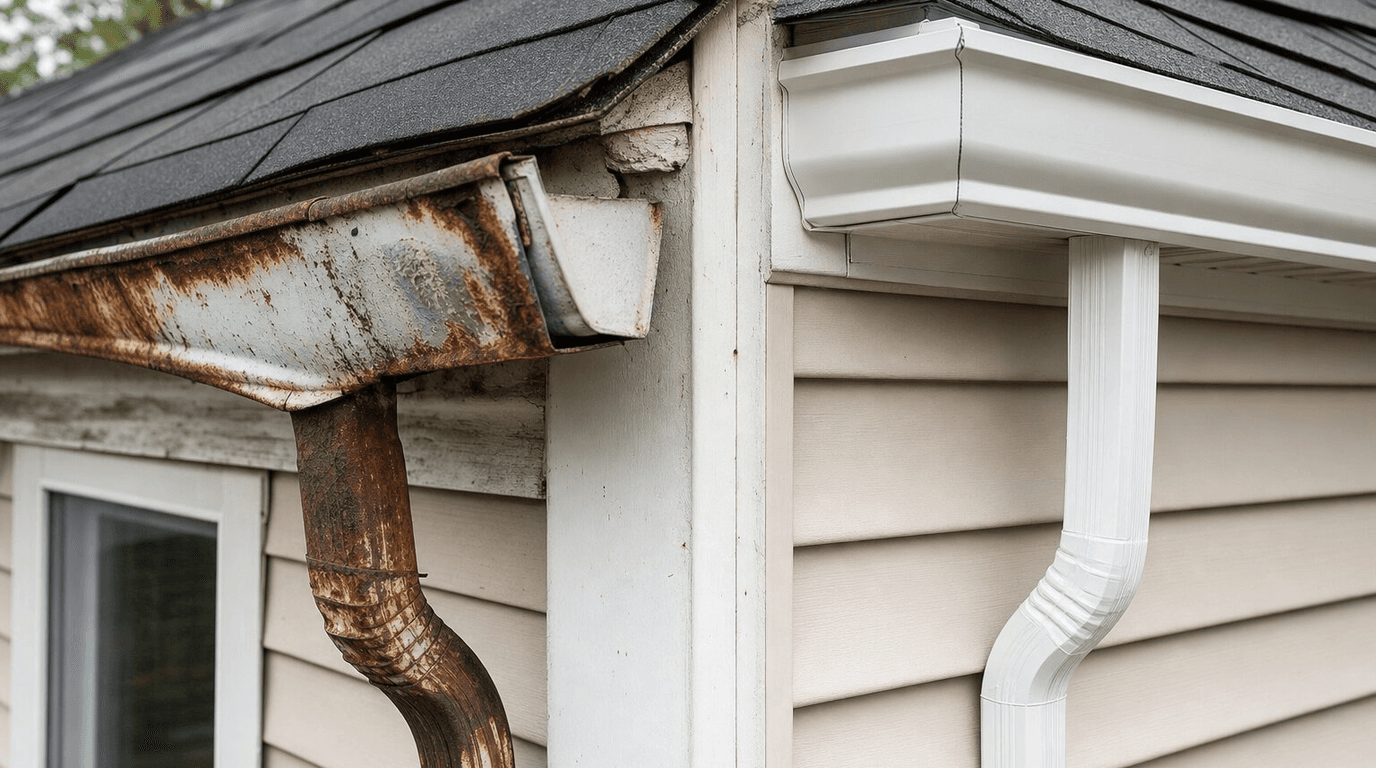
Widespread rust or corrosion. Surface rust on the outside can sometimes be treated. Rust on the inside of the trough — which you'll see as orange-brown staining in the water that comes out of your downspouts — means the metal is failing from within. That can't be patched.
Gutters pulling away from the fascia along multiple sections. If hangers are failing across the whole run, it often means the fascia board itself has rotted and can no longer hold fasteners. At that point, you're replacing the fascia and re-hanging the gutters regardless. New gutters on a fresh fascia board make more sense than re-hanging old, worn ones.
Visible cracks running along the trough. Small holes can be patched. Long hairline cracks that run with the gutter channel can't — not durably. They'll open back up with the first freeze.
Persistent water pooling against the foundation. If your gutters are draining incorrectly despite cleaning and downspout maintenance, the system may be undersized or improperly sloped. That's a design problem, not a repair problem. It requires new installation.
If any of this sounds familiar, take a look at our full breakdown of signs you need to replace your gutters in Green Bay for a more detailed checklist.
The Cost Comparison: Repair vs. Replace
This is usually what drives the decision, so let's be direct about it.
A typical gutter repair in the Green Bay area — resealing joints, replacing a few hangers, patching a small hole — runs $150 to $400 depending on the scope. Downspout work is usually on the lower end. Anything involving fascia board repair will add to that.
Full gutter replacement on a standard 1,500 to 2,000 square foot home runs $1,200 to $2,800 depending on linear footage, material, and whether the fascia needs attention. Seamless aluminum gutters cost more upfront than sectional systems but almost always work out better over time — fewer repairs, longer lifespan, better performance.
The question to ask yourself: if you're spending $300 a year on repairs and your gutters are 18 years old, replacement in the next few years is inevitable anyway. Sometimes it's better to make that call now rather than wait for a failure during a bad Wisconsin storm.
Our gutter installation team can give you a straight answer on whether repair or replacement makes more financial sense for your specific situation — no upsell, just an honest assessment.
What to Expect From a Professional Gutter Assessment
A good gutter inspection goes beyond walking along the roofline and looking at the troughs. Here's what a thorough assessment actually covers:
- Pitch and slope across the full run (gutters should slope 1/4 inch for every 10 feet toward the downspout)
- Hanger spacing and condition (hangers should be spaced no more than 24 to 36 inches apart)
- Fascia board condition behind the gutters
- Downspout sizing relative to the roof area they're draining
- Whether the system is directing water far enough away from the foundation
- Signs of previous ice dam damage to the trough and hangers
If you're unsure about your gutters or they haven't been looked at since you moved in, a free roof inspection is a good starting point. We look at the gutters as part of the overall drainage system, which is how they should be evaluated.
A Note on Maintenance and Extending Gutter Life
Most gutters fail faster than they should. Not because of bad materials or bad installation, but because they go years without being cleaned.
Leaves, pine needles, and debris pack into the trough and trap moisture against the metal. That standing water is what accelerates rust, what adds the weight that pulls hangers loose, and what creates the ice buildup in winter that bends gutters out of shape. Cleaning gutters twice a year — once in late spring after the trees finish dropping seed and once in late fall after the leaves are down — dramatically extends the system's useful life.
For more on the full maintenance picture, our gutter maintenance 101 guide for Wisconsin homeowners covers cleaning schedules, downspout flushing, and what to watch for through the seasons.
Ready to Have a Contractor Weigh In?
Pierce Roofing has been installing and repairing gutters in Northeast Wisconsin for over 30 years. We work across Brown, Kewaunee, Oconto, Outagamie, Winnebago, and Manitowoc counties, and we back our work with a 10-year workmanship warranty. Atlas PRO+ Platinum certified and insured to $2 million.
If your gutters are giving you trouble — or you're just not sure how much life they have left — call us at (920) 609-8304 or request a free inspection online. We'll give you a straight answer.