Slate and Tile Roofing in Wisconsin: A Real Answer
Most roofing guides treat this as a simple cost-benefit question. Slate costs more upfront but lasts longer, so run the math and decide. If only it were that clean.
For Wisconsin homeowners, the question involves factors that don't come up in the national articles: freeze-thaw cycling, snow load, structural requirements, and the reality that premium materials only perform as promised when they're installed correctly and maintained over decades. That last part matters more than most people realize.
Here's a straight look at what slate and tile roofing involves, what it costs in Northeast Wisconsin, what your home needs to support it, and where it makes sense and where it doesn't.
What Are We Actually Talking About?
Slate and tile get lumped together in conversations like this one, but they're meaningfully different materials. It's worth separating them before going further.
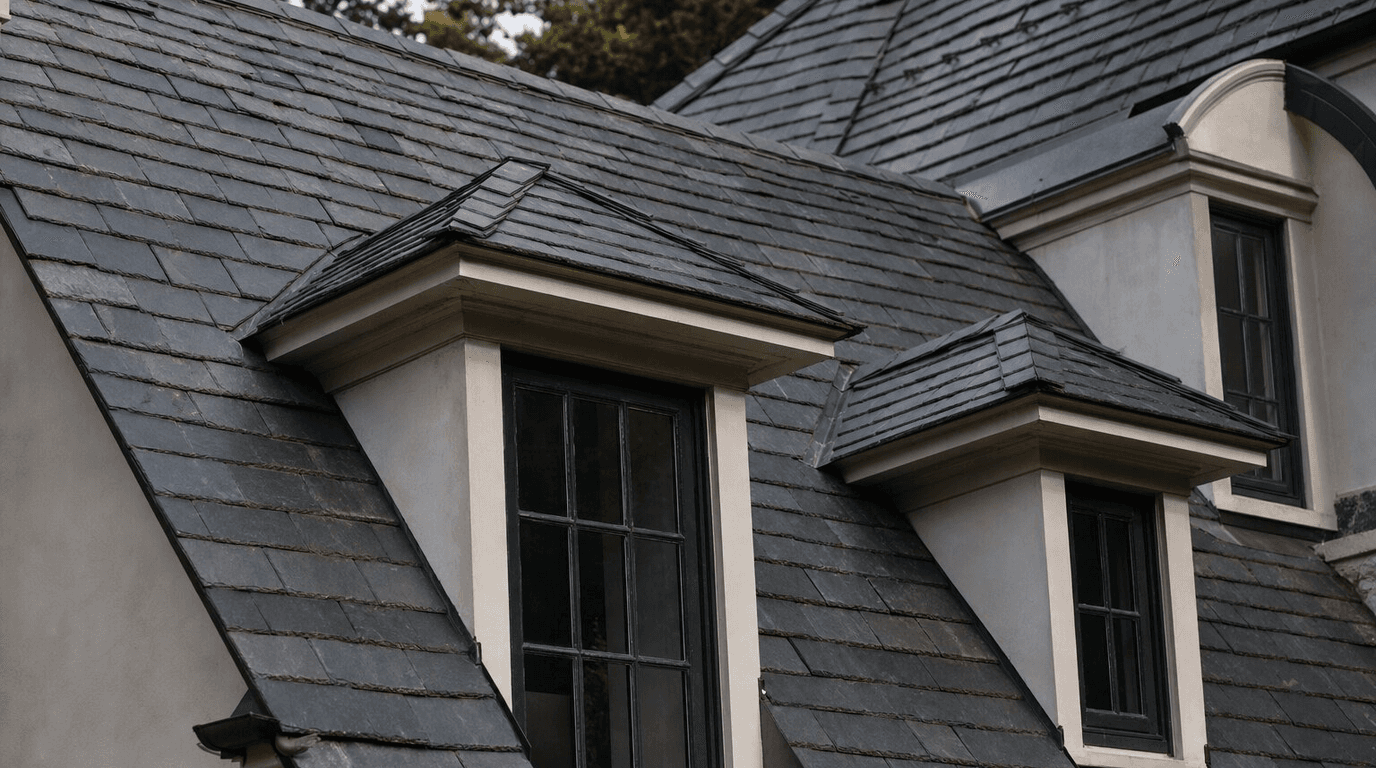
Natural slate is quarried stone, typically from Vermont, Virginia, or Pennsylvania. It's one of the oldest roofing materials in North America, and when installed correctly on an appropriate structure, it does last 75 to 150 years. Some quarried slate roofs in New England have been on houses for well over a century with only minor repairs. The material itself doesn't age the way asphalt does.
Concrete and clay tile are the other products usually grouped under "tile roofing." Clay tile, common on Mediterranean and Spanish-style homes, has similar longevity claims: 50 to 100 years is realistic. Concrete tile is somewhat less durable but still far outlasts asphalt and comes in a wider range of styles. Both are heavy, and both carry a different set of Wisconsin-specific concerns than slate does.
When homeowners in Brown or Outagamie County ask about tile roofing, they're often thinking about the look, that distinctive layered profile from certain high-end homes or older buildings downtown. That's worth acknowledging, because sometimes the goal is aesthetic, and there are ways to get a similar look with materials that are more practical for this climate.
Explore the full range of options through our slate and tile roofing services, or compare all material types on our roofing types overview.
The Wisconsin Climate Problem
What the manufacturer brochures don't emphasize is that Wisconsin is hard on premium roofing materials, and not always in the ways people expect.
Natural slate handles cold well. It doesn't soften or crack under thermal stress the way asphalt does, and it sheds snow cleanly. The issue is freeze-thaw cycling. Northeast Wisconsin averages somewhere between 50 and 70 freeze-thaw cycles per year, depending on the winter. Water works its way into any available crack or pore, freezes, expands, and gradually opens up that gap further. Over years, this process can compromise individual slates (particularly softer grades) and degrade the mortar in ridge and hip caps.
Slate doesn't fail in Wisconsin because of this, but the grade of slate matters enormously, and the installation details around ridges, hips, and valleys need to be right from day one. Hard slate grades like Buckingham Black or Vermont Grey-Black hold up far better under repeated freeze-thaw conditions than softer grades. A contractor who doesn't know the difference between slate grades isn't someone you want on this project.
Clay tile has a more significant Wisconsin problem: cracking. Clay is porous. Water penetrates, freezes, and fractures the tile. Not always, and not immediately, but over enough Wisconsin winters, clay tile that isn't specifically rated for freeze-thaw conditions will crack. Many of the clay tile products marketed nationally are designed for California or Florida climates. They look identical to freeze-thaw-rated tile, but they are not identical.
Concrete tile is generally more freeze-thaw resistant than clay, but it's heavier, and that brings us to the next issue.
Your House May Not Be Built for This
This is the most common surprise for homeowners who start researching slate or tile roofing. The roof deck and structural framing have to support it.
Standard asphalt shingles weigh roughly 2 to 4 pounds per square foot. Natural slate runs 8 to 16 pounds per square foot, depending on thickness. Clay and concrete tile typically land between 8 and 12 pounds per square foot. That's three to six times the weight your framing was probably designed for.
Most homes built in Northeast Wisconsin in the past 50 years were engineered for a standard dead load (the roof itself) plus a live load (snow). The live load calculation for this region is already higher than much of the country: our roofs are designed to handle 40 to 50 pounds per square foot of snow. Adding a 700-pound-per-square increase in dead load from switching to slate doesn't automatically break anything, but it requires a structural assessment before you commit.
Some homes can accommodate the upgrade with minimal reinforcement. Others need significant rafter sistering or ridge beam work, which adds to the project cost in ways that aren't always obvious at the estimate stage.
If you're getting quotes for a roof replacement and you're considering slate or tile, the structural evaluation should be part of the conversation before any number goes on paper.
What Does Slate or Tile Roofing Cost in Wisconsin?
Honest answer: more than most people expect, even after they've done some research.
Natural slate installed in Northeast Wisconsin typically runs between $1,500 and $3,000 per square (a roofing square is 100 square feet). For an average-sized home with a 2,000 square foot footprint and a moderate pitch, you're looking at somewhere between $45,000 and $90,000 fully installed, before any structural reinforcement. Larger or more complex roofs push past that.
Clay and concrete tile are somewhat less expensive, generally in the $700 to $1,500 per square range installed, but the structural work required can close that gap quickly.
For comparison, a quality architectural asphalt shingle replacement on the same home runs $12,000 to $20,000. Premium asphalt, like Atlas StormMaster Slate or similar impact-rated products, reaches $20,000 to $28,000, and it's designed to look similar to slate from the street.
The real question is whether the 75-to-150-year service life and the aesthetic of true slate justify the 2x to 5x cost premium for your specific situation, rather than "is slate worth it" in the abstract.
For some homeowners, it does. A historic home, a property intended to pass through generations, a house where slate is structurally appropriate and the budget supports it: those are real cases where the math works. For others, a premium asphalt product gives 85% of the visual result at 20% of the cost. Neither answer is wrong. But you should know which situation you're in before signing anything.
The Installation Quality Problem
Slate and tile are unforgiving materials. They don't hide bad flashing. They don't compensate for improper fastening. And because the materials themselves are expensive, the temptation to cut corners on the less visible parts of the installation is real for contractors who are already stretching to win the bid.
A few things go wrong more often than they should on slate and tile jobs in this region:
Nail exposure. Slates must be fastened with copper or stainless nails at the correct exposure point. Use steel and it'll rust and fail. Nail too high or too low and the slate won't have the correct overlap or hang correctly.
Undersized flashings. The flashings around chimneys, skylights, and valleys take more abuse on a heavy tile roof than they do on an asphalt one. They need to be correctly sized and properly counterflashed. This is where a lot of tile roof leaks originate.
Ridge and hip caps. On slate roofs, ridge caps are typically set in mortar. On tile roofs, they're often mechanically fastened and sealed. Either way, this is the most vulnerable part of any Wisconsin slate or tile roof, and it needs periodic inspection and repointing over the life of the roof.
This is part of why a thorough inspection matters as much as the material selection itself. The best slate in the world won't perform well if the installation isn't right.
Maintenance Expectations Over a Wisconsin Winter
Slate and tile are not no-maintenance roofs. Lower maintenance than asphalt over a full lifetime, yes, but not zero.
Plan for annual inspection of ridge and hip mortar after hard winters. Freeze-thaw cycling opens mortar joints gradually, and small cracks turn into bigger problems fast. Individual cracked or slipped slates need to be swapped out as they occur. This is normal on any older slate roof, and staying on top of it is what prevents the decking underneath from taking damage. Copper flashings can last as long as the slate itself if they're maintained; the sealants around penetrations need refreshing every decade or so.
The cumulative maintenance cost over 100 years is still less than replacing an asphalt roof four or five times. But this isn't a "set it and forget it" material, and homeowners who go in expecting zero attention tend to end up with expensive problems on an otherwise well-installed roof.
So: Is Slate or Tile Roofing Worth It in Wisconsin?
For the right home, with the right contractor, and realistic expectations, yes.
Slate lives up to its longevity claims when the grade is correct and the installation is done right. If you own a historic home in the Green Bay area where slate fits both structurally and aesthetically, and you're planning to be in that house for the long haul, the investment is defensible.
Clay tile is a harder case in Wisconsin. The freeze-thaw vulnerability is real. Many homeowners who want that look can get close with concrete tile or premium asphalt profiles at meaningfully lower cost and without the structural complexity.
Concrete tile is the more practical middle ground for Northeast Wisconsin: more freeze-thaw resistant than clay, more affordable than natural slate, available in profiles that suit a range of architectural styles. It still requires a structural assessment and skilled installation, but it's a realistic option here in a way that clay often isn't.
What's rarely worth it: rushing the decision, choosing a contractor on price alone, or skipping the structural evaluation. That's where expensive materials underperform and homeowners end up unhappy.
Talk to Someone Who Knows These Materials
Michael Pierce has been installing roofs in Northeast Wisconsin for 29 years. Slate and tile are specialty work. They're not something every contractor in this area has real experience with. If you're considering either material for your home in Brown, Kewaunee, Oconto, Outagamie, Winnebago, or Manitowoc County, the conversation should start with an honest assessment of your home's structure, your budget, and whether the material you're drawn to is right for your specific situation.
Pierce Roofing is Atlas PRO+ Platinum certified, insured to $2 million, and backs every installation with a 10-year workmanship warranty. We're not going to talk you into a $70,000 slate roof if a $25,000 premium asphalt roof serves your needs better. But if slate or tile is the right call, we know how to do it correctly.
Call us at (920) 609-8304 or request a free estimate and we'll start with the structural assessment and give you a straight answer, with no pressure or pitch, about what your home can support and what makes sense for your goals.