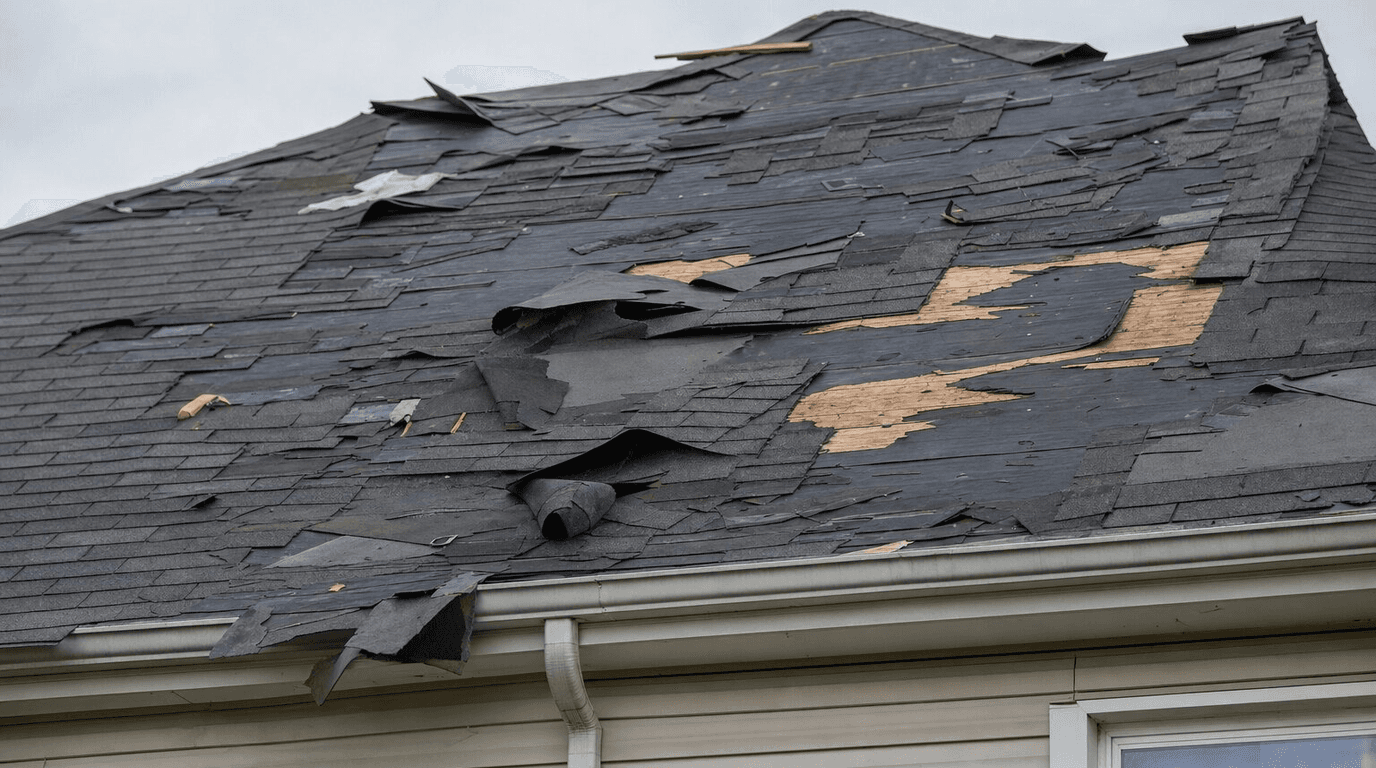
Wind Doesn't Have to Be Catastrophic to Damage Your Roof
Green Bay gets a lot of wind. Sustained 40-mile-per-hour gusts rolling off Lake Michigan aren't unusual — neither are the fast-moving thunderstorm lines that tear through Northeast Wisconsin in summer, dropping wind speeds that briefly hit 60 or 70 mph before moving east. You don't need a named storm to lose shingles or compromise your roof system.
The part that catches homeowners off guard is how invisible wind damage can be right after a storm. You walk around the yard, pick up a few branches, and your roof looks fine from the driveway. But wind damage to a roof often happens at the edges, at the ridge, and in areas that are nearly impossible to see from the ground without knowing what you're looking for.
This guide covers what wind damage actually looks like, where to look for it, and what the right steps are after a storm comes through. If you've already had a significant weather event and want eyes on your roof now, you can request a free roof inspection and we'll take it from there.
Why Wind Damages Roofs the Way It Does
Understanding the mechanics helps you know where to look.
Wind creates a pressure differential across your roof. As air flows over the surface, it generates lift — the same basic physics that keeps an airplane airborne. That lifting force pulls upward on shingles from the outside while interior air pressure pushes outward from the inside. The edges, corners, and ridge of your roof feel this most intensely. That's where the stress concentrates, and that's where failures start.
The corners of your roof — where two roof planes meet at the eaves — are typically the highest-pressure zones during a windstorm. The ridge cap is another weak point. Shingles at the perimeter have the least material anchoring them and are first to lift or separate.
Age makes it worse. A newer shingle with intact sealant strips bonds to the shingles below it and resists the lift. An older shingle with dried, cracked, or missing sealant is essentially waiting for enough wind to peel it back. In Wisconsin, where UV exposure, freeze-thaw cycles, and temperature swings push shingles through accelerated aging, even a 10-year-old roof can be more vulnerable to wind than you'd expect.
What Wind Damage Looks Like: The Full Breakdown
Missing Shingles
This is the one everyone recognizes. After a bad windstorm, you look up and see a bare patch on your roof — a dark rectangle of underlayment or decking where shingles used to be.
Missing shingles after a storm are an immediate problem, full stop. Once the shingles are gone, the underlayment is your only protection from rain. Underlayment is designed to be a secondary moisture barrier, not a long-term weather surface. It won't hold up through a week of summer rainstorms. Any exposed underlayment needs to be addressed fast, either with a proper repair or at minimum an emergency tarp until full wind storm roof repair can be scheduled.
Where to look: the corners of each roof plane, the upwind side of your home, and anywhere near the ridge.
Lifted or Curling Shingles
This one is more common than missing shingles and easier to miss. The wind got under the shingle and lifted it — but didn't remove it entirely. The shingle may have dropped back down after the gust passed and looks almost normal from a distance.
The problem is that once a shingle's sealant bond breaks from being lifted, it doesn't re-seal on its own. That shingle is now loose. The next wind event, even a modest one, may take it off completely. And in the meantime, every rain brings the risk of water getting underneath it and working its way into the roof system.
Lifted shingles often look like slight waves or raised edges along the tab line. You may need binoculars or a drone image to spot them from the ground.
Creased or Folded Shingles
High winds sometimes flip a shingle partway up and then slam it back down, creasing it across the middle. The shingle is still in place and might look intact at a glance, but the crease is a fracture point — rain will find it, and so will the next freeze-thaw cycle.
Creased shingles are almost impossible to identify from the ground. They're one of the main reasons a professional inspection after a major wind event is worth doing even when your roof "looks fine."
Ridge Cap Damage
The ridge cap runs along the peak of your roof and takes the most direct wind hit of any component. Ridge cap shingles are installed with a certain amount of overlap that allows them to shed water, but that same design means they catch wind well. They're often the first casualties in a significant windstorm.
Missing ridge cap shingles leave a gap directly at the highest point of your roof — which is also where water runs to drain from both sides. That's not a small problem.
Damaged or Dislodged Flashing
Flashing is the metal that seals around chimneys, skylights, vents, and roof-to-wall transitions. It's attached mechanically and sealed with roofing cement or sealant. Wind gets under raised flashing and can tear it away from the surface, or just break the sealant bond enough to create a gap.
You might not be able to see flashing damage from the ground at all. But water intrusion near chimneys, skylights, or dormers after a windstorm is a strong sign something failed there. Our storm damage inspection process specifically checks every flashing point, because flashing failures after wind events are common and commonly missed.
Debris Impact Damage
Wind doesn't just pull at your shingles from below — it throws things at them. Tree branches, pieces of neighbor's property, gravel from a flat roof down the street. Impact damage can crack shingles, puncture underlayment, or knock vent caps loose.
A puncture or crack from impact is an immediate water intrusion point. After any major windstorm, if you saw debris flying or found branches on or near your roof, add debris impact to your inspection checklist.
Fascia and Soffit Damage
Wind gets into the eave and lifts or tears soffit panels. The fascia board can be pulled away from the rafter tails. Neither of these is a direct roof penetration, but both create openings for water and pests, and fascia damage often pulls gutters with it.
Missing soffit sections are visible from the ground if you look up at the eave. Bent or pulled fascia is usually visible at the corner where the gutter meets the roofline.
Where to Look First After a Windstorm
Before you get on any ladder, do a full walk around your home from the ground. Safety first — wet conditions and adrenaline are a bad combination. Here's the sequence that gets you the most useful information from a ground-level inspection:
Start with the yard. Any shingles in your yard or on adjacent property are evidence of what happened and where. Note where they landed — it roughly indicates which section of roof they came from.
Check the gutters. Significant granule accumulation in gutters right after a windstorm can indicate that shingles were dragged across the roof surface during the event. Also look for gutter sections that have pulled away from the fascia.
Look at the perimeter and corners. Walk to each corner of the house and look up at the closest roof edge. Use binoculars if you have them. You're looking for raised shingle edges, any visible separation, or gaps in the ridge cap.
Look at the ridge line from multiple angles. Walk to a spot where you can see the full ridge. Missing ridge cap shingles are often visible from this angle even without climbing.
Check soft metals. The same logic that applies to hail damage applies here — dented gutters, bent aluminum trim, or damaged outdoor equipment confirms significant wind event conditions at your property.
If you see anything concerning, or if you had a storm come through but the roof looks intact and you're not sure, a professional inspection is the right next move. Our storm damage team has seen every type of wind event this part of Wisconsin produces. We know where to look.
The Hidden Damage Problem
Here's the thing nobody tells you clearly enough: wind damage is often invisible from the ground, and sometimes invisible even on close inspection by someone who doesn't know what they're looking for.
Creased shingles, lifted-and-reset shingles with broken sealant, damaged underlayment where a shingle was temporarily displaced — none of this announces itself right away. The roof looks intact. Then you get a heavy rain two weeks later, and water shows up on your ceiling.
By that point, the water has usually been sitting in your roof system for a while before it gets far enough to penetrate the ceiling finish. Wet insulation, damaged sheathing, mold beginning to form in the attic — the secondary damage from an unaddressed roof penetration compounds quickly, especially in a Wisconsin summer.
This is why we don't recommend waiting to see if a problem develops. If you had a significant windstorm — sustained winds above 45 mph, significant downed trees in the area, or a severe thunderstorm warning that verified — your roof deserves a look. A free roof inspection costs you nothing and gives you actual information instead of guesswork.
Wind Damage and Your Insurance Claim
Most homeowner's insurance policies in Wisconsin cover wind damage. But how well that claim goes depends on a few things you control.
Document the storm first. Screenshot the National Weather Service warning or local weather report from the day of the storm, noting the wind speeds recorded in your area. The NWS keeps historical records. Your insurance company will pull them, so having the same data they do is useful.
Photograph everything before any cleanup. Shingles in the yard, debris on the roof, visible damage from the ground — photograph it all with date stamps. Don't remove shingles or debris from the roof before an inspection; they're evidence.
Get a professional assessment before your adjuster visits. An independent contractor inspection before the insurance adjuster arrives gives you documentation of damage that existed at the time of the loss. It also gives you someone knowledgeable who can be present during the adjuster visit and point out things that might otherwise get moved past. We cover the full process in our post on documenting roof damage for insurance claims.
File promptly. Wisconsin policies typically require that you report storm damage within a reasonable timeframe. Waiting months to file a wind damage claim creates complications. If there's a question about when damage occurred, recent photos and a dated inspection report are your best support.
One more thing: wind damage that's been sitting for a season often looks different than it did right after the storm. Weathering, additional wear, and summer UV exposure change how the damage appears. Filing and documenting soon after the event protects you.
Wind Versus Hail: Knowing the Difference
A lot of storms that produce significant wind also produce hail. They're often the same system, and the damage overlaps in ways that matter for your insurance claim.
Wind damage typically shows up at the perimeter of the roof — edges, corners, ridge — and often involves displacement (shingles missing or lifted). Hail damage shows up in a more distributed pattern across the roof field, with the circular granule bruising and soft-metal dents that characterize hail hits.
If you had both in the same storm, documenting both types separately strengthens your claim. A roof with both wind and hail damage from the same event can often support a full replacement claim where one type of damage alone might not. Our hail damage repair work frequently coincides with wind damage assessment for exactly this reason.
Emergency Situations: When to Call Right Now
Most wind damage falls into the category of "needs professional assessment and scheduled repair." But some situations are emergencies.
If you have active water intrusion — water coming in through the ceiling or walls during or right after the storm — that needs immediate attention. A large area of missing shingles during an active rain event is an emergency. A tree impact that punched through the roof is an emergency.
For those situations, emergency roof leak repair is available. We can deploy a tarp to stop active intrusion while a proper repair is scheduled. Don't wait out active leaks — water moves through a roof system faster than most people expect, and the interior damage costs add up quickly.
For everything that's damage without active leaking, schedule an inspection. You have a little time. Use it to document properly and choose your contractor carefully.
Serving Northeast Wisconsin After Every Storm
Pierce Roofing has worked in Green Bay and across Northeast Wisconsin for over 30 years. We cover Brown, Kewaunee, Oconto, Outagamie, Winnebago, and Manitowoc counties — the full reach of the storm systems that come through this region. We're Atlas PRO+ Platinum certified, carry $2 million in insurance, and back our work with a 10-year workmanship warranty.
When a windstorm comes through and you're not sure what your roof looks like, we're the crew that comes out, tells you the truth about what we find, and handles the repair if one is needed. If nothing's wrong, we'll tell you that too.
Call us at (920) 609-8304 or schedule your free inspection online. If you want to talk through what you saw during the storm first, the contact page works too. We pick up the phone.